Rapid sequence intubation
Bottom line
- Induce and paralyze together. The Society of Critical Care Medicine (SCCM) strongly recommends a neuromuscular blocker whenever an induction agent is used for intubation, and advises an induction agent whenever a paralytic is given.1,2
- Expect trouble. In INTUBE (2,964 critically ill adults, 29 countries), 45.2% had a major adverse event around intubation. Cardiovascular instability was the most common (42.6%), then severe hypoxemia (9.3%) and cardiac arrest (3.1%).3
- Keep oxygen going before and during. Noninvasive ventilation for preoxygenation halved hypoxemia compared with an oxygen mask (9.1% vs 18.5%). Gentle bag-mask ventilation after induction halved severe hypoxemia (10.9% vs 22.8%).4,5
- Reach for a video laryngoscope. In DEVICE, first-attempt success was 85.1% with video and 70.8% with direct laryngoscopy, with similar rates of severe complications.6
- Ketamine or etomidate: neither saves lives over the other. In the 2026 RSI trial (n = 2,365), death by day 28 was 28.1% vs 29.1%. Cardiovascular collapse was more common with ketamine (22.1% vs 17.0%).7
Before induction
- Plan and brief the team. Run a call-and-response checklist. Assign at least three roles: airway operator, airway assistant and drug giver. Have a surgical cricothyroidotomy kit at the bedside.8
- Sit the patient up. SCCM suggests a head-and-torso-up (semi-Fowler) position during RSI (conditional, very low quality).1,2
- Preoxygenate. SCCM suggests high-flow nasal oxygen when laryngoscopy is expected to be hard, and noninvasive ventilation for severe hypoxemia (PaO2/FiO2 < 150). Both are conditional, low quality.1,2
- Agitated and can't tolerate the mask? SCCM suggests medication-assisted preoxygenation (conditional, very low quality).1,2 A published summary describes ketamine for this: a fixed 1.5 mg/kg infusion, or titration up from 1 mg/kg to dissociation.9
- High risk of regurgitation? Decompress with a nasogastric tube when the benefit outweighs the risk (best practice statement).1,2
- Hypotensive? SCCM found insufficient evidence to favor vasopressors or IV fluids before intubation.1,2 In PREPARE II, a routine 500 mL fluid bolus did not reduce cardiovascular collapse (21.0% vs 18.2%).10
SCCM's 2023 guideline limits its noninvasive ventilation suggestion to severe hypoxemia (PaO2/FiO2 < 150).1,2 PREOXI, published later, enrolled critically ill adults undergoing intubation without that limit. Noninvasive ventilation cut hypoxemia (SpO2 < 85%) from 18.5% to 9.1%, and every prespecified subgroup favored it.4,11 The trial excluded patients already on noninvasive ventilation and those who were vomiting or bleeding, and the control arm mostly used a nonrebreather mask.11
Induce, intubate, confirm
- Push the induction agent, then the paralytic. SCCM suggests either rocuronium or succinylcholine when there is no contraindication to succinylcholine (conditional, low quality).1,2
- Ventilate gently during apnea. In PREVENT (n = 401), bag-mask ventilation between induction and laryngoscopy lowered severe hypoxemia (SpO2 < 80%) from 22.8% to 10.9%. Operator-reported aspiration was 2.5% vs 4.0%, not significantly different.5
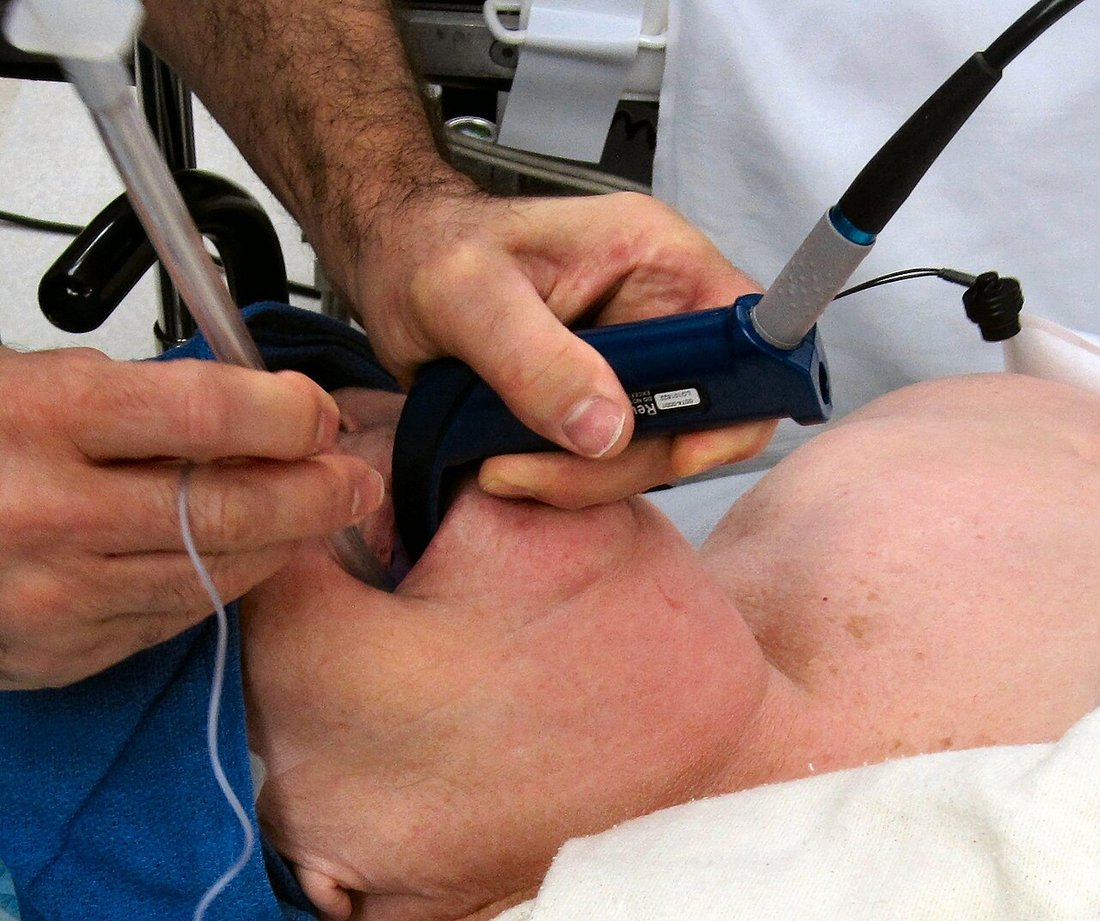
- Use a video laryngoscope. First-attempt success rose by 14.3 percentage points in 1,417 critically ill adults, most intubated by residents or fellows.6
- A bougie is a tool, not a default. Using one on the first attempt did not improve success in critically ill adults (80.4% vs 83.0% with tube and stylet).12
- Confirm with waveform capnography.13
- If the attempt fails, move through the plan: tracheal intubation (Plan A), supraglottic airway (B), facemask ventilation (C), then emergency front-of-neck airway (D), keeping oxygen going throughout.13
- Sedate early. Induction agents and succinylcholine wear off within minutes. Rocuronium paralysis lasts about an hour (FIG 2).14,15,16,17
Drugs
| Agent | Adult dose (FDA label) | Onset | Lasts | Notes |
|---|---|---|---|---|
| 1 · Induction | ||||
| Etomidate | 0.2–0.6 mg/kg IV; usual 0.3 mg/kg over 30–60 s | < 1 min | 3–5 min | Lowers cortisol for about 6–8 hours. Older patients may need less.14 |
| Ketamine | 1–4.5 mg/kg IV over 60 s; average 2 mg/kg | ~30 s | 5–10 min | Rapid push can depress breathing. KETASED used 2 mg/kg.15,18 |
| Propofol or midazolam | Dose per institutional protocol and label | — | — | Also listed as induction options in the guideline summary.9 |
| 2 · Paralysis | ||||
| Succinylcholine | 0.3–1.1 mg/kg IV; average 0.6 mg/kg | ~1 min | recovery in 4–6 min | CURASMUR used 1 mg/kg. See contraindications below.16,19 |
| Rocuronium | 0.6–1.2 mg/kg IV for RSI | < 2 min | median 67 min at 1.2 mg/kg (38–160) | CURASMUR used 1.2 mg/kg.17,19 |
Unreviewed doses. Verify against the current label and your institution's protocol before giving anything.
The succinylcholine label gives an average intubating dose of 0.6 mg/kg (range 0.3–1.1), written for short surgical procedures.16 Emergency trials used more: 1 mg/kg in CURASMUR, and at least 1 mg/kg in every trial in the Cochrane review.19,20 Follow your institutional protocol.
Choosing an induction agent
- Guideline: SCCM suggests there is no difference between etomidate and other induction agents for mortality, hypotension or vasopressor use (conditional, moderate quality). It suggests against giving corticosteroids after etomidate (conditional, low quality).1,2
- RSI trial (14 US emergency departments and ICUs, n = 2,365): death by day 28 was 28.1% with ketamine vs 29.1% with etomidate (adjusted difference −0.8 points, 95% CI −4.5 to 2.9). Cardiovascular collapse was 22.1% vs 17.0%.7
- Meta-analysis (7 randomized trials, n = 2,384): ketamine probably causes more peri-intubation hemodynamic instability (RR 1.29), but fewer new vasopressor infusions (RR 0.75) and less adrenal suppression (RR 0.54). First-attempt success and mortality did not differ (mortality RR 1.00, low certainty).21
- KETASED (n = 655 randomized): organ failure scores over the first 3 days did not differ (mean maximum SOFA 10.3 vs 9.6), and intubating conditions were similar. Adrenal insufficiency was much more common after etomidate (OR 6.7).18
Choosing a paralytic
- CURASMUR (1,248 adults, out-of-hospital France): first-attempt success was 74.6% with rocuronium 1.2 mg/kg vs 79.4% with succinylcholine 1 mg/kg. Rocuronium failed to show noninferiority. Hypotension was 6.4% vs 10.1%.19
- Cochrane review (50 trials, n = 4,151): succinylcholine gave excellent intubating conditions more often (RR 0.86 for rocuronium). Against rocuronium 1.2 mg/kg there was no statistical difference, but succinylcholine wears off sooner.20
When not to give succinylcholine
- Contraindicated: skeletal muscle myopathy, a personal or family history of malignant hyperthermia, known hypersensitivity, and after the acute phase of major burns, multiple trauma, extensive denervation or upper motor neuron injury.16
- Why: in those injuries it can cause severe hyperkalemia and cardiac arrest. The risk rises over time and usually peaks 7–10 days after the injury.16
- Use caution with known electrolyte problems or digitalis toxicity, and with chronic abdominal infection, subarachnoid hemorrhage, or degenerative nerve disease. Consider avoiding it, or check that potassium is normal first.16
Pitfalls
- Paralyzing with rocuronium and forgetting sedation. Etomidate lasts 3–5 minutes; rocuronium 1.2 mg/kg lasts a median of 67 minutes.14,17
- Giving succinylcholine after the acute phase of a major burn, multiple trauma, denervation or upper motor neuron injury.16
- Leaving the patient apneic with no oxygen delivery between induction and laryngoscopy.5
- Counting on a routine fluid bolus to prevent collapse. It did not in PREPARE II.10
- Giving steroids routinely after etomidate. SCCM suggests against it.1,2
- Trusting tube position without waveform capnography.13
How strong is the evidence?
The SCCM panel chose 10 questions from 35. It made one strong recommendation (use a paralytic, low-quality evidence), seven conditional suggestions and two best practice statements.1 Its full text was not openly accessible, so the recommendations here come from SCCM's own summary page and a published summary.2,9 PREOXI and the RSI trial, both large randomized trials in US emergency departments and ICUs, were published after the guideline.4,7
On-shift teaching
Questions to ask a learner at the bedside. Tap a question to see the answer. Every answer uses facts cited above.
Q1In INTUBE, what was the most common major adverse event around intubation?
Q2Should you bag the patient between induction and laryngoscopy?
Q3What did the 2026 RSI trial show about ketamine versus etomidate?
Q4A patient burned 10 days ago needs intubation. Which paralytic?
Q5Why start sedation right after intubating with rocuronium?
Q6Does a routine 500 mL fluid bolus prevent collapse during intubation?
References
- 1Acquisto NM, Mosier JM, Bittner EA, et al. Society of Critical Care Medicine clinical practice guidelines for rapid sequence intubation in the critically ill adult patient. Crit Care Med. 2023;51(10):1411–1430.
- 2Society of Critical Care Medicine. Guidelines for Rapid Sequence Intubation in the Critically Ill Adult Patient (recommendation summary).
- 3Russotto V, Myatra SN, Laffey JG, et al. Intubation practices and adverse peri-intubation events in critically ill patients from 29 countries (INTUBE). JAMA. 2021;325(12):1164–1172.
- 4Gibbs KW, Semler MW, Driver BE, et al. Noninvasive ventilation for preoxygenation during emergency intubation (PREOXI). N Engl J Med. 2024;390(23):2165–2177.
- 5Casey JD, Janz DR, Russell DW, et al. Bag-mask ventilation during tracheal intubation of critically ill adults (PREVENT). N Engl J Med. 2019;380(9):811–821.
- 6Prekker ME, Driver BE, Trent SA, et al. Video versus direct laryngoscopy for tracheal intubation of critically ill adults (DEVICE). N Engl J Med. 2023;389(5):418–429.
- 7Casey JD, Seitz KP, Driver BE, et al. Ketamine or etomidate for tracheal intubation of critically ill adults (RSI). N Engl J Med. 2026;394(16):1608–1620.
- 8Nickson C. Rapid sequence intubation (RSI). Life in the Fast Lane.
- 9Bagley P, Smith D. Rapid sequence intubation of critically ill patients: guidelines from the Society of Critical Care Medicine. Am Fam Physician. 2025;111(1):92–93.
- 10Russell DW, Casey JD, Gibbs KW, et al. Effect of fluid bolus administration on cardiovascular collapse among critically ill patients undergoing tracheal intubation (PREPARE II). JAMA. 2022;328(3):270–279.
- 11Bradford C. PREOXI trial: noninvasive ventilation for preoxygenation. The Bottom Line; July 2024.
- 12Driver BE, Semler MW, Self WH, et al. Effect of use of a bougie vs endotracheal tube with stylet on successful intubation on the first attempt among critically ill patients (BOUGIE). JAMA. 2021;326(24):2488–2497.
- 13Ahmad I, El-Boghdadly K, Iliff H, et al. Difficult Airway Society 2025 guidelines for management of unanticipated difficult tracheal intubation in adults. Br J Anaesth. 2026;136(1):283–307.
- 14Amidate (etomidate) injection. Hospira. FDA label.
- 15Ketalar (ketamine hydrochloride) injection. Par Health. FDA label.
- 16Succinylcholine chloride injection. FDA label.
- 17Rocuronium bromide injection. Baxter. FDA label.
- 18Jabre P, Combes X, Lapostolle F, et al. Etomidate versus ketamine for rapid sequence intubation in acutely ill patients: a multicentre randomised controlled trial (KETASED). Lancet. 2009;374(9686):293–300.
- 19Guihard B, Chollet-Xémard C, Lakhnati P, et al. Effect of rocuronium vs succinylcholine on endotracheal intubation success rate among patients undergoing out-of-hospital rapid sequence intubation (CURASMUR). JAMA. 2019;322(23):2303–2312.
- 20Tran DT, Newton EK, Mount VA, et al. Rocuronium versus succinylcholine for rapid sequence induction intubation. Cochrane Database Syst Rev. 2015;(10):CD002788.
- 21Greer A, Hewitt M, Khazaneh PT, et al. Ketamine versus etomidate for rapid sequence intubation: a systematic review and meta-analysis of randomized trials. Crit Care Med. 2025;53(2):e374–e383.
AI-generated draft. Not reviewed by a physician. This page is for education only and may contain errors, including in doses. Do not use it to diagnose, treat or make decisions about any patient. Rely on your own clinical judgment, your institution's protocols and current drug labeling. Reading this page does not create a physician-patient relationship. Full terms