Ectopic pregnancy
Bottom line
- Think ectopic in anyone who could be pregnant. Atypical presentations are common, and about a third of patients with an ectopic pregnancy have no known risk factor.1
- Scan at any hCG level. ACEP recommends a pelvic ultrasound for every symptomatic pregnant patient (Level B).2 In ED patients, an hCG under 1,500 mIU/mL raised the likelihood of ectopic (LR 2.24), and 25% of those patients had one.3
- An intrauterine pregnancy on bedside ultrasound largely rules ectopic out. Emergency physician scanning had a pooled sensitivity of 99.3% and a negative predictive value of 99.96%.4 The exception is heterotopic pregnancy, about 1 in 100 after assisted reproduction.5
- An indeterminate scan is not a negative scan. hCG cannot exclude ectopic here: a 3,000 mIU/mL cutoff had 35% sensitivity and 58% specificity.6 Every patient with an indeterminate scan needs specialty consultation or close follow-up.2
- Unstable, or free fluid in Morison's pouch: get the patient to surgery. Free fluid there had a positive LR of 112 for needing an operation.7 A tubal ectopic in an unstable patient is a surgical emergency.8
First 10 minutes
- Check for shock. Warning signs include heart rate over 100, blood pressure under 100/60 mm Hg, orthostatic hypotension, syncope, peritoneal signs, and shoulder tip pain.1
- Unstable: call OB/GYN for immediate surgery.8 Do a bedside FAST that includes Morison's pouch. Trendelenburg positioning may make fluid easier to see.7,5
- Stable: send a quantitative hCG and blood type with Rh status, and get a pelvic ultrasound at any hCG level.2,5
- Look for a definite intrauterine pregnancy: a gestational sac in the uterus containing a yolk sac or an embryo.2 Also scan the adnexa for a heterotopic pregnancy.1
- No intrauterine pregnancy? Call it a pregnancy of unknown location and manage it as a possible ectopic until the location is known.1
- Confirmed or likely ectopic: call OB/GYN to choose expectant, medical or surgical management.1,5
Who has it
- Common symptoms: abdominal or pelvic pain, a missed period, and vaginal bleeding. Other reported symptoms include dizziness or fainting, shoulder tip pain, GI or urinary symptoms, and rectal pressure.1
- Signs: pelvic, adnexal or abdominal tenderness are the most common. Cervical motion tenderness, peritoneal signs, pallor and shock can also occur.1
- It mimics other illness. Symptoms can resemble a GI problem or a urinary tract infection, so offer a pregnancy test even when complaints are vague.1
- Risk factors include prior ectopic, prior genital tract infection, prior D&C or tubal ligation, an IUD in place, assisted reproduction, progestin-only contraception, age over 35, and smoking.5 Rule out ectopic even when there are none.1
- How common: among symptomatic ED patients, prevalence has been as high as 13% in some series.2 US ED visits with an ectopic diagnosis rose from 11.0 to 13.7 per 1,000 live births between 2006 and 2013.9
- How deadly: US mortality fell to 0.50 deaths per 100,000 live births in 2003–2007. It was 6.8 times higher in Black women than in white women. Hemorrhage, shock or renal failure accompanied 67.4% of deaths in hospitalized patients.10
Diagnosis: ultrasound and hCG
Ultrasound
- Scan regardless of hCG. ACEP raised this to a Level B recommendation in 2017.2 Ectopics can present at almost any hCG level, and rupture has been documented at very low levels.2
- Low hCG does not make the scan useless. In two older series, ultrasound at hCG under 1,000 mIU/mL detected or suggested 92% and 86% of ectopic pregnancies.2
- Bedside scans miss some intrauterine pregnancies. Bedside sensitivity for an intrauterine pregnancy was 71%, with 99% specificity.6 A nondiagnostic bedside scan still needs a comprehensive scan, consultation or close follow-up.2
- Expect indeterminate results. ED studies report an indeterminate rate of 20% to 30%.2
- Know the criteria in use. ED studies usually require a yolk sac or fetal pole. Radiologists may accept a gestational sac with a double decidual sign.2
| Transvaginal finding | What it means (NICE) |
|---|---|
| Adnexal mass moving separately from the ovary, with a gestational sac containing a yolk sac or fetal pole (with or without a heartbeat) | Tubal ectopic |
| Adnexal mass moving separately from the ovary with an empty sac ("tubal ring" or "bagel" sign), or a complex inhomogeneous adnexal mass | High probability. Weigh with the rest of the scan, the clinical picture and hCG |
| Empty uterus, or a fluid collection in the uterine cavity (pseudo-sac) | Possible ectopic. Weigh with the rest of the scan, the clinical picture and hCG |
| Moderate to large free fluid in the peritoneal cavity or pouch of Douglas | Possible hemoperitoneum |
Adapted from the NICE ultrasound recommendations. NICE also advises scanning the uterus and both adnexa for a heterotopic pregnancy every time.1
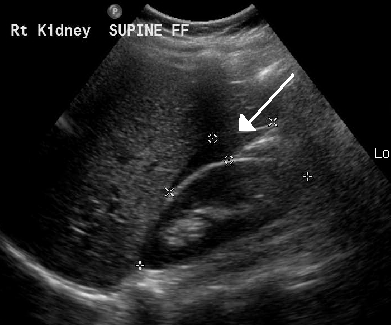
In 242 ED patients with suspected ectopic, 10 had free fluid in Morison's pouch. Nine of them went to surgery (positive LR 112).7
hCG
- There is no safe "discriminatory zone". The traditional cutoff of 1,000–2,000 mIU/mL comes from radiology transvaginal scans. ACEP does not endorse the concept or any cutoff.2
- Low hCG means higher risk, not lower. In 730 ED patients, 40 of the 158 with hCG under 1,500 mIU/mL (25%) had an ectopic pregnancy, and only 16% had a normal intrauterine pregnancy.3
- hCG does not sort indeterminate scans. With no intrauterine pregnancy on bedside scan, a 3,000 mIU/mL cutoff gave 35% sensitivity and 58% specificity for ectopic.6 ACEP says not to use hCG to exclude ectopic after an indeterminate scan (Level B).2
- Use hCG for trend, not location. NICE says not to use serum hCG to locate the pregnancy. Take two levels as close as possible to 48 hours apart, and give symptoms more weight than the numbers.1
- Skip progesterone. NICE advises against it for diagnosing either a viable intrauterine pregnancy or an ectopic.1
| hCG change over 48 h | Likely meaning | NICE action |
|---|---|---|
| Rise > 63% | Probably a developing intrauterine pregnancy. Ectopic is still possible | Transvaginal scan in 7–14 days, sooner if hCG ≥ 1,500 IU/L |
| Fall > 50% | Pregnancy unlikely to continue | Urine pregnancy test 14 days after the second hCG. If positive, review within 24 h |
| Rise < 63% or fall < 50% | Uncertain. Includes ectopic | Review in the early pregnancy service within 24 h |
From the NICE recommendations for a pregnancy of unknown location.1 For hCG, 1 IU/L equals 1 mIU/mL.
How slow a rise is still normal: NICE uses 63% over 48 hours.1 In 287 symptomatic patients who turned out to have a viable intrauterine pregnancy, the slowest rise was 53% at 2 days.11 A later cohort used an even more cautious minimum of 35% over 2 days.12 A slow rise does not prove an ectopic, so don't let a single ratio drive treatment in a pregnancy that may be wanted.
Treatment
An unstable patient needs prompt surgery.8 For stable patients, NICE matches the treatment to pain, mass size, fetal heartbeat and hCG. OB/GYN usually makes this decision.1
| Option | Who (NICE) | hCG follow-up |
|---|---|---|
| Expectant | Stable and pain free. Tubal mass < 35 mm with no heartbeat. hCG ≤ 1,000 IU/L (offer) or 1,000–1,500 (consider). Able to return | Days 2, 4 and 7. If it falls ≥ 15% each time, weekly until < 20 IU/L |
| Methotrexate | No significant pain. Unruptured, mass < 35 mm, no heartbeat. hCG < 1,500 IU/L. No intrauterine pregnancy on scan. Able to return | Days 4 and 7, then weekly until negative |
| Methotrexate or surgery | Same criteria, but hCG 1,500 to < 5,000 IU/L. Methotrexate carries a higher chance of needing more treatment | As above |
| Surgery first | Significant pain, mass ≥ 35 mm, visible heartbeat, hCG ≥ 5,000 IU/L, or unable to return | After salpingotomy: day 7, then weekly. After salpingectomy: urine test at 3 weeks |
- Methotrexate needs a definite diagnosis. NICE allows it on a first visit only when an ectopic is confirmed and a viable intrauterine pregnancy is excluded.1
- Surgery: laparoscopic when possible. Salpingectomy is preferred unless there are other risk factors for infertility. Up to 1 in 5 patients need further treatment after salpingotomy.1
- Contraindications to methotrexate listed by Core EM: renal insufficiency, immunodeficiency, active lung disease, peptic ulcer disease, hypersensitivity, breastfeeding, and a heterotopic pregnancy with a viable intrauterine pregnancy.5
| Agent | Adult dose | Notes |
|---|---|---|
| Methotrexate | No dose given here. Use the OB/GYN protocol | The US label we checked has no ectopic pregnancy indication. NICE notes that this use was off label.13,1 |
| Rho(D) immune globulin (US label) | 300 µg (1,500 IU) IM within 72 h | The label lists ectopic pregnancy as an indication for Rh-negative patients who are not sensitized.14 |
| Anti-D immunoglobulin (NICE 2026) | ≥ 250 IU (50 µg), only at 12+0 to 12+6 weeks | For Rh-negative patients having medical or surgical management. NICE advises none up to 11+6 weeks.1 |
Unreviewed doses. Verify against the current label and your institution's protocol before giving anything.
Anti-D in early ectopic pregnancy: the 2026 NICE update recommends no anti-D up to 11+6 weeks, citing a lack of evidence of benefit.1 The US RhoGAM label lists ectopic pregnancy as an indication, at 300 µg within 72 hours.14 ACEP's 2003 policy found too little evidence to recommend for or against it in ectopic pregnancy, and ACEP dropped the question in 2017.2 Follow your institution's policy.
Disposition
- Unstable, or free fluid in Morison's pouch: to the operating room with OB/GYN.8,7
- Confirmed ectopic, stable: OB/GYN decides on expectant, medical or surgical care, using the criteria above.1
- Indeterminate scan, stable: get specialty consultation or arrange close outpatient follow-up (ACEP Level C).2 Plan a repeat hCG at 48 hours.1
- Before discharge: give written advice on new or worse symptoms and on how to reach emergency care 24 hours a day.1
- After methotrexate: when these patients come back with worrying symptoms, strongly consider rupture. This was ACEP's 2012 advice, described again in 2017.2
Discharge before the location is known carries real risk. In one Canadian ED, 550 patients were sent home with a diagnosis of ectopic pregnancy, rule-out ectopic, or pregnancy of unknown location. Of these, 230 had an ectopic pregnancy, and 28 ruptured after the ED visit. Of the 221 discharged without a transvaginal scan, 73 were later diagnosed with an ectopic.15
ACEP found no study large enough to show that deferring the scan is safe. In one small series of 37 ectopic patients sent home for outpatient ultrasound, there were no adverse events despite a median delay of 14 hours.2
Pitfalls
- Skipping the ultrasound because the hCG is "below the zone". Low hCG raises the risk of ectopic.2,3
- Reading an indeterminate scan as reassuring. Make sure it has follow-up.2,6
- Calling an intrauterine fluid collection a pregnancy. A pseudo-sac can occur with an ectopic.1
- Stopping at an intrauterine pregnancy after IVF. Heterotopic pregnancy happens in about 1 in 100 pregnancies after assisted reproduction.5 ACEP's policy excludes these patients.2
- Skipping the pregnancy test because the story sounds like a UTI or gastroenteritis.1
- Applying the ACEP policy to unstable patients. It covers only patients with a normal pulse and blood pressure.2
How strong is the evidence?
ACEP's two ED recommendations are Level B (scan at any hCG; don't use hCG to exclude ectopic) and Level C (follow-up for indeterminate scans). Its 2017 searches found no new studies for either question.2 Most NICE recommendations on diagnosis and treatment date from evidence reviews in 2012 or 2019. The anti-D advice was updated in 2026.1 The bedside ultrasound data are a meta-analysis of 10 studies with 2,057 patients.4 The Morison's pouch finding comes from one prospective study.7 Emergency Medicine Cases covers this topic for further reading.16
On-shift teaching
Questions to ask a learner at the bedside. Tap a question to see the answer. Every answer uses facts cited above.
Q1A stable patient with pelvic pain has an hCG of 800 mIU/mL. Does the patient need an ultrasound today?
Q2Your bedside scan shows a yolk sac in the uterus. How well does that rule out ectopic?
Q3The scan is indeterminate and the hCG is 4,000 mIU/mL. Does the hCG tell you it's ectopic?
Q4What does free fluid in Morison's pouch mean in suspected ectopic?
Q5Which patients does NICE offer methotrexate?
References
- 1National Institute for Health and Care Excellence. Ectopic pregnancy and miscarriage: diagnosis and initial management (NG126). Published April 2019; last updated June 17, 2026.
- 2American College of Emergency Physicians Clinical Policies Subcommittee on Early Pregnancy; Hahn SA, Promes SB, Brown MD. Clinical policy: critical issues in the initial evaluation and management of patients presenting to the emergency department in early pregnancy. Ann Emerg Med. 2017;69(2):241–250.e20.
- 3Kohn MA, Kerr K, Malkevich D, et al. Beta-human chorionic gonadotropin levels and the likelihood of ectopic pregnancy in emergency department patients with abdominal pain or vaginal bleeding. Acad Emerg Med. 2003;10(2):119–126.
- 4Stein JC, Wang R, Adler N, et al. Emergency physician ultrasonography for evaluating patients at risk for ectopic pregnancy: a meta-analysis. Ann Emerg Med. 2010;56(6):674–683.
- 5McCarty M. Ectopic pregnancy. Core EM; June 7, 2017.
- 6Wang R, Reynolds TA, West HH, et al. Use of a β-hCG discriminatory zone with bedside pelvic ultrasonography. Ann Emerg Med. 2011;58(1):12–20.
- 7Moore C, Todd WM, O'Brien E, Lin H. Free fluid in Morison's pouch on bedside ultrasound predicts need for operative intervention in suspected ectopic pregnancy. Acad Emerg Med. 2007;14(8):755–758.
- 8American College of Obstetricians and Gynecologists' Committee on Practice Bulletins—Gynecology. ACOG Practice Bulletin No. 193: Tubal ectopic pregnancy. Obstet Gynecol. 2018;131(3):e91–e103.
- 9Mann LM, Kreisel K, Llata E, Hong J, Torrone EA. Trends in ectopic pregnancy diagnoses in United States emergency departments, 2006–2013. Matern Child Health J. 2020;24(2):213–221.
- 10Creanga AA, Shapiro-Mendoza CK, Bish CL, et al. Trends in ectopic pregnancy mortality in the United States: 1980–2007. Obstet Gynecol. 2011;117(4):837–843.
- 11Barnhart KT, Sammel MD, Rinaudo PF, et al. Symptomatic patients with an early viable intrauterine pregnancy: hCG curves redefined. Obstet Gynecol. 2004;104(1):50–55.
- 12Seeber BE, Sammel MD, Guo W, et al. Application of redefined human chorionic gonadotropin curves for the diagnosis of women at risk for ectopic pregnancy. Fertil Steril. 2006;86(2):454–459.
- 13Methotrexate injection (Accord Healthcare). FDA label, DailyMed.
- 14RhoGAM / MICRhoGAM Ultra-Filtered PLUS (human Rho(D) immune globulin), Kedrion Biopharma. FDA label, DailyMed.
- 15Hawrylyshyn K, McLeod SL, Thomas J, Varner C. Ectopic pregnancy outcomes in patients discharged from the emergency department. CJEM. 2019;21(1):71–74.
- 16Emergency Medicine Cases. Ectopic pregnancy. Further reading; not used for any claim above.
AI-generated draft. Not reviewed by a physician. This page is for education only and may contain errors, including in doses. Do not use it to diagnose, treat or make decisions about any patient. Rely on your own clinical judgment, your institution's protocols and current drug labeling. Reading this page does not create a physician-patient relationship. Full terms