Cardiac arrest
Bottom line
- High-quality compressions, effective ventilation and early defibrillation come first, with rapid treatment of reversible causes. Drugs and devices come second.1,2
- Nonshockable rhythm: give epinephrine early.2 In 25,095 in-hospital arrests, each later 3-minute block before the first dose came with lower survival.3 Shockable rhythm: shock first. Epinephrine comes after the initial defibrillation attempt.4,5
- Epinephrine raises survival but not good neurologic survival. In PARAMEDIC2, 30-day survival was 3.2% vs 2.4%. Favorable neurologic outcome was 2.2% vs 1.9%, not significantly different.6
- IV first, IO if IV can't be placed quickly. Two large trials found no benefit from an IO-first strategy.1,2,4,5,7,8
- Don't give calcium, bicarbonate or steroids routinely. In the COCA trial, calcium was stopped early for possible harm.2,9
First minutes
- Start compressions and attach the defibrillator. Place pads antero-lateral, with one pad over the cardiac apex.2 When someone skilled is present, use manual defibrillation rather than AED mode; rhythm analysis and shocks are faster.2
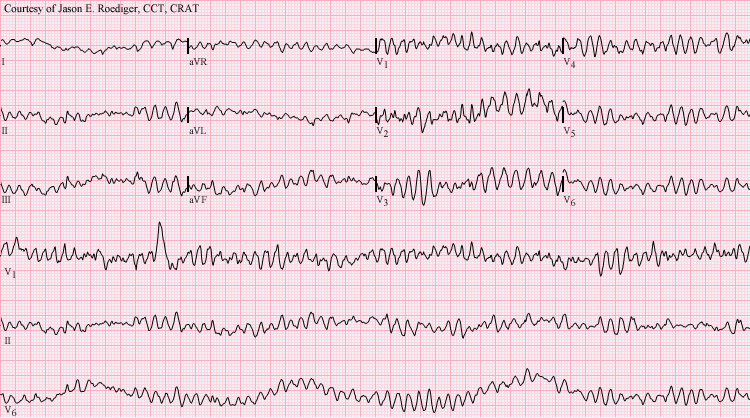
- Check the rhythm and shock VF or pulseless VT. Shock even very fine VF.2
- Ventilate effectively. Bag-mask ventilation is acceptable, ideally with two people. Confirm it works, for example by visible chest rise. Inadequate ventilation is common and affects survival.2
- Get IV access; use IO if IV can't be placed quickly.2,5
- Give epinephrine: early in asystole or PEA, and after the first shock in VF or pulseless VT.2,3,4,5
- Look for a reversible cause while CPR continues, with ultrasound only in experienced hands.2
| Shockable (VF, pulseless VT) | Nonshockable (asystole, PEA) | |
|---|---|---|
| First priority | Defibrillate early2 | CPR and early epinephrine2 |
| Epinephrine | After the initial shock fails, not before4,5 | Early; delay is linked to lower survival2,3 |
| Antiarrhythmic | Amiodarone or lidocaine are used for shock-refractory VF; neither beat placebo overall10 | — |
| Still in VF after 3 shocks | Consider an anteroposterior pad vector (ERC)2; guidelines differ, see below | — |
Drugs
| Drug | Adult dose | Notes |
|---|---|---|
| Give | ||
| Epinephrine | 1 mg IV/IO, repeat every 3–5 min | With an arterial line, the ERC suggests small IV doses (50–100 µg) instead of a 1 mg bolus. If there is no response after 1 mg in total, rule out extravasation before more 1 mg doses.2 |
| Amiodarone or lidocaine | Dose per institutional protocol and label | For shock-refractory VF or pulseless VT. Neither improved overall survival in ALPS (below).10 |
| Don't give routinely | ||
| Calcium | — | Strong recommendation against in out-of-hospital arrest, weak against in-hospital, unless there is a specific indication.2 |
| Sodium bicarbonate | — | Weak recommendation against routine use.2 |
| Corticosteroids | — | Not advised routinely.2 |
| Vasopressin with epinephrine | — | The AHA prefers epinephrine alone.5 |
Unreviewed doses. Verify against the current label and your institution's protocol before giving anything.
Epinephrine dose from the ERC 2025 guideline summary.1,2 No FDA label covers epinephrine for cardiac arrest, and no antiarrhythmic dose could be confirmed from a source read for this page, so none is given.
What the trials show
- PARAMEDIC2 (n = 8,014 out-of-hospital arrests, epinephrine vs placebo): 30-day survival 3.2% vs 2.4% (OR 1.39). Favorable neurologic outcome at discharge 2.2% vs 1.9%, not significant. More survivors had severe neurologic impairment with epinephrine (31.0% vs 17.8%).6
- Timing, nonshockable: in 25,095 in-hospital arrests, the median time to the first epinephrine dose was 3 minutes. Compared with 1–3 minutes, survival odds fell to 0.74 at 7–9 minutes and 0.63 beyond 9 minutes.3
- Timing, shockable: in 2,978 matched in-hospital patients still in a shockable rhythm, epinephrine within 2 minutes of the first shock was linked to lower survival (OR 0.70).12
- ALPS (n = 3,026, shock-refractory VF or pulseless VT): survival to discharge 24.4% with amiodarone, 23.7% with lidocaine and 21.0% with placebo, not significantly different. Both drugs did better than placebo in bystander-witnessed arrests.10
- COCA (n = 391): calcium chloride did not improve sustained ROSC (19% vs 27%). The trial stopped early over concern for harm.9
- VAM-IHCA (n = 501 in-hospital arrests): vasopressin plus methylprednisolone raised ROSC (42% vs 33%) but not 30-day survival (9.7% vs 12%) or favorable neurologic outcome (7.6% in both groups).13
Refractory VF
DOSE VF (n = 405, refractory VF): survival to discharge was 30.4% with double sequential external defibrillation (DSED) and 21.7% with a vector change to anterior-posterior pads, vs 13.3% with standard shocks. Only DSED improved good neurologic outcome. The trial stopped early because of the COVID-19 pandemic.14
The ERC says an anteroposterior vector may be considered after 3 unsuccessful shocks.2 The AHA does not recommend vector change or DSED for routine use, and calls their usefulness uncertain.5 The key trial, DOSE VF, was small and stopped early.14
Extracorporeal CPR (ECPR) may be considered for selected patients when conventional resuscitation fails.2 The trials are mixed. ARREST (n = 30, refractory VF): survival to discharge was 43% vs 7%.15 The Prague trial (n = 256): good neurologic survival at 180 days was 31.5% vs 22.0%, not significant.16 INCEPTION (n = 134): 20% vs 16%, not significant.17
Access and airway
- IV is the preferred route. Use IO if IV access can't be established quickly.2,5
- PARAMEDIC-3 (n = 6,082): IO-first did not improve 30-day survival (4.5% vs 5.1%). ROSC was less common with IO-first (36.0% vs 39.1%).7
- IVIO (n = 1,479): IO succeeded more often within two attempts (92% vs 80%), but sustained ROSC was similar (30% vs 29%).8
- Airway: a supraglottic airway or intubation should not cause long pauses in compressions, and only experienced providers should place them.2
- AIRWAYS-2 (n = 9,296): an initial supraglottic airway gave the same good functional outcome as intubation (6.4% vs 6.8%).18 PART (n = 3,004): a laryngeal tube strategy beat intubation for 72-hour survival (18.3% vs 15.4%), but initial intubation success was only 51.6%.19
Monitoring during CPR
- Targets: diastolic arterial pressure ≥ 30 mm Hg and end-tidal CO₂ ≥ 25 mm Hg (3.3 kPa).2
- A sudden fall in end-tidal CO₂ after ROSC may mean re-arrest or very low cardiac output. Restart compressions if systolic pressure falls below 50 mm Hg despite treatment.2
- Ultrasound: only by experienced providers, and never at the cost of compression quality or delay.2 In one ED video study, pauses with ultrasound lasted a median of 17 seconds vs 11 without, and were longer still when the code leader did the scan.20
- Awareness during CPR: some patients regain awareness during high-quality CPR. In selected cases, the ERC says EMS may consider light analgesia or sedation per local protocol.2
After ROSC
- Oxygen: start high, then titrate to SpO₂ 94–98% (PaO₂ 75–100 mm Hg). Pulse oximetry overestimates saturation in darker skin. Aim for normocapnia.2
- Blood pressure: avoid hypotension. The ERC targets a MAP above 60–65 mm Hg, the AHA ≥ 65.2,5
- Find the cause: coronary angiography for suspected ACS, especially with ST elevation. Without ST elevation, the ERC favors whole-body CT, including CT pulmonary angiography.2 The AHA says head-to-pelvis CT may be considered once the patient is stable.5
- Temperature: for patients who don't follow commands, keep core temperature 32–37.5 °C for at least 36 hours (AHA).5
- No prophylactic antiarrhythmics if the patient stays free of arrhythmias after ROSC.2
Special situations
- Pregnancy: start resuscitative hysterotomy as soon as arrest is recognized, aiming for delivery within 5 minutes.5
- Opioid overdose: naloxone may be given, but must not delay CPR or epinephrine.5
- Pulmonary embolism, local anesthetic toxicity and trauma: the ERC special-circumstances chapter has dedicated algorithms, including thrombolysis during CPR for suspected or proven PE and lipid for local anesthetic toxicity.2
- Hyperkalemia: standard ACLS plus potassium-directed treatment.5
Stopping
The AHA's universal termination-of-resuscitation rule for EMS applies when the arrest was not witnessed by EMS, no shock was given, and there was no ROSC.4,5 Routine mechanical CPR is discouraged; consider it when manual CPR is unsafe or impractical.5
Pitfalls
- Pushing epinephrine before the first shock in VF.4,5,12
- Delaying epinephrine in asystole or PEA while other tasks are done.3
- Pausing compressions for intubation or a long ultrasound look.2,20
- Assuming the bag-mask is working without watching for chest rise.2
- Giving calcium or bicarbonate by reflex, without a specific indication.2,9
- Drilling an IO first when a quick IV is possible.2,7
How strong is the evidence?
The core sequence rests on large placebo-controlled and pragmatic trials of out-of-hospital arrest.6,7,10,18 Timing advice comes from registry data.3,12 Refractory-VF strategies and ECPR rest on small or early-stopped trials.14,15,16,17 The full texts of both 2025 guidelines were not openly accessible. ERC recommendations come from a published summary, and AHA changes from a residency blog summary; recommendation strengths are given only where a summary stated them.1,2,4,5
On-shift teaching
Questions to ask a learner at the bedside. Tap a question to see the answer. Every answer uses facts cited above.
Q1When does the first dose of epinephrine go in for VF, and why not sooner?
Q2Did PARAMEDIC2 show that epinephrine works?
Q3IV or IO first?
Q4VF persists after 3 shocks. What did DOSE VF find, and do the guidelines agree?
Q5What end-tidal CO₂ and diastolic pressure should you aim for during CPR?
References
- 1Soar J, Böttiger BW, Carli P, et al. European Resuscitation Council Guidelines 2025 Adult Advanced Life Support. Resuscitation. 2025;215 Suppl 1:110769.
- 2Rott N, Reinsch L, Böttiger BW. The 2025 updated European Resuscitation Council guidelines: overview of the most important changes. Pol Arch Intern Med. 2026;136(4).
- 3Donnino MW, Salciccioli JD, Howell MD, et al. Time to administration of epinephrine and outcome after in-hospital cardiac arrest with non-shockable rhythms. BMJ. 2014;348:g3028.
- 4Wigginton JG, Agarwal S, Bartos JA, et al. Part 9: Adult Advanced Life Support: 2025 American Heart Association Guidelines for Cardiopulmonary Resuscitation and Emergency Cardiovascular Care. Circulation. 2025;152(16 Suppl 2):S538–S577.
- 5McKinnon M. 2025 AHA Guidelines Update: Key Changes in CPR and ECC. EM Ottawa Blog; January 8, 2026.
- 6Perkins GD, Ji C, Deakin CD, et al. A randomized trial of epinephrine in out-of-hospital cardiac arrest (PARAMEDIC2). N Engl J Med. 2018;379(8):711–721.
- 7Couper K, Ji C, Deakin CD, et al. A randomized trial of drug route in out-of-hospital cardiac arrest (PARAMEDIC-3). N Engl J Med. 2025;392(4):336–348.
- 8Vallentin MF, Granfeldt A, Klitgaard TL, et al. Intraosseous or intravenous vascular access for out-of-hospital cardiac arrest (IVIO). N Engl J Med. 2025;392(4):349–360.
- 9Vallentin MF, Granfeldt A, Meilandt C, et al. Effect of intravenous or intraosseous calcium vs saline on return of spontaneous circulation in adults with out-of-hospital cardiac arrest (COCA). JAMA. 2021;326(22):2268–2276.
- 10Kudenchuk PJ, Brown SP, Daya M, et al. Amiodarone, lidocaine, or placebo in out-of-hospital cardiac arrest (ALPS). N Engl J Med. 2016;374(18):1711–1722.
- 11Life in the Fast Lane. Ventricular fibrillation (VF) ECG library.
- 12Andersen LW, Kurth T, Chase M, et al. Early administration of epinephrine (adrenaline) in patients with cardiac arrest with initial shockable rhythm in hospital: propensity score matched analysis. BMJ. 2016;353:i1577.
- 13Andersen LW, Isbye D, Kjærgaard J, et al. Effect of vasopressin and methylprednisolone vs placebo on return of spontaneous circulation in patients with in-hospital cardiac arrest (VAM-IHCA). JAMA. 2021;326(16):1586–1594.
- 14Cheskes S, Verbeek PR, Drennan IR, et al. Defibrillation strategies for refractory ventricular fibrillation (DOSE VF). N Engl J Med. 2022;387(21):1947–1956.
- 15Yannopoulos D, Bartos J, Raveendran G, et al. Advanced reperfusion strategies for patients with out-of-hospital cardiac arrest and refractory ventricular fibrillation (ARREST). Lancet. 2020;396(10265):1807–1816.
- 16Belohlavek J, Smalcova J, Rob D, et al. Effect of intra-arrest transport, extracorporeal cardiopulmonary resuscitation, and immediate invasive assessment and treatment on functional neurologic outcome in refractory out-of-hospital cardiac arrest. JAMA. 2022;327(8):737–747.
- 17Suverein MM, Delnoij TSR, Lorusso R, et al. Early extracorporeal CPR for refractory out-of-hospital cardiac arrest (INCEPTION). N Engl J Med. 2023;388(4):299–309.
- 18Benger JR, Kirby K, Black S, et al. Effect of a strategy of a supraglottic airway device vs tracheal intubation during out-of-hospital cardiac arrest on functional outcome: the AIRWAYS-2 randomized clinical trial. JAMA. 2018;320(8):779–791.
- 19Wang HE, Schmicker RH, Daya MR, et al. Effect of a strategy of initial laryngeal tube insertion vs endotracheal intubation on 72-hour survival in adults with out-of-hospital cardiac arrest (PART). JAMA. 2018;320(8):769–778.
- 20Clattenburg EJ, Wroe P, Brown S, et al. Point-of-care ultrasound use in patients with cardiac arrest is associated prolonged cardiopulmonary resuscitation pauses: a prospective cohort study. Resuscitation. 2018;122:65–68.
AI-generated draft. Not reviewed by a physician. This page is for education only and may contain errors, including in doses. Do not use it to diagnose, treat or make decisions about any patient. Rely on your own clinical judgment, your institution's protocols and current drug labeling. Reading this page does not create a physician-patient relationship. Full terms