Bacterial meningitis
Bottom line
- The classic triad is often missing. Fever, neck stiffness and altered mental status occurred together in only 44% of adults with culture-proven disease, but 95% had at least two of headache, fever, neck stiffness and altered mental status.2
- Antibiotics within 1 hour of arrival. Take blood cultures first. Do the lumbar puncture before antibiotics only if it is safe and causes no meaningful delay.1
- Don't scan first and treat later. A door-to-antibiotic time over 6 hours was linked to higher mortality (OR 8.4), and doing CT, then LP, then antibiotics was one of the factors linked to that delay.10
- Give dexamethasone with or before the first antibiotic dose. In adults it cut unfavorable outcomes (RR 0.59), most clearly in pneumococcal meningitis.18
- Cover resistant pneumococcus and Listeria. Where ceftriaxone-resistant pneumococcus exceeds 1%, use vancomycin plus ceftriaxone. Add ampicillin for older and immunocompromised patients.6
Recognize
- Strongly suspect it when fever, headache, neck stiffness and altered consciousness or cognition occur together. It can still be strongly suspected without all four.1
- The triad is insensitive. In 696 Dutch episodes, the triad of fever, neck stiffness and altered mental status was present in only 44%. At least two of the four symptoms (adding headache) were present in 95%.2
- Absence of all three of fever, neck stiffness and altered mental status makes meningitis very unlikely. In a pooled review, 99–100% of patients had at least one of them.3
- Easy to miss in older adults, who are less often febrile, and in young adults whose confusion is blamed on alcohol or drugs.1
- Look for a non-blanching rash over the whole body and in the conjunctivae. Purpura larger than 2 mm, or a spreading petechial rash, means meningococcal disease until proven otherwise. No rash does not rule it out.1
- Risk factors: missed vaccines, absent or poorly functioning spleen, complement deficiency, student housing, recent contact with meningococcal or Hib disease, a past episode, a CSF leak, or a cochlear implant.1
Bedside signs
| Sign | Sensitivity | Specificity | Source |
|---|---|---|---|
| Kernig sign | 2% | 97% | ED cohort, n = 2304 |
| Brudzinski sign | 2% | 98% | ED cohort, n = 2304 |
| Nuchal rigidity | 13% | 80% | ED cohort, n = 2304 |
| Jolt accentuation of headache | 21% | 82% | ED cohort, n = 197 with headache4 |
| Jolt accentuation (pooled) | 65.3% | 70.4% | 9 studies, very low certainty5 |
Reference standard was CSF pleocytosis in neurologically intact adults having a lumbar puncture.4 A positive sign raises suspicion; a negative one rules nothing out.4,5
Who causes it
First hour
- Get a senior clinician to assess now. Aim for antibiotics within 1 hour of arrival.1
- Stabilize first: treat an unprotected airway, respiratory compromise, shock, uncontrolled seizures or a bleeding risk before any lumbar puncture.1
- Take blood: blood cultures, white cell count, CRP (or procalcitonin), glucose and whole-blood PCR, plus an HIV test. Swab the throat for meningococcal culture, ideally before antibiotics.1
- Lumbar puncture before antibiotics only if it is safe and quick. Otherwise give antibiotics and do it as soon as it is safe. Check blood glucose right before the tap.1
- Give dexamethasone with or just before the first antibiotic dose, but never hold antibiotics to wait for it.1,9
- Give IV antibiotics (table below).1,6
- If imaging is needed, treat first. Take bloods, give antibiotics and stabilize before the scan.1
CT before lumbar puncture?
| NICE 2024: image first if | IDSA 2004: image first if |
|---|---|
| Risk factors for an evolving mass lesion | Immunocompromise |
| New focal neurological signs, including seizures or posturing | Seizure within the past week |
| Abnormal pupil reactions | Papilledema |
| GCS 9 or less, or a sustained or rapid fall in consciousness | A specific neurologic abnormality |
NICE advises against routine imaging before lumbar puncture.1 The IDSA criteria are a B-II recommendation, taken from the official summary.8,9 With either approach, take blood cultures and give antibiotics before the scan.1,9
- Clinical features predict a normal CT. In 301 adults with suspected meningitis, 235 had a CT first. 24% were abnormal and 5% showed mass effect. When none of the high-risk features were present, 93 of 96 scans were normal (negative predictive value 97%).11
- The high-risk features were age 60 or older, immunocompromise, known CNS disease, a seizure in the past week, an abnormal level of consciousness, failing two consecutive questions or commands, gaze palsy, a visual field defect, facial palsy, arm or leg drift, and aphasia.11
- Prompt LP did better in a national cohort. In 815 Swedish adults, LP without imaging first was associated with lower mortality (aOR 0.38) and more favorable outcomes (aOR 2.11), even with altered mental status or immunosuppression.12
- A normal CT does not mean the LP is safe. Up to 80% of meningitis patients who herniate had no CT abnormality, and pre-LP CT is linked to antibiotic delays.13
Who needs a CT first varies widely. In the Swedish cohort, imaging was indicated for 7% of patients under Swedish rules, 32% under the European (ESCMID) guideline and 65% under IDSA.12 NICE limits imaging to signs of raised intracranial pressure or a possible mass lesion.1 Whatever you choose, antibiotics come first.1,10
Reading the CSF
| CSF | Normal | Bacterial | Viral |
|---|---|---|---|
| Opening pressure | 6–25 cm H₂O | Often > 20–30 | Normal or slightly raised |
| Appearance | Clear | Turbid or cloudy | Clear |
| White cells | < 5/µL | 100–10,000/µL, often > 1,000 | 10–1,000/µL, usually < 250–500 |
| Main cell type | Lymphocytes | Neutrophils* | Lymphocytes |
| Protein | 15–45 mg/dL | > 100 mg/dL | Normal or mildly raised |
| Glucose | ≥ 45 mg/dL (2.5 mmol/L) | Often < 40 mg/dL (2.2 mmol/L) | Usually normal |
| CSF:serum glucose | ~0.6 | < 0.4 | > 0.5–0.6 |
Adapted from LITFL, with protein and glucose converted to US units.14 *Lymphocytes may predominate early or after antibiotics.14 Use standard age-appropriate thresholds, allowing for prior antibiotics or immunodeficiency.1
- Send: cell count with differential, protein, glucose (with the paired blood glucose), Gram stain, culture and PCR. Keep the leftover fluid for extra tests.1
- Thresholds that suggest bacterial disease in one review: serum white cells > 10,000/µL, CSF white cells > 2,000/µL, CSF neutrophils > 1,180/µL, CSF protein > 220 mg/dL, or CSF glucose below about 34 mg/dL.6
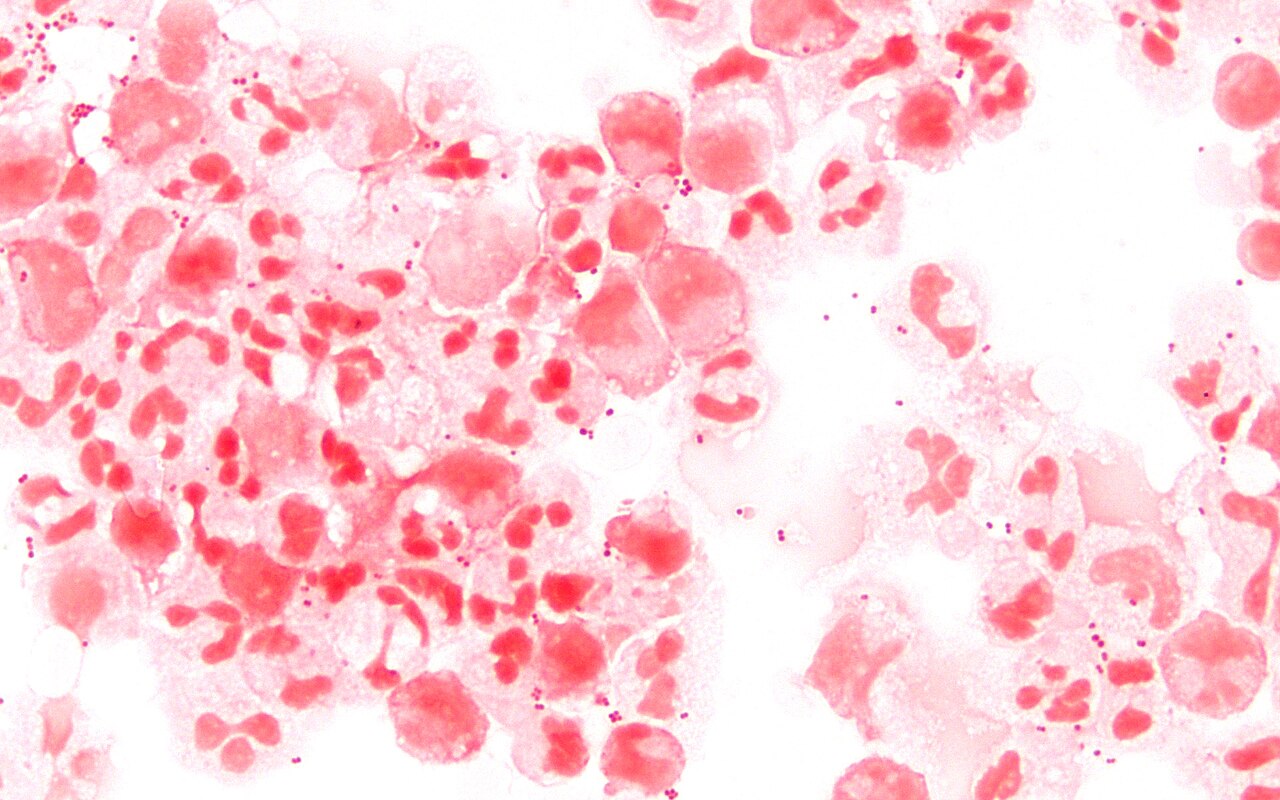
- Gram stain: a positive result is diagnostic, but sensitivity is only 50–90%.6
- CSF lactate separated bacterial from aseptic meningitis better than glucose, protein or cell count in a meta-analysis of 25 studies (area under the curve 0.98).15 The 2004 IDSA guideline did not recommend it for routine use.9
- Prior antibiotics make CSF results less reliable. Red cells in the sample may mean a traumatic tap or another diagnosis.1
- Blood tests can't rule it out. A normal CRP, procalcitonin or white cell count does not exclude bacterial meningitis.1
Treatment
| Drug | Adult dose | When | Notes |
|---|---|---|---|
| Empiric antibiotics | |||
| Ceftriaxone IV | Top of the label range: up to 4 g/day, given once daily or split twice daily | Everyone | NICE advises the highest recommended dose. The label's general adult range is 1–2 g/day. Don't mix with calcium-containing solutions.1,16 |
| Vancomycin IV | Dose per institutional protocol and label | Where ceftriaxone-resistant pneumococcus exceeds 1% | Given with ceftriaxone. Not recommended alone.6,9 |
| Ampicillin IV | 150–200 mg/kg/day, divided every 3–4 h (label) | Older or immunocompromised adults (Listeria risk) | NICE uses IV amoxicillin for the same purpose.1,6,17 |
| Adjunct | |||
| Dexamethasone IV | 0.15 mg/kg every 6 h for 2–4 days (IDSA); 10 mg every 6 h for 4 days in the main adult trial | With or 10–20 min before the first antibiotic dose | Continue for pneumococcus (and Hib); stop for other organisms.1,9,18 |
| Special situations | |||
| Severe beta-lactam allergy | Chloramphenicol; get infection specialist advice | — | Add co-trimoxazole if Listeria is a risk (NICE).1 |
| Meropenem | Dose per institutional protocol and label | Alternative to ceftriaxone | IDSA A-I as an alternative agent.9 |
| Aciclovir | Not routine | Only if HSV encephalitis is strongly suspected | 1 |
Unreviewed doses. Verify against the current label and your institution's protocol before giving anything.
Ceftriaxone and ampicillin doses come from their FDA labels.16,17 The vancomycin label gives no meningitis dose, and the meropenem label covers meningitis only in children, so neither dose is stated here. Get infection specialist advice for every confirmed case, especially after travel or with known resistant organisms.1
Empiric vancomycin. NICE recommends ceftriaxone alone when the organism is unknown.1 IDSA advises choosing empiric therapy that assumes antimicrobial resistance.9 A 2022 review recommends vancomycin plus ceftriaxone where ceftriaxone-resistant pneumococcus exceeds 1%.6 Use the regimen that fits local resistance.
Dexamethasone
- Adult trial: in 301 European adults, dexamethasone 10 mg every 6 hours for 4 days lowered unfavorable outcomes (RR 0.59) and death (RR 0.48). In pneumococcal meningitis, unfavorable outcomes fell from 52% to 26%. GI bleeding was not increased.18
- Cochrane review (25 trials, 4,121 patients): no significant overall reduction in death (17.8% vs 19.9%), but less severe hearing loss (RR 0.67) and fewer neurological sequelae. Mortality fell in pneumococcal meningitis (RR 0.84). Benefit was seen in high-income countries, not low-income ones.19
- Individual patient meta-analysis (2,029 patients, 29% with confirmed or likely HIV): no reduction in death (26.5% vs 27.2%), though survivors had less hearing loss (24.1% vs 29.5%).20
- Real-world use: after the Netherlands adopted dexamethasone, it was given in 89% of episodes and was linked to fewer unfavorable outcomes (adjusted OR 0.54).7
- Stop it if Listeria is confirmed.6
Supportive care
- Fluids: don't routinely restrict below maintenance.1
- Raised intracranial pressure: no glycerol, and no routine mannitol or hypertonic saline. If herniation is a concern, consider an osmotic agent as a temporary measure and call critical care urgently.1
- Meningococcal sepsis: no routine steroids. Consider low-dose replacement steroids for shock that persists on high-dose vasopressors.1
Contacts and public health
- Close contacts of invasive meningococcal disease need prophylaxis. First-line options are rifampin, ciprofloxacin or ceftriaxone. Health departments guide the local choice.21
- Rifampin (label dose for clearing meningococcal carriage in adults): 600 mg twice daily for 2 days.22
- Ciprofloxacin resistance is rising in the US. Where at least two resistant cases make up 20% or more of local cases in 12 months, health departments should use rifampin, ceftriaxone or azithromycin instead.21
Disposition and prognosis
- Get infection specialist advice for every case of bacterial meningitis.1
- Call critical care for signs of raised intracranial pressure or herniation.1
- If you send someone home after assessment, explain which symptoms to watch for and when to come back, including a rash that stops blanching.1
- Outcomes are poor. In the 1998–2002 Dutch cohort, 21% died, and pneumococcal disease was deadlier than meningococcal disease (30% vs 7%).2 In 2006–14, 17% died and 38% had an unfavorable outcome.7
- Markers of a worse outcome include older age, tachycardia, a low GCS, cranial nerve palsy, a CSF white count under 1,000/µL, a positive blood culture and a high CRP.7
Pitfalls
- Holding antibiotics until after the CT or the LP.1,10
- Ruling meningitis out because the classic triad is missing.2
- Trusting a negative Kernig, Brudzinski or jolt test.4,5
- Being reassured by a normal white count or CRP.1
- Forgetting dexamethasone, or giving it long after antibiotics without a plan.1,9
- Leaving out ampicillin in older or immunocompromised patients.6
- Blaming confusion in a young adult on alcohol or drugs.1
How strong is the evidence?
Antibiotic timing rests on observational data, not trials.10 The CT-before-LP question has cohort data but no randomized trial, and the decision rules have not been validated.11,12,13 Dexamethasone has the strongest support, from a randomized trial in adults, though pooled analyses that include low-income settings show less benefit.18,19,20 The US empiric regimen comes from a 2004 guideline that is now archived.8,9
On-shift teaching
Questions to ask a learner at the bedside. Tap a question to see the answer. Every answer uses facts cited above.
Q1How often is the classic triad present in adults with bacterial meningitis?
Q2Can a negative Kernig or Brudzinski sign help rule out meningitis?
Q3A patient with suspected meningitis needs a CT first. What happens before the scan?
Q4Which clinical features predicted an abnormal CT in adults with suspected meningitis?
Q5What did the main adult dexamethasone trial show?
Q6Why add ampicillin for a 70-year-old, and when do you add vancomycin?
References
- 1National Institute for Health and Care Excellence. Meningitis (bacterial) and meningococcal disease: recognition, diagnosis and management. NICE guideline NG240; March 2024.
- 2van de Beek D, de Gans J, Spanjaard L, et al. Clinical features and prognostic factors in adults with bacterial meningitis. N Engl J Med. 2004;351(18):1849–1859.
- 3Attia J, Hatala R, Cook DJ, Wong JG. The rational clinical examination. Does this adult patient have acute meningitis? JAMA. 1999;282(2):175–181.
- 4Nakao JH, Jafri FN, Shah K, Newman DH. Jolt accentuation of headache and other clinical signs: poor predictors of meningitis in adults. Am J Emerg Med. 2014;32(1):24–28.
- 5Iguchi M, Noguchi Y, Yamamoto S, et al. Diagnostic test accuracy of jolt accentuation for headache in acute meningitis in the emergency setting. Cochrane Database Syst Rev. 2020;6:CD012824.
- 6Hasbun R. Progress and challenges in bacterial meningitis: a review. JAMA. 2022;328(21):2147–2154.
- 7Bijlsma MW, Brouwer MC, Kasanmoentalib ES, et al. Community-acquired bacterial meningitis in adults in the Netherlands, 2006–14: a prospective cohort study. Lancet Infect Dis. 2016;16(3):339–347.
- 8Tunkel AR, Hartman BJ, Kaplan SL, et al. Practice guidelines for the management of bacterial meningitis. Clin Infect Dis. 2004;39(9):1267–1284. (Archived by IDSA.)
- 9American Academy of Family Physicians. Management of bacterial meningitis: new guidelines from the IDSA. Am Fam Physician. 2005;71(10):2003.
- 10Proulx N, Fréchette D, Toye B, Chan J, Kravcik S. Delays in the administration of antibiotics are associated with mortality from adult acute bacterial meningitis. QJM. 2005;98(4):291–298.
- 11Hasbun R, Abrahams J, Jekel J, Quagliarello VJ. Computed tomography of the head before lumbar puncture in adults with suspected meningitis. N Engl J Med. 2001;345(24):1727–1733.
- 12Glimåker M, Sjölin J, Åkesson S, Naucler P. Lumbar puncture performed promptly or after neuroimaging in acute bacterial meningitis in adults: a prospective national cohort study evaluating different guidelines. Clin Infect Dis. 2018;66(3):321–328.
- 13April MD, Long B, Koyfman A. Emergency medicine myths: computed tomography of the head prior to lumbar puncture in adults with suspected bacterial meningitis — due diligence or antiquated practice? J Emerg Med. 2017;53(3):313–321.
- 14Nickson C. CSF analysis. Critical Care Compendium, Life in the Fast Lane; May 2026.
- 15Huy NT, Thao NT, Diep DT, et al. Cerebrospinal fluid lactate concentration to distinguish bacterial from aseptic meningitis: a systematic review and meta-analysis. Crit Care. 2010;14(6):R240.
- 16Ceftriaxone for injection, USP. Prescribing information (Hikma Pharmaceuticals). DailyMed.
- 17Ampicillin for injection, USP. Prescribing information (Northstar Rx). DailyMed.
- 18de Gans J, van de Beek D; European Dexamethasone in Adulthood Bacterial Meningitis Study Investigators. Dexamethasone in adults with bacterial meningitis. N Engl J Med. 2002;347(20):1549–1556.
- 19Brouwer MC, McIntyre P, Prasad K, van de Beek D. Corticosteroids for acute bacterial meningitis. Cochrane Database Syst Rev. 2015;(9):CD004405.
- 20van de Beek D, Farrar JJ, de Gans J, et al. Adjunctive dexamethasone in bacterial meningitis: a meta-analysis of individual patient data. Lancet Neurol. 2010;9(3):254–263.
- 21Berry I, Rubis AB, Howie RL, et al. Selection of antibiotics as prophylaxis for close contacts of patients with meningococcal disease in areas with ciprofloxacin resistance — United States, 2024. MMWR Morb Mortal Wkly Rep. 2024;73(5):99–103.
- 22Rifampin capsules, USP. Prescribing information (American Health Packaging). DailyMed.
- 23van de Beek D, Cabellos C, Dzupova O, et al. ESCMID guideline: diagnosis and treatment of acute bacterial meningitis. Clin Microbiol Infect. 2016;22(Suppl 3):S37–S62. Further reading; not used for any claim above.
AI-generated draft. Not reviewed by a physician. This page is for education only and may contain errors, including in doses. Do not use it to diagnose, treat or make decisions about any patient. Rely on your own clinical judgment, your institution's protocols and current drug labeling. Reading this page does not create a physician-patient relationship. Full terms