Asthma exacerbation
Bottom line
- Grade severity, and look for life-threatening features first: drowsiness, confusion, cyanosis or a silent chest. Severe means any of: can't speak in full sentences or lie down, respiratory rate > 30, SpO₂ < 92%, or PEF/FEV₁ < 50% predicted.1
- For moderate or severe attacks, give albuterol plus ipratropium. In adults the combination cut hospital admission (RR 0.72), with the benefit concentrated in severe exacerbations.1,2
- Give systemic corticosteroids within 1 hour. Oral works as well as IV.1 Early steroids cut admissions (OR 0.40, NNT 8).3
- Titrate oxygen to SpO₂ 93–95%; don't flood it. High-concentration oxygen raised CO₂ by ≥ 4 mm Hg in 44% of patients, vs 19% with titrated oxygen.1,4
- IV magnesium 2 g is for patients who respond poorly, not for everyone. A Cochrane review found fewer admissions (OR 0.75). The largest single trial did not reach significance.1,5,6
Severity
| Feature | Mild (all of) | Moderate | Severe (any of) |
|---|---|---|---|
| Speech and posture | Full sentences, can lie down | Phrases, prefers sitting, not agitated | Can't speak, drink or lie down |
| Respiratory rate | Normal or mildly raised | Raised | > 30/min |
| Accessory muscles | None or mild | In use | In use |
| Chest | Mild expiratory wheeze | Expiratory wheeze, reduced air entry | Quiet or silent chest |
| SpO₂ on room air | ≥ 94% | ≥ 92% | < 92% |
| PEF or FEV₁ (% best or predicted) | > 70% | 50–70% | < 50% |
Drowsiness, confusion, cyanosis or a quiet chest: start nebulized albuterol, ipratropium, oxygen and systemic steroids immediately, and call for ICU or anesthesia help. The algorithm then lists IV access, 100% oxygen by non-rebreather mask, IV magnesium, a chest X-ray, watching for albuterol toxicity, a blood gas if needed, and continuous monitoring.1
Criteria from the GINA 2026 acute care algorithm, which covers adults and children 6 and older.1 Pulse oximetry can read falsely high in people with dark skin, and normal saturation is lower at altitude.1
First 20 minutes
- Is it asthma? Think of pneumothorax, anaphylaxis, inducible laryngeal obstruction, pneumonia, heart failure and pulmonary embolism.1
- Anaphylaxis features too? Give IM epinephrine first, then start bronchodilators. Epinephrine is not routine for asthma without anaphylaxis.1
- Start treatment while you take the history. Ask what has already been given, and screen for risk factors for fatal asthma (below).1
- Measure PEF or FEV₁ before treatment if it doesn't delay care. Repeat at 1 hour and until response plateaus.1
- Give oxygen if SpO₂ < 92%, to a target of 93–95%. Don't withhold oxygen if oximetry isn't available.1
- Give bronchodilators and systemic steroids together (doses below). Steroids within 1 hour of arrival.1
- Blood gas only for selected patients: PEF or FEV₁ < 50%, no response, or deterioration. CO₂ is usually low in an attack; a PaCO₂ that is normal or high (especially > 45 mm Hg) with PaO₂ < 60 mm Hg means respiratory failure.1
- Chest X-ray is not routine. Get one if you suspect a complication or another diagnosis, or if the patient isn't responding.1
Treatment
| Agent | Adult dose | When | Notes |
|---|---|---|---|
| Bronchodilators | |||
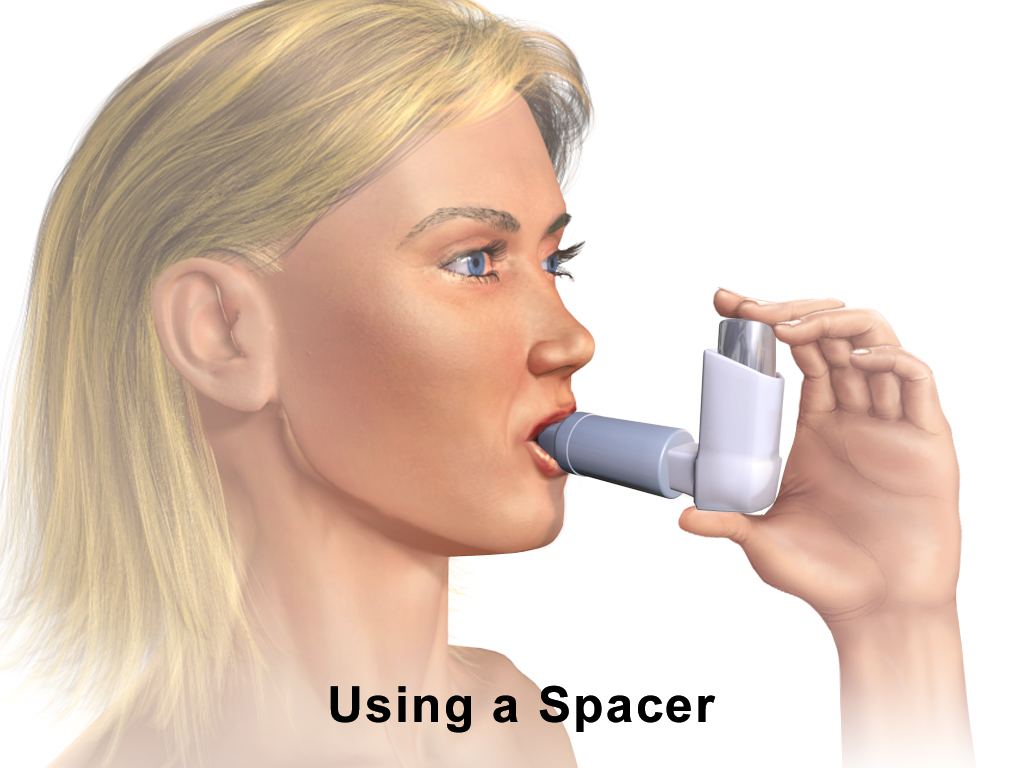
| Albuterol (salbutamol), MDI + spacer | Moderate: 4–6 puffs. Severe: 6–10 puffs | Up to 3 doses, 20–30 min apart, then as needed | GINA counts 100 mcg metered (90 mcg delivered) per puff.1 |
| Albuterol, nebulized | Moderate: 2.5 mg. Severe: 5 mg | Same schedule | GINA uses nebulized albuterol for life-threatening attacks.1 |
| Ipratropium | 4 puffs (20 mcg each) by spacer, or 0.25 mg nebulized, with each albuterol dose | Moderate and severe | No benefit after the first 1–2 hours.1,2 |
| Anti-inflammatory | |||
| Prednisone or prednisolone | 50 mg PO once daily (40–50 mg) | Within 1 h of arrival; 5–7 days total | Oral is as effective as IV.1 |
| Hydrocortisone IV | 200 mg/day in divided doses | If unable to swallow, vomiting, or on NIV or ventilator | No advantage of IM over oral.1 |
| Add-on for poor response | |||
| Magnesium sulfate IV | 2 g over 20 min, single dose | No response to initial treatment and persistent hypoxemia | Not routine. Nebulized magnesium does not help.1,5,6 |
| Not recommended | |||
| IV aminophylline or theophylline | — | — | Less effective and less safe than albuterol.1 |
| Routine IV beta-agonists | — | — | Not supported for most severe attacks.1 |
| Sedatives | — | — | Avoid. Linked to avoidable asthma deaths.1 |
| Antibiotics | — | — | Only with strong evidence of lung infection.1 |
Unreviewed doses. Verify against the current label and your institution's protocol before giving anything.
All doses from the GINA 2026 report.1 Magnesium for asthma is not an FDA-labeled indication; the dose is the guideline's.
Bronchodilators
- A spacer works as well as a nebulizer. In adults, admission risk was similar (RR 0.94, 95% CI 0.61–1.43), as were ED length of stay and lung function.7 Patients with life-threatening asthma were not studied, so nebulize them.1
- Ipratropium adds most in severe attacks. Combination therapy meant 65 fewer admissions per 1,000 adults and fewer return visits (RR 0.80), at the cost of more tremor, agitation and palpitations.2
- Watch for albuterol toxicity. High doses cause a fast pulse, palpitations, anxiety, hypokalemia, arrhythmias, lactic acidosis and hyperventilation, which can look like worsening asthma and prompt even more albuterol.1
- Budesonide-formoterol at high doses performed like high-dose albuterol in one ED study. GINA calls it an alternative while more data arrive.1
Corticosteroids
- Give them in all but the mildest attacks. They are especially important if albuterol doesn't give lasting relief, if the attack began on oral steroids, or after past exacerbations needing them.1
- Early is better. Steroids within 1 hour of arrival cut admissions (OR 0.40, NNT 8), most clearly in more severe attacks and in patients not already on steroids.3
- Oral is as good as IV, quicker and cheaper. Use IV when the patient can't swallow, is vomiting, or needs ventilatory support.1
- Dexamethasone in adults: 16 mg daily for 2 days matched 5 days of prednisone 50 mg for relapse (13% vs 11%).8 A single 12 mg dose narrowly missed noninferiority to 5 days of prednisone 60 mg (relapse 12.1% vs 9.8%).9
Magnesium
- GINA: not routine. Give a single 2 g IV dose over 20 minutes to adults who don't respond to initial treatment and stay hypoxemic.1
- Cochrane (14 trials, 2,313 people, mostly adults): 1.2–2 g IV after oxygen, nebulized albuterol and IV steroids cut admissions (OR 0.75), about 7 fewer per 100 treated. Flushing, fatigue, nausea, headache and hypotension were the usual side effects.5
- 3Mg trial (1,109 adults, 34 UK EDs): IV magnesium 2 g did not significantly reduce admission (72% vs 78%; OR 0.73, 95% CI 0.51–1.04) or breathlessness. Nebulized magnesium had no effect (OR 0.96).6
Oxygen
In 106 ED patients with severe asthma, 8 L/min by mask for an hour raised transcutaneous CO₂ by ≥ 4 mm Hg in 44%, vs 19% with oxygen titrated to 93–95%. All 10 patients who ended with CO₂ ≥ 45 mm Hg were in the high-oxygen group.4 Titrate to 93–95%, and wean using oximetry once stable.1 GINA's algorithm does list 100% oxygen by non-rebreather for the life-threatening pathway.1
The patient who is getting worse
- Call for ICU help early. Reassess clinical status and saturation often; patients who deteriorate despite full bronchodilator and steroid therapy need ICU evaluation.1
- Fatigue and sleepiness suggest rising CO₂ and a need for airway support.1
- Give extra albuterol and ipratropium (watching for toxicity), start steroids if not yet given, give IV magnesium, and think again about other causes.1
- Noninvasive ventilation has weak evidence. In a Cochrane review (5 studies, 206 adults), intubation was 2 of 45 with NIV vs 0 of 41 without; one small study found fewer admissions (3 of 17 vs 10 of 16). GINA makes no recommendation.11,1
- If you try NIV, monitor closely, don't use it in an agitated patient, and don't sedate a patient to make it work.1
- Heliox has no routine role but can be considered for severe attacks not responding to standard therapy.1
Intubation and ventilator management are beyond the scope of the GINA report.1 For further reading, see the LITFL Critical Care Compendium page on acute severe asthma.
Risk factors for fatal asthma
- Previous near-fatal asthma needing intubation.1
- Hospitalization or several emergency visits for asthma in the past year.1
- Current or recent oral steroids, or no inhaled corticosteroid.1
- Poor adherence, or no written action plan.1
- Overuse of albuterol, especially more than one canister a month, or nebulized albuterol at home.1
- Psychiatric illness or psychosocial problems; food allergy or past anaphylaxis; poor perception of breathlessness.1
- Comorbid pneumonia, diabetes or arrhythmias.1
Disposition
Status 1 hour after starting treatment, including the ability to lie flat, predicts admission better than status on arrival.1
| Consider discharge | Consider admission |
|---|---|
| Meets mild criteria for at least 1–2 h after the last albuterol | SpO₂ < 92% on room air |
| SpO₂ ≥ 92% on room air | Needs albuterol more often than every 1–2 h |
| PEF or FEV₁ > 70% of best or predicted | Dyspnea persisting 4–6 h after systemic steroids |
| Adequate resources at home | Adherence or follow-up concerns, or risk factors for fatal asthma |
From the GINA 2026 acute care algorithm.1 Other factors linked to admission include female sex, older age, more than 8 albuterol puffs in the past 24 hours, and past severe exacerbations.1
Discharge
- Oral steroids: prednisone or prednisolone 40–50 mg daily for 5–7 days. In patients on maintenance ICS, tapering adds nothing.1 A short course after the ED visit cut relapse in the first week (RR 0.38); about 10 patients are treated to prevent one relapse.12
- Always start or continue an inhaled corticosteroid. SABA-only treatment is no longer recommended. GINA prefers ICS-formoterol as maintenance and reliever therapy (MART), started at Step 4.1
- Why MART: in patients with a past severe exacerbation, it cut the risk of another in the next 12 months by 32% compared with the same dose of ICS or ICS-LABA plus an albuterol reliever.1
- If prescribing ICS or ICS-LABA with an albuterol reliever, increase the ICS dose for 2–4 weeks.1
- Check inhaler technique, give a written action plan, and arrange follow-up in 2–7 days. Refer for specialist advice after an ICU stay, or after one or more exacerbations needing steroids or urgent care in the past year.1
- Steroid courses add up. In adults, as few as 4–5 lifetime courses carry a dose-related risk of diabetes, cataract, heart failure and osteoporosis.1
Pitfalls
- Being reassured by a normal PaCO₂. In an attack it should be low; normal or high means the patient is tiring.1
- Reading tachycardia, lactate and fast breathing as worsening asthma when they may be albuterol toxicity.1
- Sedating an anxious or agitated patient, including to tolerate NIV.1
- Running high-flow oxygen in a severe (not life-threatening) attack instead of titrating to 93–95%.4,1
- Missing anaphylaxis. If present, IM epinephrine comes first.1
- Discharging on albuterol alone, without an inhaled corticosteroid.1
How strong is the evidence?
Systemic steroids and adding ipratropium in the ED rest on high-grade evidence.1 Pooled data show early steroids and IV magnesium reduce admissions.3,5 The data for noninvasive ventilation are sparse and low quality.11,1 Dexamethasone in adults rests on two modest ED trials.8,9
On-shift teaching
Questions to ask a learner at the bedside. Tap a question to see the answer. Every answer uses facts cited above.
Q1Which features make an asthma attack life-threatening, and what do you do?
Q2Why titrate oxygen instead of giving it at high flow?
Q3Who benefits most from adding ipratropium, and for how long?
Q4Your patient is mildly nauseated. Should the steroid go IV?
Q5Does IV magnesium work?
Q6What must change before a patient goes home?
References
- 1Global Initiative for Asthma. Global Strategy for Asthma Management and Prevention, 2026 update. GINA; 2026. Chapter 9: management of exacerbations.
- 2Kirkland SW, Vandenberghe C, Voaklander B, et al. Combined inhaled beta-agonist and anticholinergic agents for emergency management in adults with asthma. Cochrane Database Syst Rev. 2017;1:CD001284.
- 3Rowe BH, Spooner C, Ducharme FM, et al. Early emergency department treatment of acute asthma with systemic corticosteroids. Cochrane Database Syst Rev. 2001;(1):CD002178.
- 4Perrin K, Wijesinghe M, Healy B, et al. Randomised controlled trial of high concentration versus titrated oxygen therapy in severe exacerbations of asthma. Thorax. 2011;66(11):937–941.
- 5Kew KM, Kirtchuk L, Michell CI. Intravenous magnesium sulfate for treating adults with acute asthma in the emergency department. Cochrane Database Syst Rev. 2014;(5):CD010909.
- 6Goodacre S, Cohen J, Bradburn M, et al. Intravenous or nebulised magnesium sulphate versus standard therapy for severe acute asthma (3Mg trial): a double-blind, randomised controlled trial. Lancet Respir Med. 2013;1(4):293–300.
- 7Cates CJ, Welsh EJ, Rowe BH. Holding chambers (spacers) versus nebulisers for beta-agonist treatment of acute asthma. Cochrane Database Syst Rev. 2013;(9):CD000052.
- 8Kravitz J, Dominici P, Ufberg J, et al. Two days of dexamethasone versus 5 days of prednisone in the treatment of acute asthma: a randomized controlled trial. Ann Emerg Med. 2011;58(2):200–204.
- 9Rehrer MW, Liu B, Rodriguez M, et al. A randomized controlled noninferiority trial of single dose of oral dexamethasone versus 5 days of oral prednisone in acute adult asthma. Ann Emerg Med. 2016;68(5):608–613.
- 10Wong A. The 3Mg trial. The Bottom Line; July 2014.
- 11Lim WJ, Mohammed Akram R, Carson KV, et al. Non-invasive positive pressure ventilation for treatment of respiratory failure due to severe acute exacerbations of asthma. Cochrane Database Syst Rev. 2012;12:CD004360.
- 12Rowe BH, Spooner CH, Ducharme FM, et al. Corticosteroids for preventing relapse following acute exacerbations of asthma. Cochrane Database Syst Rev. 2007;(3):CD000195.
- 13Life in the Fast Lane. Acute severe asthma. Critical Care Compendium. Further reading; not used for any claim above.
AI-generated draft. Not reviewed by a physician. This page is for education only and may contain errors, including in doses. Do not use it to diagnose, treat or make decisions about any patient. Rely on your own clinical judgment, your institution's protocols and current drug labeling. Reading this page does not create a physician-patient relationship. Full terms