Acute heart failure
Bottom line
- Name the phenotype and the trigger. Cardiogenic shock, acute pulmonary edema, left-sided congestion and right-sided congestion each start differently. Look for acute coronary syndrome, hypertensive emergency, arrhythmia, a mechanical cause, pulmonary embolism, infection and tamponade.1,2
- Lung ultrasound beats the chest film. Pooled sensitivity was 88% vs 73%, with the same specificity. An NT-proBNP under 300 pg/mL makes acute heart failure very unlikely (negative predictive value 98%).3,4
- Use NIV for respiratory distress. In a Cochrane review it lowered hospital mortality (RR 0.65) and intubation (RR 0.49). Give oxygen when SpO2 is under 90% or PaO2 under 60 mm Hg.5,1,2
- Give every congested patient an IV loop diuretic, then measure the response. Furosemide 40 mg IV if diuretic-naive, or double the daily oral dose. Aim for urine sodium ≥ 70 mEq/L at 2 hours or urine output ≥ 100 mL/h at 6 hours.1,2,6
- Hypertensive pulmonary edema: think nitroglycerin, not morphine. ACEP suggests considering high-dose nitroglycerin when blood pressure is high. The ESC recommends against routine opiates.7,1,2
Recognize and sort
The 2026 ESC guideline renames acute heart failure decompensated heart failure, because many patients worsen over days rather than suddenly.8 It sorts patients into four phenotypes, each with its own first treatment. All four may need ventilatory support.1,2
| Phenotype | First treatment |
|---|---|
| Cardiogenic shock | Inotropes, vasopressors, mechanical support; diuretics only if needed |
| Acute pulmonary edema | Diuretics and vasodilators |
| Decompensated left-sided HF | Diuretics |
| Decompensated right-sided HF | Optimize fluid status; diuretics |
From the ESC management algorithm for decompensated heart failure.1,2
Congested, hypoperfused, or both?
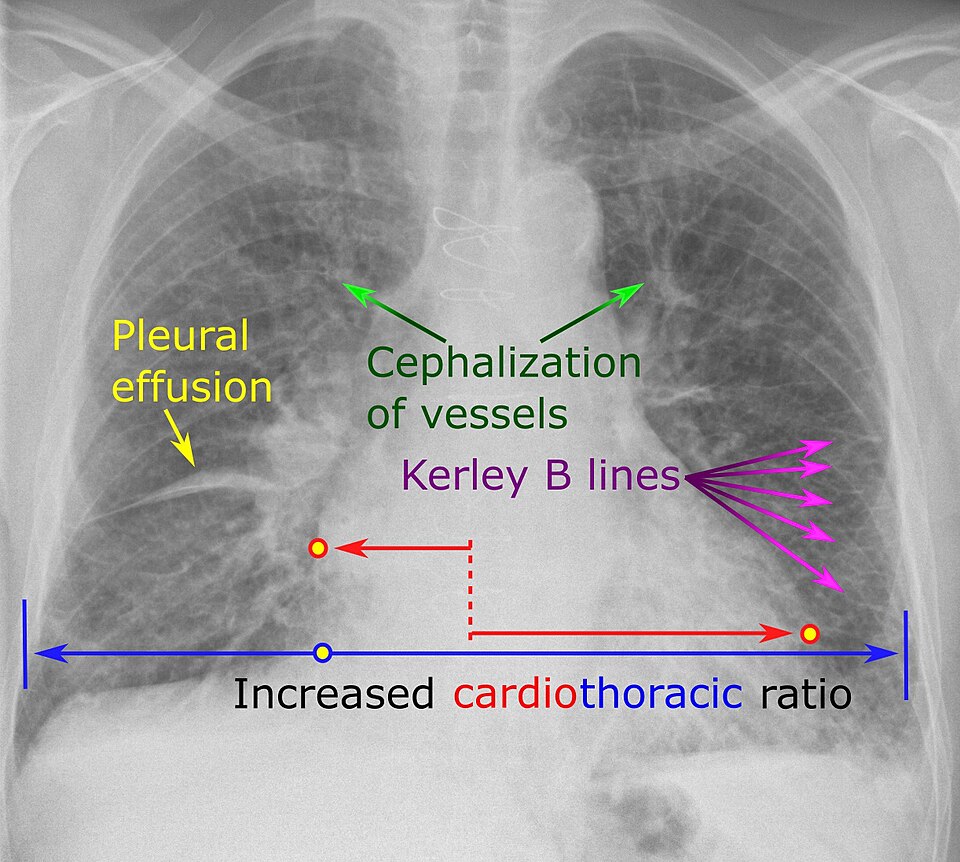
- Left-sided congestion: dyspnea, orthopnea, cough, tachypnea, rales, an S3, pleural effusion, raised natriuretic peptides.2
- Right-sided congestion: peripheral edema, abdominal distension, hepatomegaly, jugular venous distension, hepatojugular reflux, raised creatinine and liver enzymes.2
- Hypoperfusion: cold, sweaty extremities, pale skin, dizziness, confusion, oliguria, a narrow pulse pressure, raised lactate, creatinine and aminotransferases.2
Tests that help
- NT-proBNP: in 1,461 dyspneic ED patients, a level under 300 pg/mL had a sensitivity of 93.9% and a negative predictive value of 98.0% for acute heart failure. Age-stratified cutoffs of 450, 900 and 1,800 pg/mL help rule it in.4 The ESC diagnostic pathway uses NT-proBNP ≥ 300 pg/mL to move on to echocardiography when clinical suspicion is not already high.2
- Lung ultrasound: ACEP gives a Level B recommendation to use it with the history and exam when the diagnosis is uncertain, if the equipment and skills are available.7 Against chest radiography, pooled sensitivity was 0.88 vs 0.73, with specificity 0.90 for both.3 In ED studies, B-lines alone had a pooled sensitivity of 82.5% and specificity of 83.6%.9
- Chest radiograph: useful, but a film without edema does not exclude heart failure. It missed about a quarter of cases in pooled data.3
- ECG and echocardiography: the ECG is part of the first assessment. Echocardiography, chest radiograph and lung ultrasound follow when suspicion is high or the NT-proBNP is raised.2
First 30 minutes
- Monitor and get an ECG. Take a history and check vital signs, exam and labs.2
- Look for the trigger: acute coronary syndrome, hypertensive emergency, arrhythmia, a mechanical cause, pulmonary embolism, infection or inflammation, and tamponade. Treat it alongside the heart failure.2
- Breathing: oxygen if SpO2 < 90% or PaO2 < 60 mm Hg. Start NIV early for respiratory distress (respiratory rate > 25 or SpO2 < 90%).1,2
- High blood pressure with pulmonary edema: start nitroglycerin.7,2
- Fluid overload: give an IV loop diuretic once you are confident of the diagnosis. Diuretics can harm patients with another cause of dyspnea.7,1,2
- Hypotension or hypoperfusion: treat as cardiogenic shock (below).1,2
- Place a urine collection plan so that sodium can be checked at 2 hours and output at 6 hours.2
Oxygen and ventilation
| Recommendation | ESC class, level |
|---|---|
| Oxygen for SpO2 < 90% or PaO2 < 60 mm Hg | I, C |
| Noninvasive positive pressure ventilation for respiratory distress (RR > 25, SpO2 < 90%), started as soon as possible | IIa, B2 |
| Intubation for persistent, progressive respiratory failure despite oxygen or NIV | I, C |
From the 2026 ESC guideline recommendation tables.1,2
- Cochrane review (24 trials, 2,664 patients): CPAP or bilevel NIV lowered hospital mortality (RR 0.65, NNT 17, low-quality evidence) and intubation (RR 0.49, NNT 13, moderate quality). Myocardial infarction rates did not change.5
- 3CPO (n = 1,069): NIV improved dyspnea, heart rate, acidosis and hypercapnia at 1 hour. Seven-day mortality was 9.8% with oxygen and 9.5% with NIV, not significantly different. CPAP and bilevel ventilation performed the same.10
Diuretics
IV loop diuretics are recommended for every patient admitted with fluid overload (class I, level A).1,2 Give them as soon as you are confident of the diagnosis. Earlier diuretics may shorten stays and lower in-hospital mortality, but ACEP's advice is consensus only.7
| Agent | Adult dose | Notes |
|---|---|---|
| Loop diuretic | ||
| Furosemide IV, diuretic-naive | 40 mg IV over 1–2 min | If the response is poor within 1 hour, the label allows 80 mg.6 This is also the ESC starting dose.2 |
| Furosemide IV, already on a loop diuretic | 2 × the total daily oral dose | ESC starting dose. Repeat every 12 hours while the response is adequate. Double the dose if it is not.2 |
| Add-on for poor response (patients on loop diuretics before admission) | ||
| Acetazolamide IV | 500 mg IV once daily in ADVOR | Trial dose, given with IV loop diuretic.11 The label's starting dose for heart failure diuresis is 250–375 mg once daily.12 ESC: class IIa.2 |
| Hydrochlorothiazide PO | Dose by eGFR, per institutional protocol | ESC: class IIa as an add-on.2 Watch creatinine (see CLOROTIC below).13 |
| Last resort | ||
| Ultrafiltration | Specialist decision | Consider when decongestion fails despite maximal diuretic therapy.2 |
Unreviewed doses. Verify against the current label and your institution's protocol before giving anything.
What the trials show
- DOSE (n = 308): bolus every 12 hours and continuous infusion gave the same symptom relief and creatinine change. A high dose (2.5 × the oral dose) gave more diuresis and a non-significant trend to better symptoms (P = 0.06), with transient worsening of renal function.14
- PUSH-AHF (n = 310): intensifying treatment when spot urine sodium was < 70 mmol/L raised 24-hour sodium excretion (409 vs 345 mmol). Death or heart failure rehospitalization at 180 days was 31% in both arms.15 The ESC rates urine-sodium-guided therapy class IIb.2
- ADVOR (n = 519): adding IV acetazolamide 500 mg to loop diuretics raised successful decongestion within 3 days (42.2% vs 30.5%; RR 1.46). Death or heart failure rehospitalization at 3 months did not differ (29.7% vs 27.8%). Kidney function, potassium and blood pressure problems were similar.11
- CLOROTIC (n = 230, older patients, age about 83): adding hydrochlorothiazide increased weight loss at 72 hours (2.3 vs 1.5 kg) but not dyspnea relief. Impaired renal function was more common (46.5% vs 17.2%). Mortality and rehospitalization did not differ.13
Nitroglycerin and other vasodilators
- ESC: IV vasodilators may be considered as initial therapy when systolic BP is > 110 mm Hg (class IIb, level C).1,2
- ACEP: consider high-dose nitroglycerin as a safe and effective option for acute heart failure with raised blood pressure (Level C, consensus).7
- How fast it works: nitrate vasodilation starts within 1–3 minutes and the half-life is 2–7 minutes, so it can be titrated quickly.7
- Contraindications on the label: recent phosphodiesterase inhibitors (sildenafil, tadalafil, vardenafil), riociguat, tamponade, restrictive cardiomyopathy, constrictive pericarditis and raised intracranial pressure. Severe hypotension can follow even small doses.16
| Regimen | Adult dose | Source |
|---|---|---|
| Label infusion | Start 5 mcg/min. Increase by 5 mcg/min every 3–5 min; above 20 mcg/min, steps of 10–20 mcg/min | FDA label, nonadsorptive tubing.16 |
| High-dose infusion | Infusions up to 400 mcg/min have been called "standard"; ≥ 200 mcg/min is often called high dose | ACEP clinical policy.7 |
| High-dose bolus | 2,000 mcg IV every 3–5 min, with an infusion | Described by ACEP from an ED study in hypertensive patients (SBP ≥ 160 or MAP ≥ 120).7,17 |
Unreviewed doses. Verify against the current label and your institution's protocol before giving anything.
What the studies show
- Levy, single-arm ED study (n = 29, hypertensive, refractory to initial therapy): with 2 mg boluses, intubation was 13.8% and ICU admission 37.9%, against 26.7% and 80.0% in a retrospective comparison group. One patient (3.4%) had symptomatic hypotension.17
- Sympathetic crashing acute pulmonary edema (SCAPE) RCT, a small open-label ED trial in India: high-dose nitroglycerin (> 100 mcg/min) resolved symptoms by 6 hours in 65.4% vs 11.5% with low dose.18 The high-dose arm started with a 600–1,000 mcg bolus. Patients were young (median age in the 40s) and few had a reduced ejection fraction.19
- Meta-analysis of 4 studies (185 patients, 1 RCT): high-dose nitroglycerin reduced the need for mechanical ventilation (RR 0.31). No hypotension was reported in either group.20
- GALACTIC (n = 788, ward patients with SBP ≥ 100): an intensive, sustained vasodilation strategy did not lower death or rehospitalization at 180 days (30.6% vs 27.8%). Headache, dizziness and hypotension were more common.21
The ESC gives vasodilators only a weak recommendation, and a large trial of sustained vasodilation showed no outcome benefit.2,21 ACEP and small ED studies favor early high-dose nitroglycerin for hypertensive pulmonary edema, mainly for faster relief and fewer intubations.7,18,20 The high-dose evidence is small, open-label or nonrandomized.7,19
Hypotension and cardiogenic shock
| SCAI stage | Meaning |
|---|---|
| A · At risk | No shock yet, but at risk (for example acute MI or heart failure) |
| B · Beginning | Hemodynamic instability (relative hypotension or tachycardia) without hypoperfusion |
| C · Classic | Hypoperfusion needing more than fluid: inotrope, vasopressor or mechanical support |
| D · Deteriorating | Like C, but failing to respond to initial treatment |
| E · Extremis | Refractory shock or cardiac arrest needing several simultaneous interventions, including CPR |
SCAI cardiogenic shock stages as reproduced in the ESC guideline slide set.2
- Inotropes may be considered when systolic BP is < 90 mm Hg with hypoperfusion that does not respond to standard treatment, including a fluid challenge (IIb, C).2
- Vasopressors, preferably norepinephrine, may be considered in cardiogenic shock (IIb, C). Dose per institutional protocol and label.2
- Call the shock team for any potential candidate for temporary mechanical support (I, C).2
- STEMI with cardiogenic shock: a microaxial flow pump should be considered in selected patients with left ventricular dysfunction and no risk of hypoxic brain injury (IIa, B1). Temporary mechanical support is not recommended in unselected MI shock (III, B1), and an intra-aortic balloon pump is not recommended in unselected cardiogenic shock (III, B1).2
Morphine and anxiolysis
- ESC: routine opiates are not recommended unless there is severe or intractable pain or anxiety, because of the risk of harm (III, C).2
- Observational data: a systematic review of 7 studies found that most associated morphine with more adverse events and deaths. None was a trial designed to answer the question.22
- MIMO (n = 111, stopped early): midazolam vs morphine for anxious patients with acute cardiogenic pulmonary edema. In-hospital mortality was 12.7% vs 17.9%, not significantly different. Serious adverse events were 18.2% vs 42.9%.23
Disposition
- Don't rely on a risk tool alone to decide who can go home (ACEP Level B). Consider the Ottawa Heart Failure Risk Scale to identify higher-risk patients who should not be discharged (Level B). EHMRG7 or STRATIFY may also help (Level C). Use shared decision-making (consensus).7
- Ottawa Heart Failure Risk Scale: 10 items.24 In 1,100 ED patients, serious adverse events occurred in 15.5%, including 10.2% of those discharged. Admitting everyone with a score > 1 would have raised sensitivity from 71.8% to 91.8%, but admissions from 57.2% to 77.6%.25 Of 41 deaths, 16 were in patients sent home.7
- Before discharge, check carefully for residual congestion (I, C).2
- Start an SGLT2 inhibitor in hospital once the patient is stable (I, B1).2 In EMPULSE (n = 530), empagliflozin 10 mg daily started a median of 3 days after admission gave more clinical benefit at 90 days (win ratio 1.36).26
- Arrange early follow-up. Rapid start and uptitration of foundational medicines, with frequent visits in the first 6 weeks, is recommended (I, B2).2 In STRONG-HF, this approach cut 180-day heart failure readmission or death (15.2% vs 23.3%).27
Pitfalls
- Giving diuretics before you are confident of the diagnosis. They can harm patients whose dyspnea has another cause.7
- Missing the trigger: acute coronary syndrome, arrhythmia, pulmonary embolism, infection or tamponade.2
- Being reassured by a chest film without edema. Its pooled sensitivity was only 0.73.3
- Giving a diuretic and not measuring the response. Check urine sodium at 2 hours and urine output at 6 hours.2
- Starting nitroglycerin in a patient who has taken a phosphodiesterase inhibitor.16
- Reaching for morphine for air hunger.2,23
How strong is the evidence?
Among the ESC recommendations for decompensated heart failure, only IV loop diuretics for fluid overload carry level A evidence. Vasodilators, inotropes, vasopressors and the opiate advice are all level C expert opinion.2 Every ACEP recommendation on early diuretics and high-dose nitroglycerin is Level C consensus, and the high-dose nitroglycerin evidence is one small nonrandomized study plus a small trial.7,18 Trials of diuretic dosing and add-ons improved decongestion but not death or readmission.14,15,11,13 The stronger outcome evidence is for what happens around discharge.27,26
On-shift teaching
Questions to ask a learner at the bedside. Tap a question to see the answer. Every answer uses facts cited above.
Q1What IV furosemide dose does the ESC algorithm start with, and how do you know it is working?
Q2How do lung ultrasound and chest radiography compare for diagnosing acute heart failure?
Q3What NT-proBNP value makes acute heart failure unlikely in a dyspneic ED patient?
Q4Does NIV reduce mortality in cardiogenic pulmonary edema?
Q5What did ADVOR show about adding acetazolamide?
References
- 1Køber L, Adamo M, Ruwald AC, et al. 2026 ESC Guidelines for the management of heart failure. Eur Heart J. 2026;47(38):5346–5457.
- 2European Society of Cardiology. 2026 ESC Guidelines for the management of heart failure: official slide set (recommendation tables and Figures 11–15).
- 3Maw AM, Hassanin A, Ho PM, et al. Diagnostic accuracy of point-of-care lung ultrasonography and chest radiography in adults with symptoms suggestive of acute decompensated heart failure: a systematic review and meta-analysis. JAMA Netw Open. 2019;2(3):e190703.
- 4Januzzi JL Jr, Chen-Tournoux AA, Christenson RH, et al. N-terminal pro-B-type natriuretic peptide in the emergency department: the ICON-RELOADED study. J Am Coll Cardiol. 2018;71(11):1191–1200.
- 5Berbenetz N, Wang Y, Brown J, et al. Non-invasive positive pressure ventilation (CPAP or bilevel NPPV) for cardiogenic pulmonary oedema. Cochrane Database Syst Rev. 2019;4(4):CD005351.
- 6Furosemide injection, USP. Prescribing information (Amneal). DailyMed.
- 7American College of Emergency Physicians Clinical Policies Subcommittee on Acute Heart Failure Syndromes. Clinical policy: critical issues in the evaluation and management of adult patients presenting to the emergency department with acute heart failure syndromes. Ann Emerg Med. 2022;80(4):e31–e59.
- 8European Society of Cardiology. Major changes made to the ESC Guidelines on heart failure (press release). August 28, 2026.
- 9McGivery K, Atkinson P, Lewis D, et al. Emergency department ultrasound for the detection of B-lines in the early diagnosis of acute decompensated heart failure: a systematic review and meta-analysis. CJEM. 2018;20(3):343–352.
- 10Gray A, Goodacre S, Newby DE, et al. Noninvasive ventilation in acute cardiogenic pulmonary edema (3CPO). N Engl J Med. 2008;359(2):142–151.
- 11Mullens W, Dauw J, Martens P, et al. Acetazolamide in acute decompensated heart failure with volume overload (ADVOR). N Engl J Med. 2022;387(13):1185–1195.
- 12Acetazolamide for injection. Prescribing information (Avet). DailyMed.
- 13Trullàs JC, Morales-Rull JL, Casado J, et al. Combining loop with thiazide diuretics for decompensated heart failure: the CLOROTIC trial. Eur Heart J. 2023;44(5):411–421.
- 14Felker GM, Lee KL, Bull DA, et al. Diuretic strategies in patients with acute decompensated heart failure (DOSE). N Engl J Med. 2011;364(9):797–805.
- 15Ter Maaten JM, Beldhuis IE, van der Meer P, et al. Natriuresis-guided diuretic therapy in acute heart failure: a pragmatic randomized trial (PUSH-AHF). Nat Med. 2023;29(10):2625–2632.
- 16Nitroglycerin in 5% dextrose injection. Prescribing information (Baxter). DailyMed.
- 17Levy P, Compton S, Welch R, et al. Treatment of severe decompensated heart failure with high-dose intravenous nitroglycerin: a feasibility and outcome analysis. Ann Emerg Med. 2007;50(2):144–152.
- 18Siddiqua N, Mathew R, Sahu AK, et al. High-dose versus low-dose intravenous nitroglycerine for sympathetic crashing acute pulmonary edema: a randomised controlled trial. Emerg Med J. 2024;41(2):96–102.
- 19Propersi M, Amoo AA. Sympathetic crashing acute pulmonary edema: high-dose vs low-dose nitro. REBEL EM; June 20, 2024.
- 20Pramudyo M, Kamarullah W, Pranata R, et al. Low-dose versus high-dose intravenous nitroglycerin in the treatment of sympathetic crashing acute pulmonary oedema: a systematic review and meta-analysis. BMJ Open. 2025;15(6):e099142.
- 21Kozhuharov N, Goudev A, Flores D, et al. Effect of a strategy of comprehensive vasodilation vs usual care on mortality and heart failure rehospitalization among patients with acute heart failure: the GALACTIC randomized clinical trial. JAMA. 2019;322(23):2292–2302.
- 22Gil V, Domínguez-Rodríguez A, Masip J, et al. Morphine use in the treatment of acute cardiogenic pulmonary edema and its effects on patient outcome: a systematic review. Curr Heart Fail Rep. 2019;16(4):81–88.
- 23Domínguez-Rodríguez A, Suero-Mendez C, Burillo-Putze G, et al. Midazolam versus morphine in acute cardiogenic pulmonary oedema: results of a multicentre, open-label, randomized controlled trial (MIMO). Eur J Heart Fail. 2022;24(10):1953–1962.
- 24Stiell IG, Clement CM, Brison RJ, et al. A risk scoring system to identify emergency department patients with heart failure at high risk for serious adverse events. Acad Emerg Med. 2013;20(1):17–26.
- 25Stiell IG, Perry JJ, Clement CM, et al. Prospective and explicit clinical validation of the Ottawa Heart Failure Risk Scale, with and without use of quantitative NT-proBNP. Acad Emerg Med. 2017;24(3):316–327.
- 26Voors AA, Angermann CE, Teerlink JR, et al. The SGLT2 inhibitor empagliflozin in patients hospitalized for acute heart failure: a multinational randomized trial (EMPULSE). Nat Med. 2022;28(3):568–574.
- 27Mebazaa A, Davison B, Chioncel O, et al. Safety, tolerability and efficacy of up-titration of guideline-directed medical therapies for acute heart failure (STRONG-HF): a multinational, open-label, randomised trial. Lancet. 2022;400(10367):1938–1952.
- 28Emergency Medicine Cases. Acute heart failure. Further reading; not used for any claim above.
AI-generated draft. Not reviewed by a physician. This page is for education only and may contain errors, including in doses. Do not use it to diagnose, treat or make decisions about any patient. Rely on your own clinical judgment, your institution's protocols and current drug labeling. Reading this page does not create a physician-patient relationship. Full terms