

Wrist and forearm fractures
Bottom line
- Treat pain early and by severity. Avoid NSAIDs in frail or older adults, and use IV opioids with care in them.1
- Reduce a dorsally displaced distal radius fracture under a regional block. NICE suggests a Bier block by trained clinicians, and advises against nitrous oxide on its own.1
- Judge the reduction by the numbers. Under 65, shortening over 3 mm, dorsal tilt over 10° or an articular step-off over 2 mm after reduction makes surgery more likely to help. Over 65, surgery did not improve patient-reported outcomes.2,3
- A child's buckle fracture needs no cast and no follow-up. A soft bandage gave the same pain at 3 days as rigid immobilization in 965 children.1,4
- Normal x-rays don't exclude a scaphoid fracture. NICE suggests MRI as the first-line test after a careful exam.1
First steps
- Assess pain with a scale suited to age and cognition, and keep reassessing.1
- Adults: oral acetaminophen (paracetamol) for mild pain, add codeine for moderate pain, and IV acetaminophen with titrated IV morphine for severe pain. NSAIDs can supplement this, except in frail or older adults.1
- Children: oral ibuprofen, acetaminophen or both for mild to moderate pain; intranasal or IV opioids for moderate to severe pain.1
- X-ray, and get a definitive report from a trained reader before the patient leaves the ED.1
- Decide on reduction and anesthesia (below).1
- Treat pain by severity: acetaminophen, then codeine, then IV morphine in adults; ibuprofen or acetaminophen, then intranasal or IV opioid in children. No NSAIDs in frail older adults.1
- No
- NoA child with a displaced distal radius fracture?YesAfter manipulation: below-elbow cast, or K-wires if completely displaced.1
- No: adults
- Manipulation and a cast is reasonable for adults.1
- After reduction: shortening > 3 mm, dorsal tilt > 10°, or step-off > 2 mm?
- NoArrange fracture follow-up. In a cast alone, 13% lost position and needed fixation within 6 weeks.8
Distal radius fractures
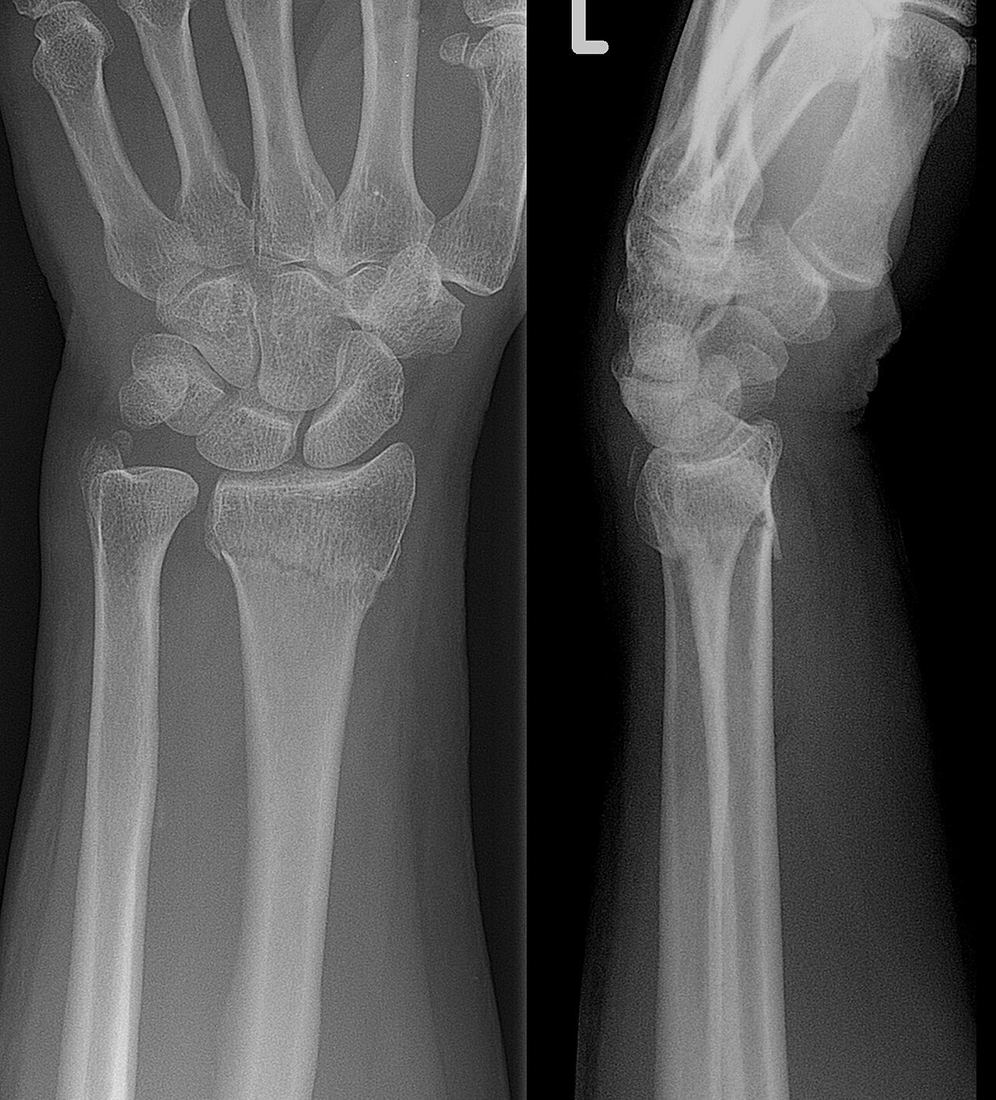
Anesthesia for reduction
- Bier block (IV regional anesthesia): NICE suggests it for reducing dorsally displaced fractures in adults in the ED, performed by trained clinicians who need not be anesthetists.1
- Not nitrous oxide on its own.1
- Nerve blocks vs hematoma block: in a meta-analysis of 4 studies (538 adults), ultrasound-guided nerve blocks gave better pain relief after the block and more successful reductions (RR 1.47). Pain during the reduction, ED length of stay and the need for surgery did not differ.6
Cast or surgery?
| After reduction | Under 65 (or high demand) | 65 or older |
|---|---|---|
| Shortening > 3 mm, dorsal tilt > 10°, or step-off > 2 mm | More likely to benefit from surgery | Surgery did not improve patient-reported outcomes |
From the 2020 AAOS/ASSH guideline as its authors summarize it. They treat age as a stand-in for functional demand, so an active older adult may be managed like a younger one.2,3
- DRAFFT2 (500 adults, mean age 60, dorsally displaced fractures after manipulation): K-wires and a cast gave the same wrist score at 12 months as a moulded cast alone. But 13% of the cast group needed surgery for loss of position within 6 weeks, compared with 1 patient after K-wires.8
- Older adults: in a meta-analysis of 11 studies, a volar locking plate did not improve disability scores, complications or range of motion compared with nonoperative care, though grip strength and x-ray alignment were better.7
- Technique: NICE suggests manipulation and a cast for displaced fractures in adults. When surgery is needed, K-wires if the joint surface is intact or can be reduced closed, and open fixation if it can't.1
- Timing: operate within 72 hours for intra-articular fractures and within 7 days for extra-articular fractures. For re-displacement, operate within 72 hours of deciding to.1
Casting and fixation gave the same function at a year in DRAFFT2, yet 13% of casted patients needed later surgery.8 In older adults, plates improved grip strength and alignment but not disability scores.7 The AAOS authors recommend shared decision-making based on what the patient values, such as grip strength, cost or time in a cast.3
Children
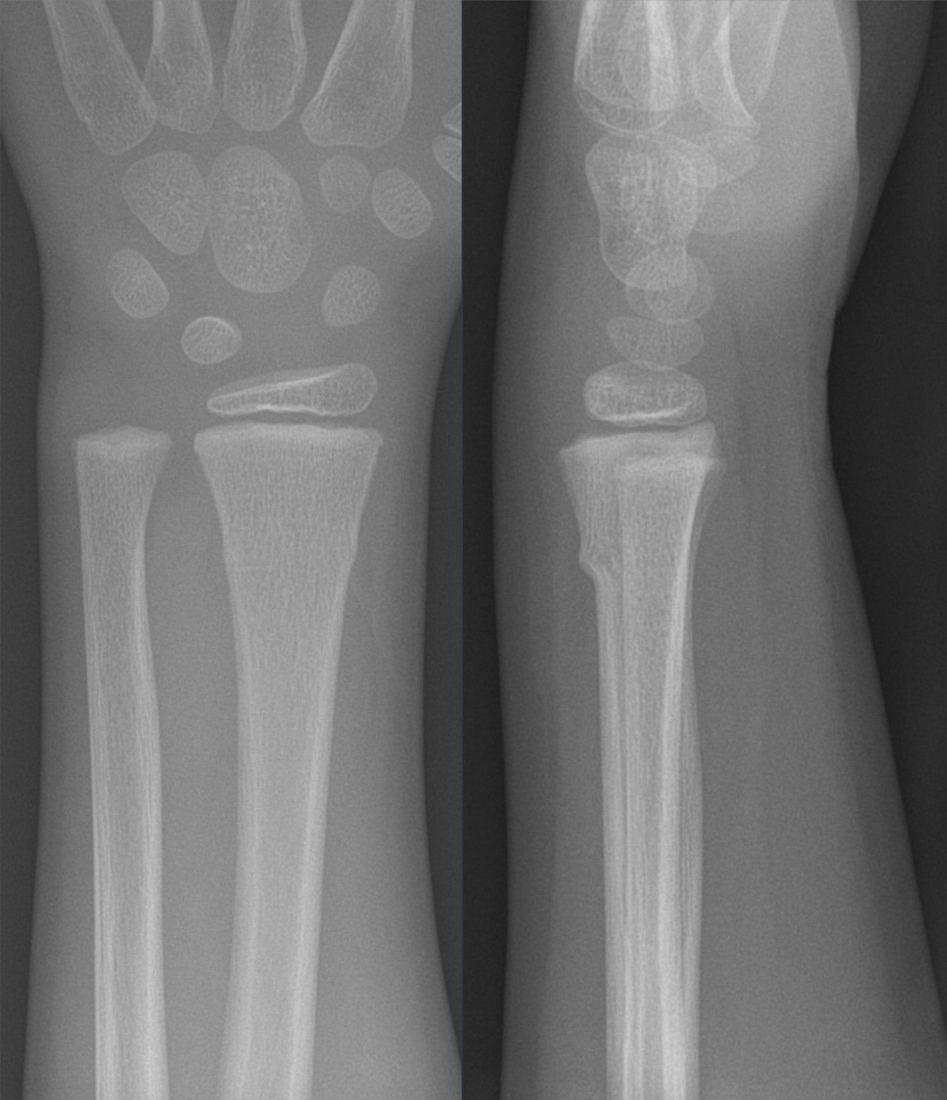
- Torus (buckle) fractures: don't use a rigid cast. Discharge after the first assessment and tell families that further review usually isn't needed.1
- FORCE trial: 965 children aged 4–15 at 23 UK hospitals were offered a soft bandage and immediate discharge, or rigid immobilization with follow-up. Pain at 3 days was equivalent (3.21 vs 3.14 on the Wong-Baker scale), with no differences over 6 weeks.4
- In practice: children with an associated ulnar buckle fracture were eligible; greenstick fractures were not. About 7% of the bandage group switched to a rigid splint.9
- Displaced fractures after manipulation, including growth plate fractures: a below-elbow cast, or K-wires if the fracture is completely displaced.1
Suspected scaphoid fracture
- NICE suggests MRI as the first-line test for a suspected scaphoid fracture after a thorough examination.1
- Why: early diagnosis lowers the risk of nonunion and avoids unnecessary casting, but first x-rays can't exclude a fracture.10
- SMaRT trial (patients with negative x-rays): immediate MRI in the ED was more accurate for scaphoid fractures (100% vs 93.8%) and found more other fractures (22.4% vs 7.7%). It cost less at 6 months.5
- Cochrane review: in patients with normal x-rays, MRI was 88% sensitive and 100% specific, and CT 72% sensitive and 99% specific. Only about 20% of suspected fractures were real.10
Disposition
Pitfalls
- Giving NSAIDs to frail older adults with fractures.1
- Reducing a displaced radius fracture with nitrous oxide alone.1
- Putting a child's buckle fracture in a rigid cast and booking a clinic visit.1,4
- Telling a patient with a suspected scaphoid fracture and normal x-rays that nothing is broken.1,10
- Assuming older adults need surgery for a poor x-ray result. Function may be no better.2,3,7
How strong is the evidence?
Buckle fracture care and cast-versus-wire decisions rest on large randomized trials.4,8 The AAOS guideline calls the evidence strong that surgery does not improve long-term patient-reported outcomes over 65.3 The scaphoid imaging evidence is limited by small studies and wide confidence intervals.10 The nerve block meta-analysis includes only 4 studies.6
On-shift teaching
Questions to ask a learner at the bedside. Tap a question to see the answer. Every answer uses facts cited above.
Q1Which post-reduction measurements suggest surgery in a patient under 65?
Q2What did DRAFFT2 find when comparing K-wires with a moulded cast?
Q3How should a 7-year-old's buckle fracture be managed?
Q4Which anesthetic does NICE suggest for reducing a displaced distal radius fracture, and which does it advise against?
Q5You suspect a scaphoid fracture, but the wrist x-rays are normal. What next?
Q6Which analgesic should you avoid in a frail 85-year-old with a wrist fracture?
References
What this page is built on
10 sources, cited 72 times. Dots are sources, filled by how far each was read; stronger color means a larger share of the citations. Tap a tier to see its sources.
Checked by the writer, not a physician. The dots show how each source was read, not that anyone has confirmed the claims.
- 1National Institute for Health and Care Excellence. Fractures (non-complex): assessment and management (NG38). February 2016.
- 2Shapiro LM, Kamal RN; Management of Distal Radius Fractures Work Group (AAOS/ASSH). Distal radius fracture clinical practice guidelines: updates and clinical implications. J Hand Surg Am. 2021;46(9):807–811.
- 3Kamal RN, Shapiro LM. Practical application of the 2020 distal radius fracture AAOS/ASSH clinical practice guideline: a clinical case. J Am Acad Orthop Surg. 2022;30(9):e714–e720.
- 4Perry DC, Achten J, Knight R, et al. Immobilisation of torus fractures of the wrist in children (FORCE): a randomised controlled equivalence trial in the UK. Lancet. 2022;400(10345):39–47.
- 5Rua T, Malhotra B, Vijayanathan S, et al. Clinical and cost implications of using immediate MRI in the management of patients with a suspected scaphoid fracture and negative radiographs: results from the SMaRT trial. Bone Joint J. 2019;101-B(8):984–994.
- 6Jones PNR, Araújo MR, Targueta MS, de Freitas NTM. Ultrasound-guided peripheral nerve blocks versus hematoma block for closed reduction of distal radius fractures in adults: a meta-analysis. J Orthop Sci. 2026;31(6):1356–1362.
- 7Li Q, Ke C, Han S, et al. Nonoperative treatment versus volar locking plate fixation for elderly patients with distal radial fracture: a systematic review and meta-analysis. J Orthop Surg Res. 2020;15(1):263.
- 8Costa ML, Achten J, Ooms A, et al. Surgical fixation with K-wires versus casting in adults with fracture of distal radius: DRAFFT2 multicentre randomised clinical trial. BMJ. 2022;376:e068041.
- 9Carley S. The FORCE study. St Emlyn's; July 10, 2022.
- 10Mallee WH, Wang J, Poolman RW, et al. Computed tomography versus magnetic resonance imaging versus bone scintigraphy for clinically suspected scaphoid fractures in patients with negative plain radiographs. Cochrane Database Syst Rev. 2015;(6):CD010023.
AI-generated draft. Not reviewed by a physician. This page is for education only and may contain errors, including in doses. Do not use it to diagnose, treat or make decisions about any patient. Rely on your own clinical judgment, your institution's protocols and current drug labeling. Reading this page does not create a physician-patient relationship. Full terms