


Urticaria and allergic reactions
Bottom line
- Acute urticaria means wheals, angioedema or both for 6 weeks or less. It usually settles on its own, so the guideline recommends against routine tests.1
- Hives plus breathing trouble, low blood pressure or severe GI symptoms is anaphylaxis. Give IM epinephrine, 0.01 mg/kg up to 0.5 mg. Antihistamines only ease the skin.2
- Treat plain hives with a second-generation antihistamine.1 In an ED trial, IV cetirizine relieved itch as well as IV diphenhydramine, with fewer adverse events and fewer return visits.3
- Steroids are optional, not routine. In a meta-analysis they helped about 1 in 7 patients who were unlikely to settle on antihistamines alone, and caused adverse events in about 1 in 9.4
- Swelling without hives suggests bradykinin: an ACE inhibitor or hereditary angioedema (HAE). Antihistamines and steroids do not work for it.5,6 Protect the airway, stop the ACE inhibitor, and treat HAE with its specific drugs.5,6
First steps
- Check the airway, breathing and blood pressure first. Look for tongue swelling, voice change, drooling and dyspnea; in ACE inhibitor angioedema these went with intubation.7
- Decide whether this is anaphylaxis (table below). If it is, give IM epinephrine before anything else.2
- Look at the skin. Wheals point to mast cells and histamine. Angioedema without wheals points to bradykinin.1,5
- Ask about ACE inhibitors, family history and past episodes, and about triggers: a recent infection, new drugs (including NSAIDs) and foods.5,6,1
- Plain hives: a second-generation antihistamine. No routine blood tests.1
- Swelling of the tongue or throat, or voice or breathing complaints: look at the larynx with a flexible scope if one is immediately available, and plan the airway early.5
- Skin or mucosal signs with breathing trouble, low blood pressure or severe GI symptoms? Or sudden hypotension, bronchospasm or laryngeal swelling after a likely allergen?
- NoAngioedema without wheals (especially on an ACE inhibitor), or known HAE?Yes: think bradykininTongue, throat, voice or breathing involved: scope the larynx if available and secure the airway early. Avoid extraglottic devices and blind nasal intubation.5,6Known HAE: IV C1 inhibitor 20 IU/kg, icatibant 30 mg SC, or sebetralstat 600 mg PO, as early as possible.6,8,9Lips, face or soft palate only: often home or observation. More than three sites: no outpatient care. Airway involvement or distress: ICU.5
- No: wheals, with or without swellingNo routine tests. Ask about recent infection, drugs (including NSAIDs) and foods.1
- Then
Recognize
- A wheal is a sharply outlined, raised swelling, almost always ringed by redness. It itches or burns and fades within 30 minutes to 24 hours.1
- Angioedema is a deeper swelling of the skin or mucosa. It tingles, burns or feels tight rather than itching, and can take up to 72 hours to resolve.1
- Acute urticaria lasts 6 weeks or less; beyond that it is chronic.1 Up to 20% of people have urticaria at some point in life.1
- Common triggers: a recent upper respiratory infection, drugs (IgE-mediated, such as penicillin, or non-IgE, such as NSAIDs), and food in sensitized patients.1
- No routine tests in acute spontaneous urticaria. Allergy testing helps only when food allergy or drug hypersensitivity is suspected.1
- Look-alikes: urticarial vasculitis, autoinflammatory syndromes, mastocytosis and bradykinin-mediated angioedema can all produce wheals or swelling.1
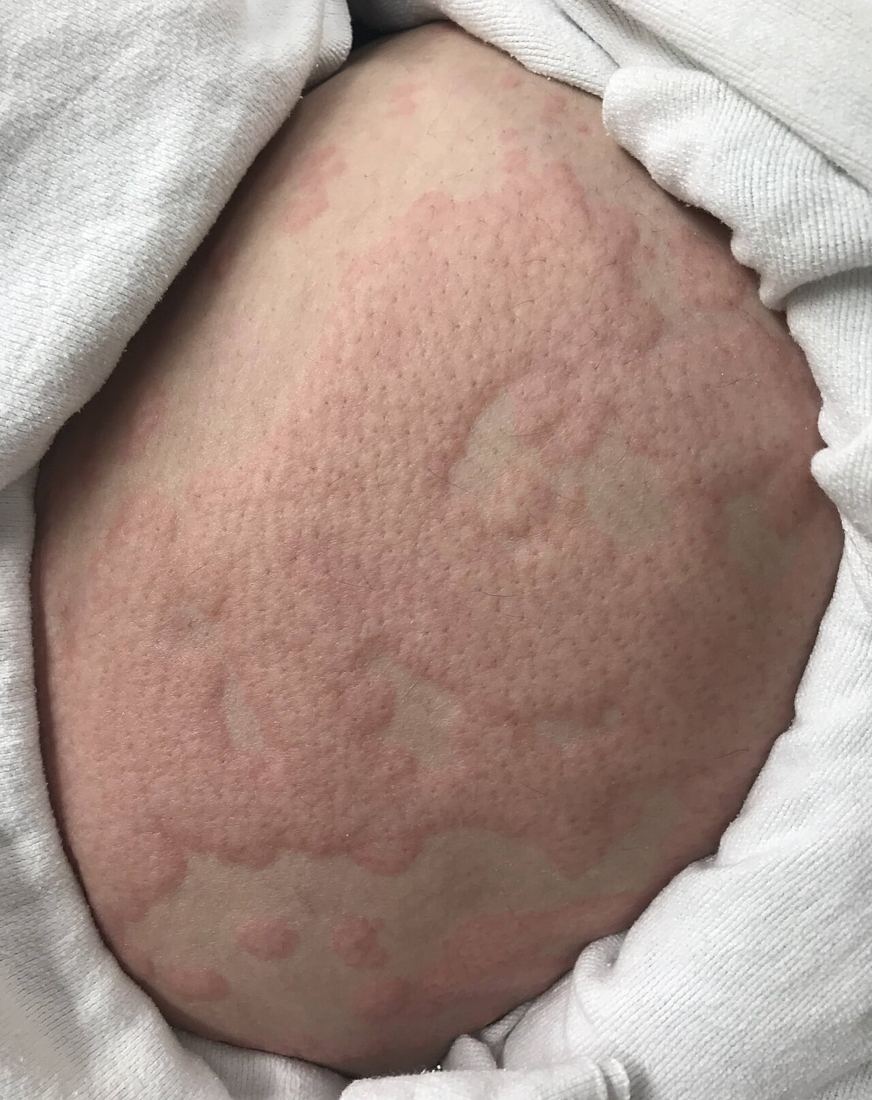
When is it anaphylaxis?
| WAO criterion | Findings |
|---|---|
| 1. Skin or mucosa, plus one more system | Sudden hives, itch, flushing or lip-tongue-uvula swelling and at least one of: breathing trouble, low blood pressure or end-organ signs (collapse, syncope, incontinence), or severe GI symptoms (especially after a non-food allergen) |
| 2. No skin signs needed | Sudden hypotension, bronchospasm or laryngeal involvement after exposure to a known or highly probable allergen for that patient |
Anaphylaxis is highly likely when either criterion is met.2 Management is on the Anaphylaxis page.
Treating hives
| Drug | Adult dose | Notes |
|---|---|---|
| Anaphylaxis | ||
| Epinephrine 1 mg/mL, IM thigh | 0.01 mg/kg, max 0.5 mg; repeat every 5–15 min if needed | First line in anaphylaxis, before anything else.2 |
| Hives | ||
| Cetirizine PO (second generation) | 10 mg once daily | First-line class for all urticaria. No single second-generation drug is preferred.1,10 |
| Cetirizine IV | 10 mg, once every 24 h as needed | Labeled for acute urticaria. Less sedating than IV diphenhydramine.11,3 |
| Prednisone (optional) | 20–50 mg/day, no more than 10 days | Possible benefit in severe or refractory cases; more adverse events.1,4 |
| First-generation antihistamines (diphenhydramine, hydroxyzine) | Dose per label | Sedating and anticholinergic. Not recommended as routine first line. Rapid IV chlorphenamine can cause hypotension.1,2 |
| H2 blocker add-on | Dose per label | Small ED trial benefit for hives at 2 hours; no guideline recommendation either way.14,1 |
Unreviewed doses. Verify against the current label and your institution's protocol before giving anything.
For chronic urticaria not controlled at the standard dose, the guideline recommends raising one second-generation antihistamine up to fourfold, off-label, rather than mixing several.1
IV antihistamines
In 262 ED and urgent care patients, IV cetirizine 10 mg was noninferior to IV diphenhydramine 50 mg for itch at 2 hours. It also shortened the stay (1.7 vs 2.1 hours), halved return visits (5.5% vs 14.1%), and caused fewer adverse events (3.9% vs 13.3%).3
Steroids: what the trials show
- Pollack 1995 (n = 43): adding prednisone 20 mg twice daily for 4 days to antihistamines lowered itch scores at 2 days (1.3 vs 4.4 on a 10-cm scale). Patients with angioedema or wheeze were excluded.15
- Barniol 2018 (n = 100): adding prednisone 40 mg daily for 4 days to levocetirizine did not help. Itch had gone at 2 days in 62% vs 76% on placebo, and relapses were similar (30% vs 24%).12
- Palungwachira 2021 (n = 75): IV dexamethasone added to IV chlorpheniramine did not improve itch at 60 minutes. Patients sent home on prednisolone had more active urticaria at 1 week and 1 month.16
- Meta-analysis, 12 trials (n = 944): add-on steroids improved urticaria activity (OR 2.17; NNT 7) when the chance of settling on antihistamines alone was low to moderate, but only NNT 45 when it was high. Adverse events rose (NNH 9; moderate certainty).4
The urticaria guideline says a course of up to 10 days may shorten acute urticaria, while noting good trials are lacking.1 A systematic review found that adding prednisone to an antihistamine did not help in two of three trials,17 and an ED trial of IV dexamethasone found no benefit.16 The meta-analysis found a modest benefit, mainly in patients unlikely to respond to antihistamines.4 Reserve steroids for severe or refractory hives.
H2 blockers
In 91 ED patients with acute allergic reactions, adding IV ranitidine to IV diphenhydramine cleared hives in more patients at 2 hours. It made no difference to angioedema or redness.14
Angioedema
| Feature | Histamine (mast cell) | Bradykinin |
|---|---|---|
| Wheals | Often present | Absent |
| Typical duration | 24–48 hours | 2–5 days |
| Causes | Drugs, foods, latex, insect stings; often idiopathic | ACE inhibitors, hereditary or acquired C1 inhibitor deficiency |
| Antihistamines and steroids | Work | Do not work |
From the emergency department angioedema consensus and the WAO HAE guideline.5,6 Wheals do not rule out HAE, and their absence does not rule out mast-cell angioedema.6,5 C4 and tryptase results come back too slowly to guide ED care.5
ACE inhibitor angioedema
- How common: about 0.1–0.7% of patients on ACE inhibitors.5 In a large US Veterans Affairs cohort, 0.20% of people starting one developed angioedema.18
- When: most often in the first 30 days, but the risk stays raised after more than a year of treatment.5 It can occur at any time during treatment.18
- Who: Black patients and patients on immunosuppressants are at higher risk;5 women and smokers too.18
- Where: the head and neck most often, mainly the lips and tongue.5
- Related drugs: angiotensin receptor blockers, gliptins and neprilysin inhibitors have also been linked to it, much less often.1 Reported cross-reactivity between ACE inhibitor and ARB angioedema is under 10%.18
The airway
- In 190 ED visits for ACE inhibitor angioedema, 9.5% were intubated. Intubation went with arrival within 6 hours of onset, anterior tongue swelling, voice change, drooling and dyspnea. Isolated lip swelling (54% of visits) went with not needing intubation.7
- Use a flexible scope, if immediately available, for any tongue involvement or upper airway complaint. Imaging adds delay and little else.5
- Oxygen, nasal trumpets and bag-mask ventilation only buy time; they do not replace intubation when the airway is threatened.5
- If a difficult airway is predicted, intubate awake rather than with paralysis. Never intubate blindly through the nose. Extraglottic devices are not appropriate rescue devices here. Mark the cricothyroid membrane before you start.5
Drugs for ACE inhibitor angioedema
- No drug is proven. Antihistamines and glucocorticoids have not been shown to work.18
- Icatibant: in a 27-patient trial, it resolved swelling faster than IV prednisolone plus clemastine (median 8 vs 27 hours).19 In a 121-patient placebo-controlled trial it made no difference: median time to discharge criteria was 4 hours in both arms.20,21 Pooled, the difference was not significant.22
- Fresh frozen plasma is, per the ED consensus, the only potential treatment readily available in most EDs. It carries risks of infection, allergic reaction and volume overload.5
- Stop all ACE inhibitors. The risk of another attack persists for weeks after stopping.5
Hereditary angioedema
- Suspect it with recurrent swelling of the skin, face, limbs or genitals, recurrent abdominal pain, or upper airway swelling, especially with a family history and no response to epinephrine, antihistamines or steroids.6
- Attacks worsen over 24 hours and subside over the next 48–72 hours. About half of patients have laryngeal swelling at least once.6
- Consider treating every attack, as early as possible. Upper airway swelling makes treatment mandatory.6
- Antihistamines, steroids and epinephrine are ineffective in bradykinin angioedema and can delay specific treatment.6
- Prepare the airway even after giving the drug. Consider intubation, cricothyrotomy or tracheotomy promptly when the upper airway is involved.6
- Let patients use their own medicine. Many carry their own on-demand drug and an action plan.5
| HAE attack drug | Adult dose | Notes |
|---|---|---|
| C1 inhibitor, plasma-derived (Berinert) | 20 IU/kg IV | First line. Do not give less than 20 IU/kg.6,9 |
| Icatibant | 30 mg SC (abdomen) | First line. Repeat after at least 6 h if needed; no more than 3 doses in 24 h.6,8 |
| Sebetralstat | 600 mg PO (two 300 mg tablets) | First line, oral.6 |
| Ecallantide | 30 mg SC | Second line; anaphylaxis risk, so give only under supervision.6 |
| Solvent detergent plasma or FFP | Volume per guideline | Third line, when nothing else is available.6 |
| Tranexamic acid | Not for attacks | No benefit as on-demand treatment.6 |
Unreviewed doses. Verify against the current label and your institution's protocol before giving anything.
When the cause of angioedema is unclear, the ED consensus advises starting with epinephrine, H1 and H2 blockers and steroids, and says epinephrine is not contraindicated in bradykinin angioedema.5 The 2025 WAO guideline says these drugs do not work in bradykinin angioedema and should not be used for HAE attacks, because they delay specific treatment.6
Disposition
- Hives that have settled: home on a daily second-generation antihistamine.1 Among 2,323 ED allergic reactions without anaphylaxis, 0.13% had a clinically important biphasic reaction; prolonged routine monitoring after symptoms resolve is likely unnecessary.13
- Suspected food or drug trigger: arrange allergy testing and teach avoidance.1
- Hives lasting more than 6 weeks: chronic urticaria, for follow-up.1
- Angioedema of the lips, face or soft palate only: often home or to an observation unit. More than three sites among lips, tongue, floor of mouth, soft palate, tongue base and larynx: not for outpatient care. Respiratory distress or airway intervention: ICU.5
- ACE inhibitor angioedema: in one center, 32 of 53 patients who improved in the ED went home after a median 4-hour stay; none of the 12 who worsened did, and only 1 of all 94 patients returned.23
- Before discharge with angioedema: stop the ACE inhibitor, arrange a replacement antihypertensive, and give an epinephrine autoinjector unless the patient has HAE treatment of their own.5 A first attack that did not respond to antihistamines or steroids, with a family history of angioedema, needs allergist follow-up, where a C4 level can be reviewed.5
Pitfalls
- Calling hives with wheeze or low blood pressure an "allergic reaction" and giving an antihistamine instead of epinephrine.2
- Treating ACE inhibitor angioedema as allergy and expecting antihistamines and steroids to work.18,5
- Ruling out the ACE inhibitor because the patient has taken it for years.5,18
- Being reassured by mild swelling early on. Arrival within 6 hours of onset, tongue swelling and voice change went with intubation.7
- Ordering routine blood tests for acute hives.1
- Sending patients home on a sedating first-generation antihistamine; they impair driving and complex tasks.1
How strong is the evidence?
Acute urticaria has only a few small randomized trials, and the state-of-the-art treatment remains unclear.17 The guideline's advice against routine tests is expert consensus.1 The steroid evidence is moderate certainty at best.4 Icatibant has not shown a clear benefit in ACE inhibitor angioedema,22 and most of the ED consensus airway and disposition statements carry low evidence grades (C or D).5 The HAE drugs carry strong recommendations.6
On-shift teaching
Questions to ask a learner at the bedside. Tap a question to see the answer. Every answer uses facts cited above.
Q1What three features define a wheal?
Q2A patient with hives after a bee sting now feels faint and has a systolic pressure of 80. Is this still urticaria?
Q3Why might you choose IV cetirizine over IV diphenhydramine?
Q4Should every patient with acute hives get prednisone?
Q5A patient has taken lisinopril for 4 years and now has a swollen tongue. Why not blame something else?
References
What this page is built on
24 sources, cited 144 times. Dots are sources, filled by how far each was read; stronger color means a larger share of the citations. Tap a tier to see its sources.
Checked by the writer, not a physician. The dots show how each source was read, not that anyone has confirmed the claims.
- 1Zuberbier T, Ansari ZA, Abdul Latiff AH, et al. The international guideline for the definition, classification, diagnosis and management of urticaria. Allergy. 2026;81(8):2582–2632.
- 2Cardona V, Ansotegui IJ, Ebisawa M, et al. World Allergy Organization anaphylaxis guidance 2020. World Allergy Organ J. 2020;13(10):100472.
- 3Abella BS, Berger WE, Blaiss MS, et al. Intravenous cetirizine versus intravenous diphenhydramine for the treatment of acute urticaria: a phase III randomized controlled noninferiority trial. Ann Emerg Med. 2020;76(4):489–500.
- 4Chu X, Wang J, Ologundudu L, et al. Efficacy and safety of systemic corticosteroids for urticaria: a systematic review and meta-analysis of randomized clinical trials. J Allergy Clin Immunol Pract. 2024;12(7):1879–1889.e8.
- 5Moellman JJ, Bernstein JA, Lindsell C, et al. A consensus parameter for the evaluation and management of angioedema in the emergency department. Acad Emerg Med. 2014;21(4):469–484.
- 6Vázquez DO, Giavina-Bianchi P, Josviack D, et al. The 2025 WAO guidelines for the classification, diagnosis, and treatment of hereditary angioedema, with consideration of worldwide disparities. World Allergy Organ J. 2026;19(5):101335.
- 7Mudd PA, Hooker EA, Stolz U, et al. Emergency department evaluation of patients with angiotensin converting enzyme inhibitor associated angioedema. Am J Emerg Med. 2020;38(12):2596–2601.
- 8Firazyr (icatibant) injection. Prescribing information. Takeda Pharmaceuticals America.
- 9Berinert (C1 esterase inhibitor, human). Prescribing information. CSL Behring.
- 10Cetirizine hydrochloride tablets 10 mg (allergy). Drug Facts label.
- 11Quzyttir (cetirizine hydrochloride) injection for intravenous use. Prescribing information. Esteve Pharmaceuticals.
- 12Barniol C, Dehours E, Mallet J, et al. Levocetirizine and prednisone are not superior to levocetirizine alone for the treatment of acute urticaria: a randomized double-blind clinical trial. Ann Emerg Med. 2018;71(1):125–131.e1.
- 13Grunau BE, Li J, Yi TW, et al. Incidence of clinically important biphasic reactions in emergency department patients with allergic reactions or anaphylaxis. Ann Emerg Med. 2014;63(6):736–744.
- 14Lin RY, Curry A, Pesola GR, et al. Improved outcomes in patients with acute allergic syndromes who are treated with combined H1 and H2 antagonists. Ann Emerg Med. 2000;36(5):462–468.
- 15Pollack CV Jr, Romano TJ. Outpatient management of acute urticaria: the role of prednisone. Ann Emerg Med. 1995;26(5):547–551.
- 16Palungwachira P, Vilaisri K, Musikatavorn K, et al. A randomized controlled trial of adding intravenous corticosteroids to H1 antihistamines in patients with acute urticaria. Am J Emerg Med. 2021;42:192–197.
- 17Badloe FMS, Grosber M, Ring J, et al. Treatment of acute urticaria: a systematic review. J Eur Acad Dermatol Venereol. 2024;38(11):2082–2092.
- 18Brown T, Gonzalez J, Monteleone C. Angiotensin-converting enzyme inhibitor-induced angioedema: a review of the literature. J Clin Hypertens (Greenwich). 2017;19(12):1377–1382.
- 19Baş M, Greve J, Stelter K, et al. A randomized trial of icatibant in ACE-inhibitor-induced angioedema. N Engl J Med. 2015;372(5):418–425.
- 20Sinert R, Levy P, Bernstein JA, et al. Randomized trial of icatibant for angiotensin-converting enzyme inhibitor-induced upper airway angioedema (CAMEO). J Allergy Clin Immunol Pract. 2017;5(5):1402–1409.e3.
- 21Swaminathan A. Icatibant doesn't improve outcomes in ACE-I induced angioedema. REBEL EM; June 22, 2017.
- 22Jeon J, Lee YJ, Lee SY. Effect of icatibant on angiotensin-converting enzyme inhibitor-induced angioedema: a meta-analysis of randomized controlled trials. J Clin Pharm Ther. 2019;44(5):685–692.
- 23Briggs B, Cline D, Husain I. Disposition of emergency department patients presenting with angiotensin-converting enzyme inhibitor-induced angioedema. Int J Emerg Med. 2025;18(1):11.
- 24Farkas J. Angioedema. Internet Book of Critical Care, EMCrit. Further reading; not used for any claim above.
AI-generated draft. Not reviewed by a physician. This page is for education only and may contain errors, including in doses. Do not use it to diagnose, treat or make decisions about any patient. Rely on your own clinical judgment, your institution's protocols and current drug labeling. Reading this page does not create a physician-patient relationship. Full terms