

Toxic alcohol poisoning
Bottom line
- The alcohol is not the poison; its metabolites are. Ethylene glycol becomes glycolate and oxalate, causing acidosis and kidney injury. Methanol becomes formic acid, causing acidosis and blindness.1,2
- Start fomepizole on suspicion. A history of ingestion, an anion gap acidosis, a raised osmolal gap, visual symptoms or urine oxalate crystals are enough. Don't wait for a level.1
- A normal osmolal gap does not rule it out. The gap falls as the alcohol is metabolized, and it is a poor screening test at low values.2,3
- Dialysis is for severe poisoning: coma, seizures, kidney injury, severe acidosis, and for methanol, new vision loss. EXTRIP also sets level and anion gap thresholds.2,4
- Acidosis and coma predict death. In methanol poisoning, mortality was 84% with coma or seizures and 89% with an initial pH under 7.5
First steps
- Suspect it in any unexplained anion gap metabolic acidosis, kidney injury, neurologic depression or raised osmolal gap, even without a history.6
- Send a blood gas, electrolytes, BUN, creatinine, glucose, measured serum osmolality, ethanol, and methanol and ethylene glycol levels if your lab offers them.1,7 Get an ECG.1
- Give fomepizole now if the history or the labs suggest poisoning. Don't wait for a level.1
- Treat the acidosis and replace potassium and calcium as needed.1
- Call nephrology and your poison center early. A history of ingestion alone should prompt early contact and, if needed, transfer to a center that can dialyze.2
- No: treat as poisonedFomepizole 15 mg/kg IV over 30 minutes, then 10 mg/kg every 12 hours for 4 doses, then 15 mg/kg every 12 hours.1
- Coma, seizures, new vision loss, AKI, severe or persistent acidosis, or a level or anion gap above the EXTRIP threshold?
- No
- Recheck the blood gas, anion gap, creatinine and levels often. Stop fomepizole when the level is under 20 mg/dL and the patient has no symptoms and a normal pH.1
Recognize
| Methanol | Ethylene glycol | Isopropanol | |
|---|---|---|---|
| Found in | Windshield washer fluid, solvents, illicit spirits1,6 | Antifreeze, coolants, de-icers2 | Rubbing alcohol, cleaners6 |
| Toxic product | Formic acid1 | Glycolate (acidosis) and oxalate crystals (kidney and nerve injury)2 | Acetone; no acidosis6 |
| Early | Symptoms usually develop over 6–24 h, later if ethanol was also taken6 | Looks like ethanol: inebriation, ataxia2 | Deep CNS depression within 30 min; GI irritation6 |
| Later | Visual disturbance at 12–24 h, GI bleeding, pancreatitis, acidosis6 | Acidosis after 3–6 h, then coma, seizures, cranial nerve palsies and kidney injury2 | Osmolal gap without acidosis; ketosis6 |
| Antidote | Fomepizole1 | Fomepizole1 | None; supportive care6 |
- Methanol and the eye: visual disturbance occurs in 29–72% of cases, from blurring and photophobia to field loss and blindness.6
- Ethylene glycol and the kidney: acute kidney injury occurs in 30–70%. It usually lasts 7–10 days and most patients recover.2
- Ethanol delays both. Co-ingested ethanol slows metabolism to the toxic acids, so symptoms and acidosis can appear late.2,6
Labs
- Levels are the answer but rarely arrive in time. Ethylene glycol assays are seldom available locally fast enough to guide early decisions.2
- Anion gap and osmolal gap move in opposite directions. Early, the parent alcohol raises the osmolal gap. As it is metabolized, the osmolal gap falls and the anion gap rises.3
- The osmolal gap is a poor screening test. It can be normal, or even below zero, after a small ingestion or once the alcohol is metabolized, and many other conditions raise it.2
- But a high gap matters. In 131 patients tested for toxic alcohols, an osmolal gap threshold of 10 had a sensitivity of 0.85–0.90 for levels needing an antidote, with specificity only 0.22–0.50. It caught every patient who needed dialysis (sensitivity 1).7
- Many osmolality formulas exist. Use your lab's.2 Adjusting for ethanol with a coefficient of 1.25 improved specificity without losing sensitivity.7
- A high lactate may be glycolate. Glycolate can falsely raise the lactate on some analyzers.2,3
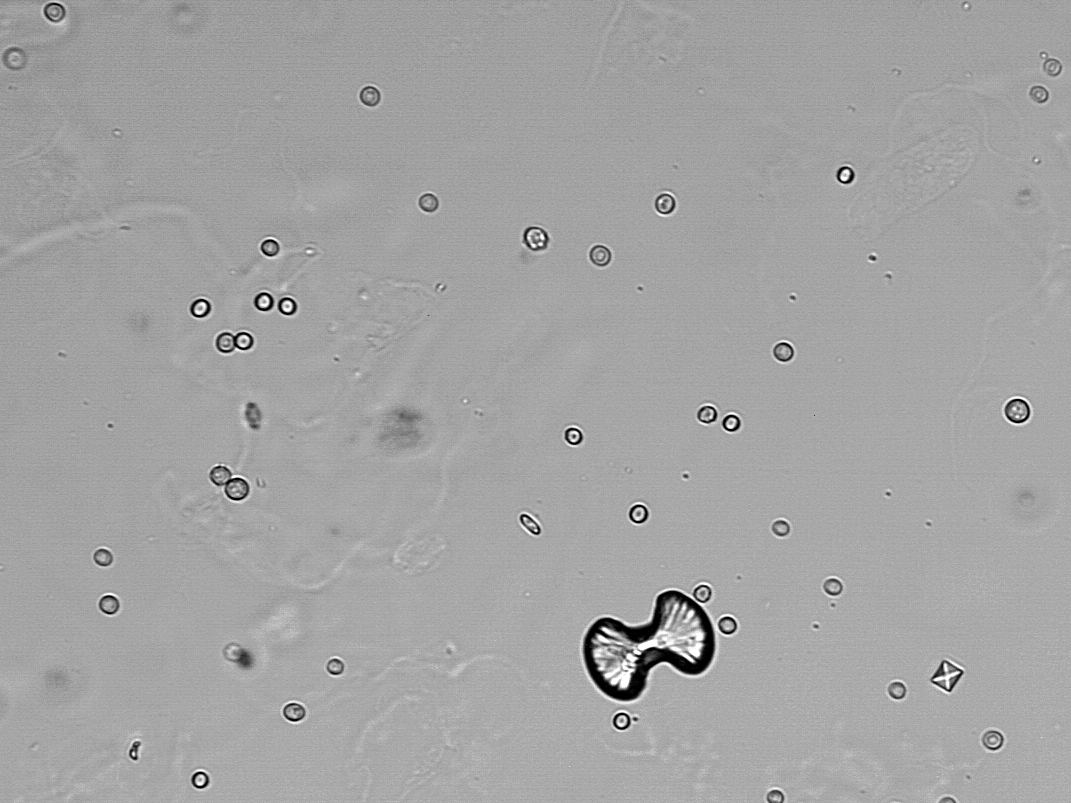
- Urine crystals appear about 4–8 hours after ethylene glycol ingestion. They are neither sensitive nor specific, and their absence rules nothing out.6
- Skip the Wood's lamp. Not all antifreeze contains fluorescein, and physicians detected it with a sensitivity of 35% and specificity of 75% in one study.6
- Units: ethylene glycol 20 mg/dL is 3.2 mmol/L.9 Methanol 50 mg/dL is 500 mg/L, or 15.6 mmol/L.4
Treatment
Start fomepizole immediately on suspicion: a history of ingestion, an anion gap metabolic acidosis, a raised osmolal gap, visual disturbances or urine oxalate crystals, or a documented methanol or ethylene glycol level over 20 mg/dL.1
| Step | Adult dose | Notes |
|---|---|---|
| Fomepizole (FDA label) | ||
| Loading | 15 mg/kg IV | Dilute in at least 100 mL saline or D5W; infuse over 30 min. Never undiluted or as a bolus.1 |
| Maintenance | 10 mg/kg IV every 12 h for 4 doses, then 15 mg/kg every 12 h | Fomepizole induces its own metabolism after about 30–40 h of dosing.1 |
| During hemodialysis | Same dose every 4 h | Fomepizole is dialyzable. The label gives timing rules for the start and end of each session.1 |
| Stop | — | When the level is undetectable or under 20 mg/dL, and the patient has no symptoms and a normal pH.1 |
| Alternatives and adjuncts | ||
| Ethanol | Per toxicology advice | Blocks the same enzyme when fomepizole is unavailable.6 Blockade is less predictable.2 |
| Folic or folinic acid (methanol) | Dose per institutional protocol | Speeds conversion of formic acid; consider in all methanol poisoning.6 No mortality or visual benefit was shown in one outbreak.10 |
| Thiamine and pyridoxine (ethylene glycol) | Dose per institutional protocol | Used to divert metabolism away from oxalate; clinical benefit never shown.2 |
Unreviewed doses. Verify against the current label and your institution's protocol before giving anything.
- Supportive care: fluids and sodium bicarbonate for acidosis, with potassium, calcium and oxygen usually needed.1 In methanol poisoning, correcting acidosis also helps the kidneys clear formate.6
- Avoid polycarbonate syringes and needles when drawing up fomepizole; it degrades them. It solidifies below 25 °C; warm the vial to liquefy it.1
- Activated charcoal and lavage add little. Both alcohols are absorbed within about 30 minutes.6
- Common side effects of fomepizole are headache (14%), nausea (11%), and dizziness, drowsiness and a metallic taste (6% each).1
What the evidence shows
- Ethylene glycol (n = 19): with fomepizole, acid–base status normalized within hours. None of the 10 patients with a normal creatinine at enrollment developed kidney injury. One patient with extreme acidosis died.9
- Methanol (n = 11): formic acid fell and acidosis resolved in all patients. Nine survived, and no survivor had a lasting visual deficit. The two deaths had anoxic brain injury on arrival.11
- Fomepizole vs ethanol (Czech outbreak, n = 100): survival did not differ, even in closely matched groups. Ethanol is generally linked to more complications, but the authors found no difference in effectiveness.8
- Neither trial had a control group, and dialysis and ethanol confounded many results.1
Dialysis
Any one indication is enough.2 Dialysis removes the alcohol and its acids and corrects the acidosis. Without acidosis or kidney injury, its main benefit is a shorter, cheaper admission.2
| Indication | Ethylene glycol (EXTRIP 2023) | Methanol (EXTRIP 2015) |
|---|---|---|
| Clinical | ||
| Coma or seizures | Recommended2 | Indicated4 |
| New vision deficit | — | Indicated4 |
| Kidney | AKI stage 2–3: recommended. CKD with eGFR < 45: suggested2 | Impaired kidney function4 |
| Acid–base | ||
| Acidosis | Anion gap > 27: recommended. 23–27: suggested2 | pH ≤ 7.15, anion gap > 24, or acidosis persisting despite antidotes4 |
| Glycolate | > 12 mmol/L: recommended. 8–12: suggested2 | — |
| Level | ||
| On fomepizole | > 310 mg/dL: suggested2 | > 70 mg/dL (700 mg/L)4 |
| On ethanol | > 310 mg/dL: recommended. 124–310: suggested2 | > 60 mg/dL (600 mg/L)4 |
| No antidote | > 62 mg/dL: recommended2 | > 50 mg/dL (500 mg/L)4 |
| Reported dose alone | Not an indication2 | — |
| Stopping | ||
| Stop when | Anion gap < 18 and acid–base corrected; level < 25 mg/dL2 | Level < 20 mg/dL (200 mg/L) and clinically improving4 |
EXTRIP uses the anion gap with potassium (Na + K − Cl − HCO₃).2 When a level is not available, the osmolal gap can stand in: for ethylene glycol, the same numbers as the mmol/L level thresholds (over 50 on fomepizole; over 10 with no antidote).2,4 All EXTRIP recommendations rest on very low quality evidence.2
- Modality: intermittent hemodialysis first; continuous therapy if hemodialysis is not available.2,4 Continuous therapy raises intracranial pressure less in a patient with marked brain edema.2
- Keep the antidote going during dialysis, at increased frequency.1,4
- Methanol: avoid systemic anticoagulation of the circuit; it may cause or worsen intracerebral hemorrhage.4
When a high level alone needs dialysis. The fomepizole label says to consider dialysis at a level of 50 mg/dL or more.1 EXTRIP suggests it for ethylene glycol on fomepizole only above 310 mg/dL, because patients without kidney injury or acidosis do well on fomepizole alone.2 Methanol thresholds sit in between.4
Isopropanol
- About twice as intoxicating as ethanol. It is converted to acetone, itself a sedative, so expect a raised osmolal gap and ketosis without acidosis.6
- Acidosis does not exclude it. Hypotension from a large ingestion can cause lactic acidosis.6
- Supportive care, including airway, fluids and control of GI bleeding. No antidote is needed. Consider dialysis for a level over 200 mg/dL with coma or hypotension.6
Prognosis and disposition
- Methanol, Toronto (n = 50): 36% died. Mortality was 84% with coma or seizures vs 6% without, and 89% with an initial pH under 7 vs 3%. Survivors with lasting visual damage had longer acidosis.5
- Methanol, Czech outbreak (n = 121): hospital mortality 21% and overall 34%. Only pH under 7.0, a negative serum ethanol and coma independently predicted death. Twenty survivors had visual or CNS sequelae.10
- Ethylene glycol: mortality has fallen below 10% with antidotes and dialysis. Death is rare without kidney injury.2
- ICU for acidosis or organ injury, such as kidney failure or visual loss.3
- Clearing a patient: a level under 20 mg/dL without organ dysfunction or instability. Without a level, consider it only with low suspicion, normal anion and osmolal gaps, a normal pH, and improvement over several hours of observation.3
- Transfer if dialysis or fomepizole is not readily available.3,2
Pitfalls
- Waiting for a toxic alcohol level before giving fomepizole.1
- Ruling out ethylene glycol or methanol because the osmolal gap is normal.2
- Being reassured by a well patient who also drank ethanol. Ethanol delays the acidosis.2,6
- Calling an unexplained high lactate "lactic acidosis" when it may be glycolate.2
- Forgetting to give fomepizole every 4 hours during dialysis.1
- Ordering dialysis on the reported dose of ethylene glycol alone.2
- Anticoagulating the dialysis circuit systemically in methanol poisoning.4
How strong is the evidence?
Weak, as in most poisoning. Fomepizole's approval rests on two small uncontrolled US trials.1,9,11 Every EXTRIP recommendation for ethylene glycol is graded very low quality, because there are no reliable comparative studies.2 The methanol review noted publication and selection bias in its 272 sources.4 The best comparison of fomepizole with ethanol comes from an outbreak, not a randomized trial.8
On-shift teaching
Questions to ask a learner at the bedside. Tap a question to see the answer. Every answer uses facts cited above.
Q1Why can a patient with serious ethylene glycol poisoning have a normal osmolal gap?
Q2What is enough to start fomepizole?
Q3How is fomepizole dosed, and what changes during dialysis?
Q4An ethylene glycol patient on fomepizole has a level of 150 mg/dL, a normal creatinine and no acidosis. Is dialysis needed?
Q5Which findings predicted death in methanol poisoning?
Q6The blood gas shows a lactate of 12 in a patient who drank antifreeze. Why be careful?
References
What this page is built on
11 sources, cited 148 times. Dots are sources, filled by how far each was read; stronger color means a larger share of the citations. Tap a tier to see its sources.
Checked by the writer, not a physician. The dots show how each source was read, not that anyone has confirmed the claims.
- 1Fomepizole injection prescribing information. Zydus Pharmaceuticals USA Inc. DailyMed; revised December 2024.
- 2Ghannoum M, Gosselin S, Hoffman RS, et al.; EXTRIP Workgroup. Extracorporeal treatment for ethylene glycol poisoning: systematic review and recommendations from the EXTRIP workgroup. Crit Care. 2023;27(1):56.
- 3Burns E. Toxic alcohol ingestion. Life in the Fast Lane; 2019.
- 4Roberts DM, Yates C, Megarbane B, et al.; EXTRIP Work Group. Recommendations for the role of extracorporeal treatments in the management of acute methanol poisoning: a systematic review and consensus statement. Crit Care Med. 2015;43(2):461–472.
- 5Liu JJ, Daya MR, Carrasquillo O, Kales SN. Prognostic factors in patients with methanol poisoning. J Toxicol Clin Toxicol. 1998;36(3):175–181.
- 6Gallagher N, Edwards FJ. The diagnosis and management of toxic alcohol poisoning in the emergency department: a review article. Adv J Emerg Med. 2019;3(3):e28.
- 7Lynd LD, Richardson KJ, Purssell RA, et al. An evaluation of the osmole gap as a screening test for toxic alcohol poisoning. BMC Emerg Med. 2008;8:5.
- 8Zakharov S, Pelclova D, Navratil T, et al. Fomepizole versus ethanol in the treatment of acute methanol poisoning: comparison of clinical effectiveness in a mass poisoning outbreak. Clin Toxicol (Phila). 2015;53(8):797–806.
- 9Brent J, McMartin K, Phillips S, et al.; Methylpyrazole for Toxic Alcohols Study Group. Fomepizole for the treatment of ethylene glycol poisoning. N Engl J Med. 1999;340(11):832–838.
- 10Zakharov S, Pelclova D, Urban P, et al. Czech mass methanol outbreak 2012: epidemiology, challenges and clinical features. Clin Toxicol (Phila). 2014;52(10):1013–1024.
- 11Brent J, McMartin K, Phillips S, Aaron C, Kulig K; Methylpyrazole for Toxic Alcohols Study Group. Fomepizole for the treatment of methanol poisoning. N Engl J Med. 2001;344(6):424–429.
AI-generated draft. Not reviewed by a physician. This page is for education only and may contain errors, including in doses. Do not use it to diagnose, treat or make decisions about any patient. Rely on your own clinical judgment, your institution's protocols and current drug labeling. Reading this page does not create a physician-patient relationship. Full terms