
Supraventricular tachycardia
Bottom line
- Start with a modified Valsalva in a stable patient. Finishing the strain by lying flat with the legs raised converted 43% of patients, against 17% with the standard strain.1,2
- Adenosine next: 6 mg as a rapid push, then 12 mg. Push it fast, as close to the patient as possible on the line, and chase it with a rapid saline flush.3,1
- IV diltiazem or verapamil works about as well as adenosine (sinus rhythm in 92.9% vs 89.7%). Avoid them with hypotension, an EF under 40%, suspected VT or pre-excited AF.4,1
- Unstable means synchronized cardioversion. Fast, irregular, wide and bizarre (pre-excited AF) means no adenosine, calcium channel blocker, beta-blocker or digoxin.1
- Most patients go home once converted. After prompt conversion and a short stay, 4% of discharged patients had a recurrence, all within 24 hours, and none were unstable.5
First minutes
- Monitor, get IV access and a 12-lead ECG. Keep a defibrillator ready: adenosine can trigger fast AF, which can degenerate into VF when an accessory pathway is present.1
- Check stability. Hypotension, altered mental status, chest pain, acute heart failure or shock call for synchronized cardioversion.1
- Read the rhythm. Regular and narrow points to AVNRT, AVRT or atrial tachycardia. Wide and regular should be treated as VT until proven otherwise.1
- Stable and regular: modified Valsalva. Strain against about 40 mm Hg for 15 seconds, sitting semi-recumbent, then lie the patient flat and raise the legs.2,6
- Still in SVT: adenosine, 6 mg then 12 mg as rapid pushes with a flush.3,1
- Still in SVT, or adenosine unsuitable: slow IV diltiazem or verapamil, or a beta-blocker.1,7
- Monitor, defibrillator ready, 12-lead ECG. Wide and regular is VT until proven otherwise.1
- Hypotension, altered mental status, chest pain, heart failure or shock?YesSynchronized cardioversion.1
- No, stable
- No, regular
- Adenosine 6 mg rapid IV push with a fast flush. If still in SVT after 1–2 min, 12 mg.3
- Still in SVT, or adenosine unsuitable (severe asthma)?
- Converted
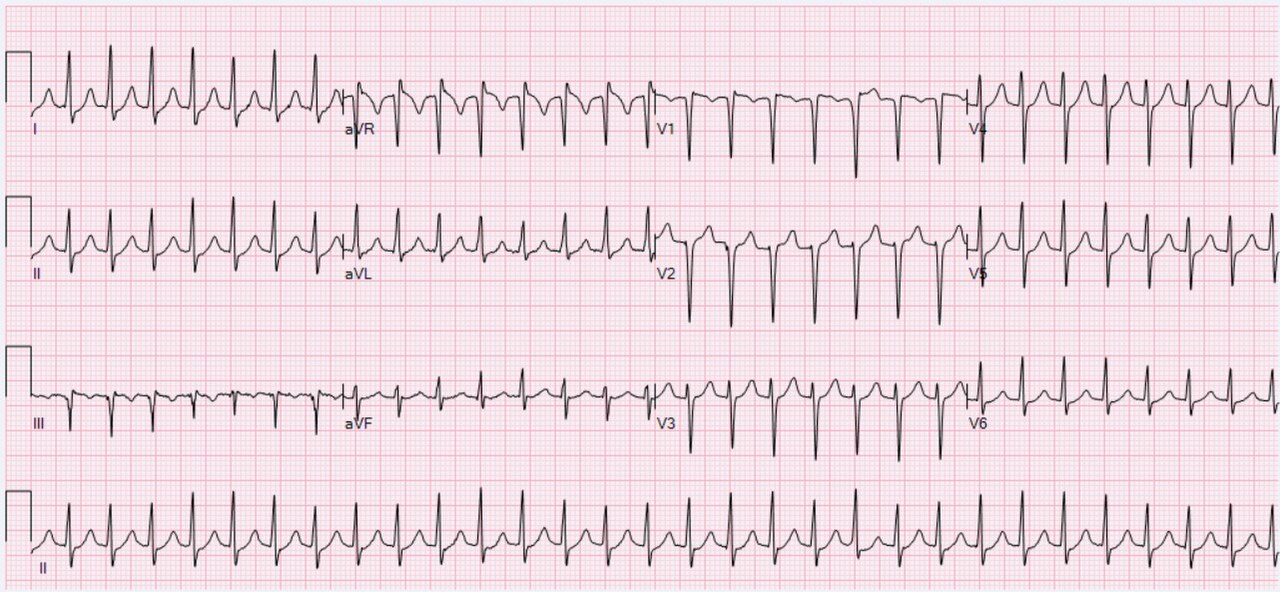
On the ECG
- AVNRT is regular and narrow, roughly 140–280/min. P waves are often buried in the QRS. When seen, they are inverted in II, III and aVF.11
- Clues to typical AVNRT: a pseudo-R′ in V1–V2 and a pseudo-S wave in the inferior leads.11
- Rate-related ST depression is common. Suspect ischemia only if it persists after conversion.11
- Adenosine as a diagnostic test: it does not convert atrial flutter, AF or VT, though it may briefly slow the ventricular rate.3 It does not interrupt macro-re-entrant atrial tachycardias.1
- Look for pre-excitation (short PR, delta wave) once the patient is in sinus rhythm. See the LITFL pre-excitation library.12
Vagal maneuvers
- Standard vagal maneuvers work in 19–54% of patients.1
- REVERT (433 enrolled, 214 per group, English EDs): the modified maneuver restored sinus rhythm at 1 minute in 43% vs 17% (adjusted OR 3.7). No serious adverse events were recorded.2
- Pooled trials (5 RCTs, 1,181 adults) agree: modified vs standard Valsalva, OR 4.36 for conversion, with less medication use and no significant difference in adverse events.13
- No manometer? Have the patient blow into a 10 mL syringe hard enough to move the plunger.1,6
- Carotid sinus massage: one side only, for no more than 5 seconds. Avoid it after a TIA or stroke, or with a carotid bruit.1
REVERT excluded AF and flutter and patients with a systolic pressure under 90 mm Hg, and clinicians knew which maneuver was used.6
Drugs
| Agent | Adult dose | Notes |
|---|---|---|
| First line after vagal maneuvers | ||
| Adenosine | 6 mg rapid IV bolus over 1–2 s. If SVT persists after 1–2 min, 12 mg; the 12 mg dose may be repeated once | Push close to the patient with a rapid saline flush. Flushing (18%) and dyspnea (12%) are common and brief.3 |
| Alternatives | ||
| Diltiazem | 0.25 mg/kg (about 20 mg) IV over 2 min. If inadequate at 15 min, 0.35 mg/kg (about 25 mg) | Contraindicated with severe hypotension, IV beta-blockers, VT, or AF/flutter with an accessory pathway.8 |
| Verapamil | 5–10 mg (0.075–0.15 mg/kg) IV over at least 2 min (3 min if older). May repeat 10 mg at 30 min | Avoid with hypotension, EF < 40%, suspected VT or pre-excited AF.9,1 |
| Metoprolol | 2.5–15 mg IV, given in 2.5 mg boluses | Not in decompensated heart failure.1 |
| Avoid | ||
| IV calcium channel blocker plus IV beta-blocker | Do not combine | Serious reactions reported with IV verapamil; contraindicated on the diltiazem label.9,8 |
Unreviewed doses. Verify against the current label and your institution's protocol before giving anything.
- Adenosine vs calcium channel blockers: 7 ED trials (622 patients) found no difference in conversion (89.7% vs 92.9%). Hypotension was rare: one case, in the calcium channel blocker group.4
- Slow infusions in 206 ED patients: verapamil 1 mg/min (to 20 mg) or diltiazem 2.5 mg/min (to 50 mg) converted 98%, against 86.5% with adenosine 6 then 12 mg. One patient became hypotensive.7
- Interactions: caffeine and theophylline blunt adenosine, so larger doses may be needed. Dipyridamole strengthens it, so smaller doses may work. Carbamazepine can deepen the heart block.3
- Contraindications to adenosine: second- or third-degree AV block or sinus node disease without a working pacemaker. Do not give more if one dose causes high-grade block.3
Unstable patients and pre-excitation
- Synchronized cardioversion for a tachycardia causing hypotension, altered mental status, chest pain, acute heart failure or shock.1 For SVT, start at 70–120 J and step up if needed. The UK algorithm also shocks stable patients when vagal maneuvers, adenosine and a second drug have failed.10
- Pre-excited AF looks fast, irregular and wide. AV nodal blockers (adenosine, verapamil, diltiazem, beta-blockers, digoxin) may raise the risk of VF, so avoid them.1
- Its treatment: urgent electrical cardioversion has a low threshold. Ibutilide or procainamide are drug options. The guideline says IV amiodarone should not be considered, and procainamide appears safer.1
- Adenosine with known pre-excitation can trigger AF with rapid conduction. Use it with caution in AVRT, with a defibrillator ready.1
Pregnancy
- Electrical cardioversion is first choice when SVT is unstable, and is considered safe in every trimester.1
- If vagal maneuvers fail, adenosine is the first drug in the second and third trimesters. Data in the first trimester are scarce; avoid antiarrhythmics then if possible.1
- Diltiazem is generally not recommended; verapamil is a second-line option.1
Disposition
- Discharge after prompt conversion and a short observation suits most patients. In one ED series, 71% went home after a mean stay of 3.8 hours; 4% of them had a recurrence, all within 24 hours, and none were unstable.5
- Recurrence was more likely in older patients and those with cardiovascular disease.5
- Refer for catheter ablation when episodes are symptomatic and recurrent. For AVNRT it succeeds in about 97%, and AV block is now rare in experienced centres. Patients with minimal, infrequent symptoms can be followed instead.1
- Teach the modified Valsalva to patients for future episodes.2
Pitfalls
- Giving adenosine slowly or into a distant port. It must be a rapid push, as close to the patient as possible, with a fast flush.3
- Giving verapamil or diltiazem for a wide-complex tachycardia that might be VT. It can cause severe deterioration.1
- Giving any AV nodal blocker for fast, irregular, wide pre-excited AF.1
- Stacking an IV beta-blocker on an IV calcium channel blocker.9,8
- Calling rate-related ST depression ischemia before repeating the ECG in sinus rhythm.11
- Skipping the post-conversion ECG and missing a delta wave.1,12
How strong is the evidence?
The modified Valsalva rests on one large randomized trial and a meta-analysis of five trials, none blinded.2,13 The adenosine vs calcium channel blocker comparison is moderate-quality for conversion and low-quality for harms.4 Disposition data come from a single retrospective ED series.5 The ESC guideline's recommendation classes appear in its tables, which were not machine-readable here, so this page does not quote them.1 The 2015 US guideline's full text could not be read.14
On-shift teaching
Questions to ask a learner at the bedside. Tap a question to see the answer. Every answer uses facts cited above.
Q1What is the modified part of the modified Valsalva, and how much does it help?
Q2Where and how should adenosine go in?
Q3Your patient drinks a lot of coffee and takes theophylline. How might adenosine behave?
Q4Is adenosine better than diltiazem or verapamil?
Q5The rhythm is fast, irregular and wide, with varying QRS shapes. What do you avoid, and what do you do?
References
What this page is built on
14 sources, cited 91 times. Dots are sources, filled by how far each was read; stronger color means a larger share of the citations. Tap a tier to see its sources.
Checked by the writer, not a physician. The dots show how each source was read, not that anyone has confirmed the claims.
- 1Brugada J, Katritsis DG, Arbelo E, et al. 2019 ESC Guidelines for the management of patients with supraventricular tachycardia. Eur Heart J. 2020;41(5):655–720.
- 2Appelboam A, Reuben A, Mann C, et al. Postural modification to the standard Valsalva manoeuvre for emergency treatment of supraventricular tachycardias (REVERT): a randomised controlled trial. Lancet. 2015;386(10005):1747–1753.
- 3Adenosine injection, for rapid bolus intravenous use. FDA prescribing information (Henry Schein). DailyMed.
- 4Alabed S, Sabouni A, Providencia R, et al. Adenosine versus intravenous calcium channel antagonists for supraventricular tachycardia. Cochrane Database Syst Rev. 2017;10:CD005154.
- 5Luber S, Brady WJ, Joyce T, Perron AD. Paroxysmal supraventricular tachycardia: outcome after ED care. Am J Emerg Med. 2001;19(1):40–42.
- 6REBEL EM. The REVERT trial: a modified Valsalva maneuver to convert SVT.
- 7Lim SH, Anantharaman V, Teo WS, Chan YH. Slow infusion of calcium channel blockers compared with intravenous adenosine in the emergency treatment of supraventricular tachycardia. Resuscitation. 2009;80(5):523–528.
- 8Diltiazem hydrochloride in sodium chloride injection. FDA prescribing information (WG Critical Care). DailyMed.
- 9Verapamil hydrochloride injection. FDA prescribing information (Henry Schein). DailyMed.
- 10Resuscitation Council UK. Adult advanced life support guidelines (2025 Resuscitation Guidelines, adapted from the ERC 2025 guidelines), published October 27, 2025; and Adult tachyarrhythmia algorithm, updated March 2026.
- 11Life in the Fast Lane. Supraventricular tachycardia (SVT). ECG library.
- 12Life in the Fast Lane. Pre-excitation syndromes. ECG library.
- 13Lodewyckx E, Bergs J. Effectiveness of the modified Valsalva manoeuvre in adults with supraventricular tachycardia: a systematic review and meta-analysis. Eur J Emerg Med. 2021;28(6):432–439.
- 14Page RL, Joglar JA, Caldwell MA, et al. 2015 ACC/AHA/HRS Guideline for the Management of Adult Patients With Supraventricular Tachycardia: Executive Summary. Circulation. 2016;133(14):e471–e505.
AI-generated draft. Not reviewed by a physician. This page is for education only and may contain errors, including in doses. Do not use it to diagnose, treat or make decisions about any patient. Rely on your own clinical judgment, your institution's protocols and current drug labeling. Reading this page does not create a physician-patient relationship. Full terms