Rhabdomyolysis
Bottom line
- Rhabdomyolysis is muscle breakdown. Most studies define it as CK above 5 times the upper limit of normal.1,2 Muscle pain, weakness and dark urine are classic, but symptoms are often nonspecific.2
- Early IV crystalloid is the main treatment. Two guidelines favor fluids: EAST conditionally recommends aggressive IV fluids, and the Danish guideline suggests early fluids and crystalloid over colloid.3,4
- Skip routine bicarbonate and mannitol. Both guidelines advise against them (conditional or weak recommendations, low or very low certainty).3,4
- Risk depends on the cause and the labs, not CK alone. In the McMahon cohort, 2.3% of the lowest-risk patients died or needed dialysis, against 61.2% of the highest-risk.5
- Look for compartment syndrome and high potassium. Compartment syndrome must be found and released. Hyperkalemia is the electrolyte problem that needs rapid correction.3,1
Recognize
- Causes: exertion, heat or cold, ischemia, immobility, infection, drugs, toxins, trauma, and endocrine, autoimmune or genetic conditions.2
- Symptoms: muscle pain, weakness and dark urine, though nonspecific symptoms are more common.2 Patients may have little or no urine output.1
- Complications: kidney failure, electrolyte disturbances, liver injury, compartment syndrome and DIC.2
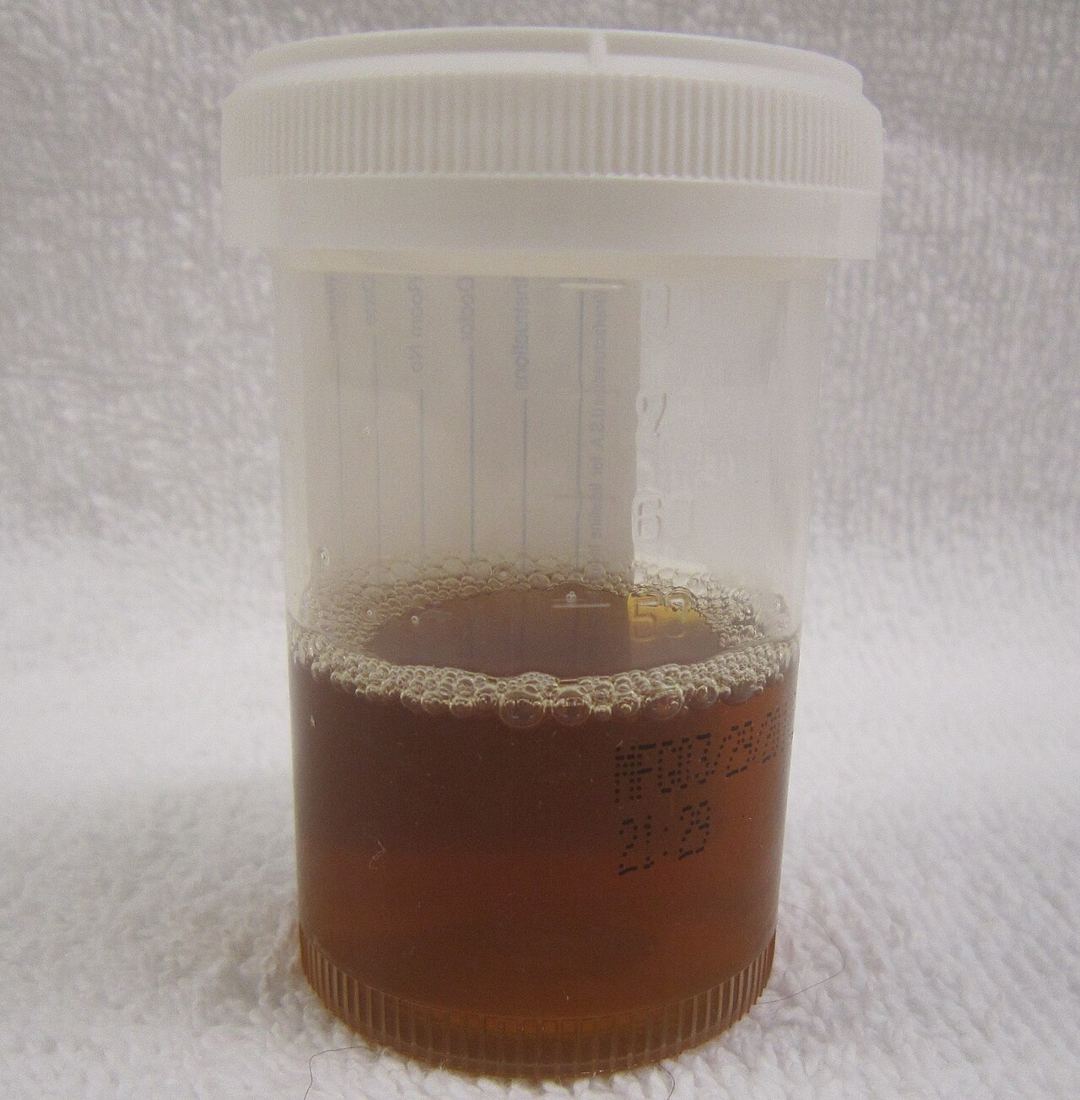
- Urine dipstick: the blood pad reacts to the heme in myoglobin and can't tell it from hemoglobin. A positive blood test with few red cells on microscopy suggests myoglobinuria.1
| Source | CK threshold for diagnosis |
|---|---|
| Most published studies | > 5 × upper limit of normal (often > 1,000 U/L)1 |
| ENMC workshop 2024, non-exertional | > 5,000 U/L, with muscle symptoms6 |
| ENMC workshop 2024, exertional | > 10,000 U/L, with muscle symptoms6 |
| Statin-associated | > 10 × upper limit of normal1 |
When CK peaks: within 3–5 days, back to baseline over the following 6–10 days, per a systematic review.1 An expert workshop puts the peak at 1–4 days, normalizing in 1–2 weeks of rest.6 In a UK ICU cohort, CK peaked by day 3 in 91% of cases.7 Either way, a single ED value may not be the peak.
First steps
- Check CK, creatinine, potassium, calcium, phosphate and bicarbonate. These, with age, sex and cause, predict dialysis or death.5
- Examine every limb for compartment syndrome. It must be found and released.3
- Treat hyperkalemia urgently.1
- Start IV crystalloid early.3,4
- Treat the cause: stop the offending drug, control temperature, treat infection.1
Who gets kidney failure?
The McMahon score was built from 2,371 inpatients with CK over 5,000. Its inputs are age, sex, cause, and the first creatinine, CK, phosphate, calcium and bicarbonate. It predicted dialysis or death well (C statistic 0.83 in validation).5
| Cause (McMahon cohort) | Dialysis or in-hospital death |
|---|---|
| After cardiac arrest | 58.5% |
| Compartment syndrome | 41.2% |
| Sepsis | 39.3% |
| Seizures | 6.0% |
| Exercise | 3.2% |
| Myositis | 1.7% |
Overall, 19% died or needed dialysis. Scores under 5 carried a 2.3% risk; scores over 10 carried 61.2%.5
- CK alone is a weak predictor. A peak CK of 5,000 or more was 83% sensitive but only 55% specific for needing dialysis, and is often a late finding. A McMahon score of 6 or more on admission did better (86% sensitive, 68% specific).7
- But very high CK matters in trauma. In 2,083 trauma ICU patients, kidney failure occurred in 19% with CK above 5,000 versus 8% below it.9
Treatment
| Intervention | Recommendation | Strength, certainty |
|---|---|---|
| Fluids | ||
| Early IV fluids | Early rather than late (DASAIM/DSIT) | Weak, very low4 |
| Fluid type | Crystalloid rather than colloid (DASAIM/DSIT) | Weak, low4 |
| Aggressive IV fluids | For, to reduce kidney failure and dialysis (EAST) | Conditional, very low3 |
| Not routinely | ||
| Sodium bicarbonate | Against (EAST; DASAIM/DSIT for routine use) | Conditional, very low; weak, low3,4 |
| Mannitol | Against (EAST; DASAIM/DSIT) | Conditional, very low; weak, very low3,4 |
| Loop diuretics | Against routine use (DASAIM/DSIT) | Weak, very low4 |
| Renal replacement therapy | Against routine use (DASAIM/DSIT) | Weak, low4 |
- How much fluid: neither guideline sets a volume in its summary.3,4 Reviews suggest starting within 6 hours of injury and aiming for urine output around 300 mL/h.1,2 Watch closely for fluid overload and metabolic acidosis.1
- Bicarbonate and mannitol: in trauma ICU patients with CK above 5,000, the combination did not change kidney failure, dialysis or mortality.9 No randomized trial has compared fluids alone with fluids plus either drug.1
- Mannitol in anuria: avoid it.1
Who needs treatment: EAST conditionally recommends aggressive IV fluids for patients with rhabdomyolysis.3 The 2024 ENMC expert workshop says to treat only patients at high risk of kidney injury, as predicted by the McMahon score.6
Electrolytes
- Hyperkalemia is the only electrolyte abnormality that needs rapid correction, because of the risk of arrhythmia.1
- Low calcium: avoid giving calcium just to correct it, because it may worsen muscle injury.1
- High phosphate: monitor phosphate and calcium together; high phosphate may promote calcium deposits in damaged muscle.1
Disposition
- Most patients are admitted, but some can go home.2
- ED data: of 400 ED patients with CK over 1,000, 35% went home from the ED. Within 30 days, 8% died or needed dialysis. None of the 257 patients with an initial eGFR above 60 needed dialysis.8
- Exertional cases had the lowest risk in the McMahon cohort (3.2%).5
- Follow-up: the ENMC workshop recommends follow-up for physical and psychological after-effects, and suggests genetic testing for selected patients.6
Pitfalls
- Missing compartment syndrome while focused on the CK.3
- Reading a positive blood dipstick as hematuria. The blood pad can't tell myoglobin from hemoglobin.1
- Ordering bicarbonate or mannitol by habit.3,4
- Giving calcium just to correct a low calcium.1
- Judging risk by CK alone. Cause, kidney function and the other labs matter more.5,7
- Discharging on a single CK that may still be rising.1,7
How strong is the evidence?
Low to very low. Both guidelines issued only conditional or weak recommendations, based mostly on retrospective studies.3,4 No randomized trial has compared fluids alone with fluids plus bicarbonate or mannitol.1 The guidelines' full texts were not openly accessible; their recommendations here come from their published abstracts.
On-shift teaching
Questions to ask a learner at the bedside. Tap a question to see the answer. Every answer uses facts cited above.
Q1Should you alkalinize the urine or give mannitol?
Q2The dipstick is strongly positive for blood, but microscopy shows few red cells. What does that suggest?
Q3Which causes of rhabdomyolysis carried the highest and lowest risk of dialysis or death?
Q4Calcium is low. Do you replace it?
Q5Why is CK a poor guide to kidney risk?
Q6Who might be safe to discharge?
References
What this page is built on
10 sources, cited 94 times. Dots are sources, filled by how far each was read; stronger color means a larger share of the citations. Tap a tier to see its sources.
Checked by the writer, not a physician. The dots show how each source was read, not that anyone has confirmed the claims.
- 1Chavez LO, Leon M, Einav S, Varon J. Beyond muscle destruction: a systematic review of rhabdomyolysis for clinical practice. Crit Care. 2016;20(1):135.
- 2Long B, Koyfman A, Gottlieb M. An evidence-based narrative review of the emergency department evaluation and management of rhabdomyolysis. Am J Emerg Med. 2019;37(3):518–523.
- 3Sawhney JS, Kasotakis G, Goldenberg A, et al. Management of rhabdomyolysis: a practice management guideline from the Eastern Association for the Surgery of Trauma. Am J Surg. 2022;224(1 Pt A):196–204.
- 4Michelsen J, Cordtz J, Liboriussen L, et al. Prevention of rhabdomyolysis-induced acute kidney injury: a DASAIM/DSIT clinical practice guideline. Acta Anaesthesiol Scand. 2019;63(5):576–586.
- 5McMahon GM, Zeng X, Waikar SS. A risk prediction score for kidney failure or mortality in rhabdomyolysis. JAMA Intern Med. 2013;173(19):1821–1828.
- 6Kruijt N, Laforet P, Vissing J, et al.; 276th ENMC workshop participants. 276th ENMC International Workshop: recommendations on optimal diagnostic pathway and management strategy for patients with acute rhabdomyolysis worldwide. Neuromuscul Disord. 2025;50:105344.
- 7Simpson JP, Taylor A, Sudhan N, Menon DK, Lavinio A. Rhabdomyolysis and acute kidney injury: creatine kinase as a prognostic marker and validation of the McMahon Score in a 10-year cohort. Eur J Anaesthesiol. 2016;33(12):906–912.
- 8Grunau BE, Pourvali R, Wiens MO, et al. Characteristics and thirty-day outcomes of emergency department patients with elevated creatine kinase. Acad Emerg Med. 2014;21(6):631–636.
- 9Brown CV, Rhee P, Chan L, et al. Preventing renal failure in patients with rhabdomyolysis: do bicarbonate and mannitol make a difference? J Trauma. 2004;56(6):1191–1196.
- 10Farkas J. Rhabdomyolysis. Internet Book of Critical Care, EMCrit. Further reading; not used for any claim above.
AI-generated draft. Not reviewed by a physician. This page is for education only and may contain errors, including in doses. Do not use it to diagnose, treat or make decisions about any patient. Rely on your own clinical judgment, your institution's protocols and current drug labeling. Reading this page does not create a physician-patient relationship. Full terms