Renal colic
Bottom line
- An infected, obstructed kidney is a urological emergency. Start antibiotics, send cultures and decompress urgently with a stent or nephrostomy; the two work equally well.1
- Give an NSAID first. It is the guideline's first choice. In a 1,645-patient ED trial, IM diclofenac relieved pain better than IV morphine with fewer adverse events.1,4
- Ketorolac has a ceiling. In ED patients with acute pain, 10, 15 and 30 mg IV gave the same pain relief.6
- Ultrasound first is safe. In 2,759 ED patients, starting with ultrasound rather than CT gave less radiation with no more missed high-risk diagnoses.2 Non-contrast CT confirms the stone.1
- Most small stones pass. About 75% of stones under 5 mm pass on their own, at an average of about 17 days.1 Whether tamsulosin helps is disputed.1,9,10,11
First steps
- Treat pain now. Don't let imaging delay analgesia.1
- Look for infection and obstruction. Fever, sepsis or no urine output with an obstructing stone is an emergency.1
- Image immediately if there is fever, a single kidney, or doubt about the diagnosis.1
- Otherwise image by ultrasound first, with non-contrast CT to confirm the stone.1,2
- Decide on passage or removal by symptoms, kidney function and the stone's size and position.1
- Suspected renal colic. Treat pain first; don't wait for imaging.1
- No
- Then
- Ongoing pain or obstruction, kidney failure, a single kidney, bilateral obstruction, or a stone unlikely to pass?YesRefer to urology for stone removal.1
- NoTrial of passage. About 75% of stones under 5 mm pass, at an average of about 17 days.1
- Re-evaluate if infection, uncontrolled pain or worsening kidney function develops.1
Imaging
| Test | Accuracy and role |
|---|---|
| Ultrasound | First-line. Sensitivity 45%, specificity 94% for ureteral stones; also shows dilatation. No radiation.1 |
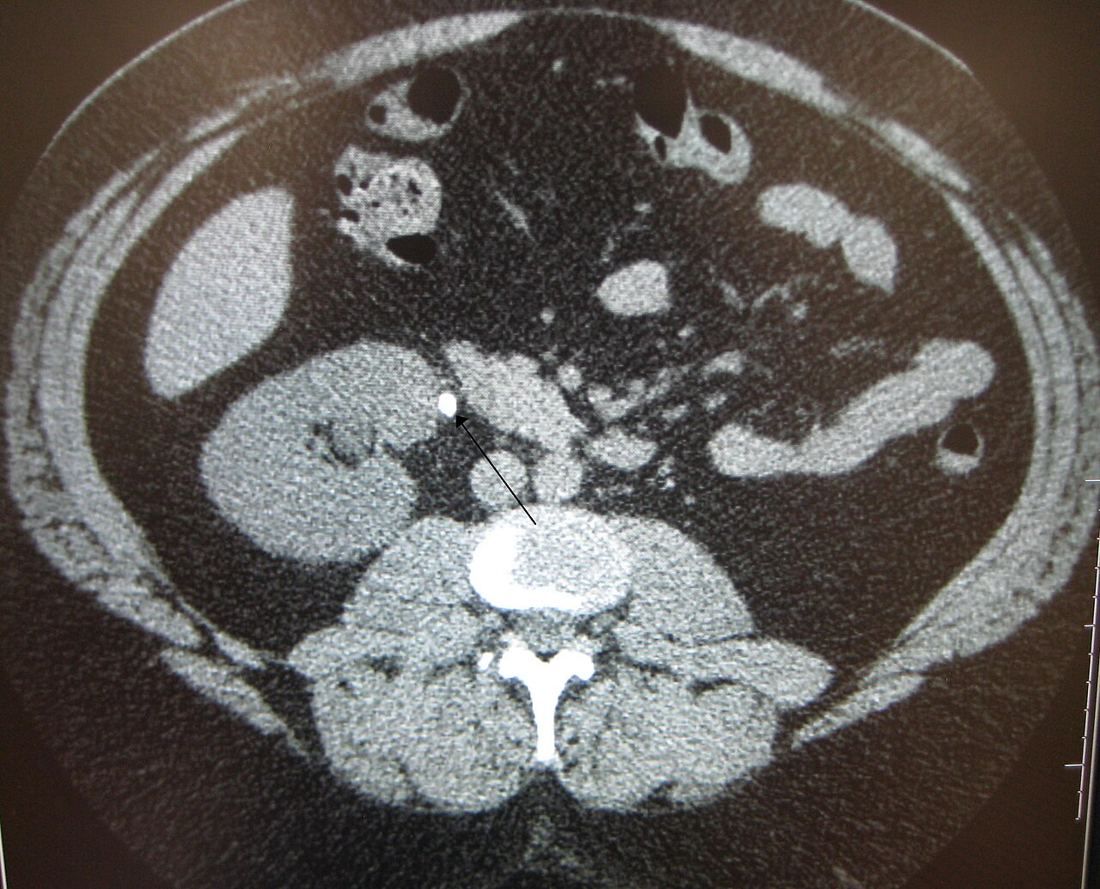
| Non-contrast CT | Confirms the stone after ultrasound (strong recommendation). More accurate than ultrasound, and finds other causes when there is no stone.1 |
| Low-dose CT | Pooled sensitivity 93.1%, specificity 96.6% in a meta-analysis cited by the guideline.1 |
| Plain film (KUB) | Sensitivity and specificity 44–77%. Helps tell radiopaque from radiolucent stones for follow-up.1 |
- Ultrasound first doesn't miss more. In a trial of 2,759 ED patients randomized to point-of-care ultrasound, radiology ultrasound or CT, complicated high-risk diagnoses within 30 days were rare (0.4%) and the same in every arm. Radiation was lower with ultrasound first; serious adverse events, pain at 7 days, return visits and admissions did not differ.2
- The STONE score combines sex, pain duration, race, nausea or vomiting, and microscopic hematuria. A ureteral stone was found in about 9% of low scorers, 51% of moderate and 89% of high. In the high group, other acutely important findings were seen in 0.3–1.6%.3
- Pregnancy: ultrasound first, MRI second, low-dose CT last (all strong recommendations). Start with conservative management.1
Pain
| Agent | Adult dose | Notes |
|---|---|---|
| First choice: NSAID | ||
| Ketorolac IV | 30 mg once; 15 mg once if ≥ 65 y, < 50 kg or renally impaired | Label dosing.7 10 mg gave the same relief in an ED trial.6 Contraindicated in advanced renal impairment, volume depletion and high bleeding risk. Total use ≤ 5 days.7 |
| Alternatives | ||
| Acetaminophen IV | 1,000 mg over 15 min (≥ 50 kg); max 4,000 mg/day | Label dosing.8 At least as effective as morphine at 30 min in one trial.4 |
| Opioid (hydromorphone, tramadol) or ketamine | Per institutional protocol and label | Second choice (weak recommendation). Avoid pethidine (meperidine).1 |
| Antispasmodics added to NSAIDs | Not recommended | No added pain relief.1 |
Unreviewed doses. Verify against the current label and your institution's protocol before giving anything.
- The guideline position: offer an NSAID first, weighing cardiovascular risk and side effects (strong). Opioids or ketamine are second choice (weak).1
- Diclofenac vs morphine vs acetaminophen (1,645 ED patients): at least 50% pain relief at 30 minutes in 68% with IM diclofenac 75 mg, 66% with IV acetaminophen 1 g and 61% with IV morphine 0.1 mg/kg. Diclofenac beat morphine (OR 1.35). Adverse events were 1% with each non-opioid and 3% with morphine.4
- Meta-analysis (36 trials, 4,887 patients): NSAIDs and opioids relieved pain about equally at 30 minutes, but NSAIDs needed less rescue analgesia (NNT 11) and caused less vomiting (NNT 5). NSAIDs also needed less rescue than acetaminophen (RR 0.56).5
- Cautions: NSAIDs can reduce kidney function when GFR is already low. Diclofenac and ibuprofen increase coronary events, so use the lowest dose for the shortest time.1
- Refractory pain is an indication for decompression or ureteroscopic stone removal (strong).1
Infected, obstructed kidney
- Decompress urgently with a ureteral stent or percutaneous nephrostomy (strong). They work equally well, with no difference in time to defervescence. Nephrostomy patients stay longer; stents affect quality of life more.1
- Start antibiotics immediately, after urine and blood cultures, and involve intensive care if needed (strong).1
- Send urine again for culture after decompression, and adjust antibiotics to the results (strong).1
- Delay definitive stone treatment until the sepsis has resolved (strong).1
Passage, tamsulosin and referral
| Stone | Passed on its own |
|---|---|
| By size | |
| < 5 mm | ~75% |
| ≥ 5 mm | 62% |
| By position | |
| Upper ureter | 49–52% |
| Mid ureter | 58–70% |
| Distal ureter | 68–83% |
| By both | |
| < 5 mm, distal | 89% |
| < 5 mm, upper | 71% |
From the EAU guideline, which notes the data are limited. Average time to passage was about 17 days (range 6–29).1
Medical expulsive therapy
- EAU: offer an alpha-blocker as one option for distal ureteral stones of 5–10 mm (strong; off-label). Use it only in informed patients who don't need active removal, and stop it if infection, refractory pain or worsening kidney function develops.1
- Dose: tamsulosin 0.4 mg once daily, the labeled dose for benign prostatic hyperplasia; stone passage is not a labeled use.12,1
- Meta-analysis (55 trials): alpha-blockers increased passage (RR 1.49), with no clear benefit for smaller stones (RR 1.19, 1.00–1.48) and a benefit for larger ones (RR 1.57).9
- SUSPEND (1,136 UK adults): no further intervention needed at 4 weeks in 81% on tamsulosin vs 80% on placebo.10
- STONE (512 US ED patients, stones < 9 mm, mean 3.8 mm): passage by 28 days 50% vs 47%, not significant.11 Ejaculatory problems were more common with tamsulosin (18.2% vs 7.4%).13
The EAU guideline strongly recommends offering an alpha-blocker for distal stones of 5–10 mm, based on meta-analyses.1,9 The two largest placebo-controlled trials found no benefit.10,11 Stones in the US trial were mostly small (mean 3.8 mm).11 REBEL EM advises against routine tamsulosin and calls any benefit for larger stones unclear.13
When the stone needs removing
- Refer to urology for a stone unlikely to pass, pain despite adequate analgesia, persistent obstruction, or renal insufficiency (kidney failure, bilateral obstruction or a single kidney).1
- In pregnancy, a stent or nephrostomy is needed if the stone doesn't pass or complications develop, such as intractable symptoms, severe hydronephrosis or preterm labor.1
Pitfalls
- Sending home a febrile patient with an obstructing stone. That kidney needs decompression and antibiotics.1
- Reaching for morphine first. NSAIDs relieve pain at least as well, with less vomiting and less rescue analgesia.4,5
- Giving ketorolac 30 mg when 10 mg works as well.6
- Giving NSAIDs to a volume-depleted patient or one with advanced kidney disease.7,1
- Holding analgesia until imaging is done.1
- Promising that tamsulosin will help the stone pass.10,11
How strong is the evidence?
The analgesia evidence is the firmest: a large blinded trial and a meta-analysis of 36 trials favor NSAIDs, though the trials in the meta-analysis varied widely.4,5 Imaging choice rests on one large pragmatic trial.2 Drainage choice in infection rests on few, small studies of medium to very low quality.1 The evidence on alpha-blockers conflicts.1,9,10,11
On-shift teaching
Questions to ask a learner at the bedside. Tap a question to see the answer. Every answer uses facts cited above.
Q1In the 1,645-patient ED trial, which worked better for renal colic: diclofenac or morphine?
Q2What IV ketorolac dose is enough?
Q3Is starting with ultrasound instead of CT safe?
Q4A patient with an obstructing stone has a fever of 39 °C. What do they need?
Q5What are the odds that a 4 mm distal ureteral stone passes on its own?
References
What this page is built on
13 sources, cited 95 times. Dots are sources, filled by how far each was read; stronger color means a larger share of the citations. Tap a tier to see its sources.
Checked by the writer, not a physician. The dots show how each source was read, not that anyone has confirmed the claims.
- 1European Association of Urology. EAU Guidelines on Urolithiasis. EAU Guidelines Office, Arnhem; 2026 edition.
- 2Smith-Bindman R, Aubin C, Bailitz J, et al. Ultrasonography versus computed tomography for suspected nephrolithiasis. N Engl J Med. 2014;371(12):1100–1110.
- 3Moore CL, Bomann S, Daniels B, et al. Derivation and validation of a clinical prediction rule for uncomplicated ureteral stone: the STONE score. BMJ. 2014;348:g2191.
- 4Pathan SA, Mitra B, Straney LD, et al. Delivering safe and effective analgesia for management of renal colic in the emergency department: a double-blind, multigroup, randomised controlled trial. Lancet. 2016;387(10032):1999–2007.
- 5Pathan SA, Mitra B, Cameron PA. A systematic review and meta-analysis comparing the efficacy of nonsteroidal anti-inflammatory drugs, opioids, and paracetamol in the treatment of acute renal colic. Eur Urol. 2018;73(4):583–595.
- 6Motov S, Yasavolian M, Likourezos A, et al. Comparison of intravenous ketorolac at three single-dose regimens for treating acute pain in the emergency department: a randomized controlled trial. Ann Emerg Med. 2017;70(2):177–184.
- 7Ketorolac tromethamine injection. FDA label, DailyMed.
- 8Ofirmev (acetaminophen) injection. FDA label, DailyMed.
- 9Hollingsworth JM, Canales BK, Rogers MA, et al. Alpha blockers for treatment of ureteric stones: systematic review and meta-analysis. BMJ. 2016;355:i6112.
- 10Pickard R, Starr K, MacLennan G, et al. Medical expulsive therapy in adults with ureteric colic: a multicentre, randomised, placebo-controlled trial (SUSPEND). Lancet. 2015;386(9991):341–349.
- 11Meltzer AC, Burrows PK, Wolfson AB, et al. Effect of tamsulosin on passage of symptomatic ureteral stones: a randomized clinical trial (STONE). JAMA Intern Med. 2018;178(8):1051–1057.
- 12Tamsulosin hydrochloride capsules. FDA label, DailyMed.
- 13Swaminathan A. Can tamsulosin get that stone to drop? REBEL EM; June 29, 2018.
AI-generated draft. Not reviewed by a physician. This page is for education only and may contain errors, including in doses. Do not use it to diagnose, treat or make decisions about any patient. Rely on your own clinical judgment, your institution's protocols and current drug labeling. Reading this page does not create a physician-patient relationship. Full terms