Pyelonephritis
Bottom line
- Pyelonephritis is a complicated UTI. The 2025 IDSA guideline calls a UTI complicated when signs suggest spread beyond the bladder, especially fever.1 Flank pain, costovertebral angle tenderness, chills and rigors count.2
- Send a urine culture with susceptibilities in every patient, and narrow to a targeted drug when results return.3,1
- Choose the empiric drug by sepsis first, then resistance risk. Avoid any class a previous urine isolate resisted, and avoid fluoroquinolones after any use in the past 12 months.1
- Fluoroquinolone resistance is common. Across 15 US emergency departments, 22.1% of E. coli were resistant.4 Where resistance may exceed 10%, the 2010 guideline gives one IV dose of ceftriaxone 1 g before oral therapy.3
- Short courses work. For patients who improve, give 5–7 days of a fluoroquinolone or 7 days of another effective agent, and 7 days for gram-negative bacteremia.1
First steps
- Recognize it. A UTI with fever, flank pain, costovertebral angle tenderness, chills or rigors has spread beyond the bladder. Treat it as a complicated UTI.1,2
- Screen for sepsis. The guideline uses the Sepsis-3 definition and accepts SOFA, qSOFA or SIRS to identify it. Sepsis changes the empiric choice.1
- Send a urine culture with susceptibilities.3
- Look back. Check earlier urine cultures and any fluoroquinolone in the past 12 months. Avoid drugs those point against.1
- Choose and give the empiric antibiotic (tables below).1,3
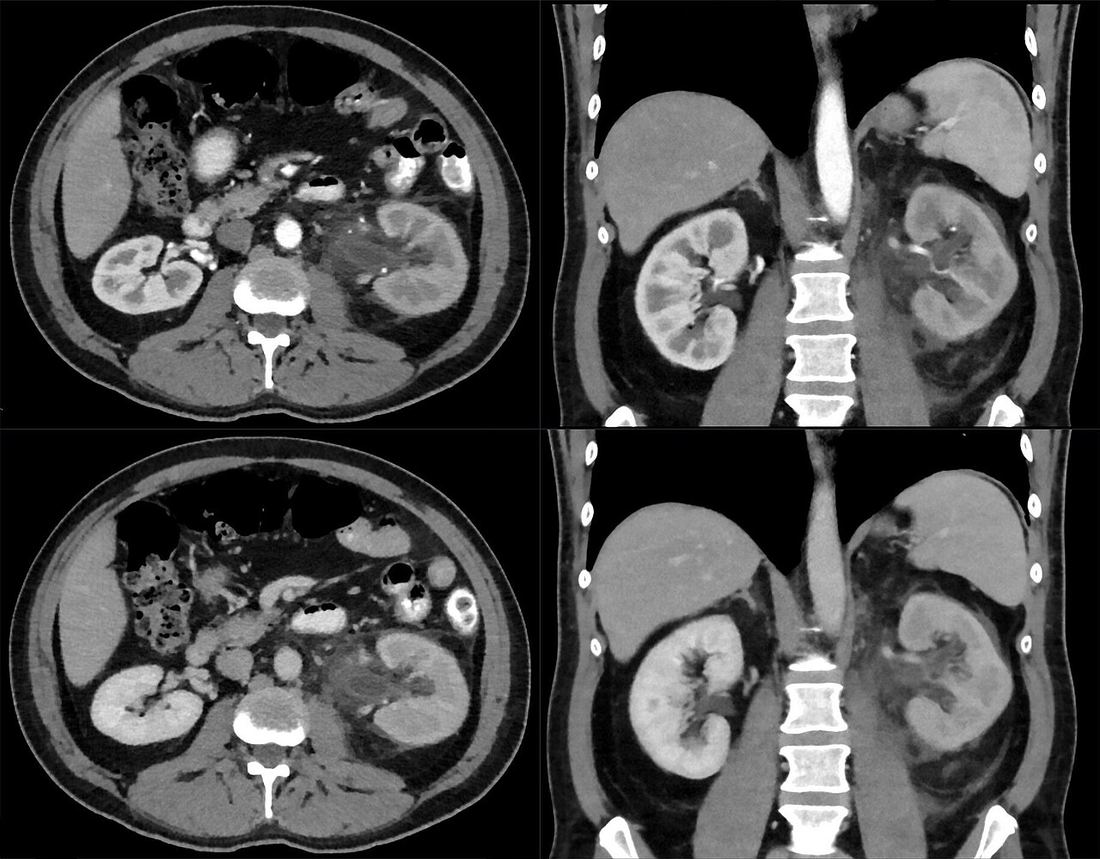
- Image selected patients: a history of stones, urine pH ≥ 7.0, or eGFR ≤ 40.5
- Look back at earlier urine cultures and any fluoroquinolone in the past 12 months. Avoid drugs those point against.1
- Is there sepsis?Sepsis or septic shockThird- or fourth-generation cephalosporin, carbapenem, piperacillin-tazobactam or a fluoroquinolone.1With a local antibiogram from the past 12 months, aim for ≥ 90% susceptibility in shock and ≥ 80% without.1No sepsisThird- or fourth-generation cephalosporin, piperacillin-tazobactam or a fluoroquinolone, in preference to a carbapenem.1
- Well enough to go home on oral antibiotics?YesCeftriaxone 1 g IV once where fluoroquinolone resistance may exceed 10%, as it does in many US emergency departments.3,4
- No, admitted
- History of stones, urine pH ≥ 7.0 or eGFR ≤ 40?YesImage the urinary tract. Without any of the three, urgent findings such as pyonephrosis or abscess were very unlikely.5
- Either wayNot improving promptly? Look for a source that needs control.1
- Switch to oral once improving, taking oral medication, with an effective oral drug.1
Diagnosis and imaging
- What makes a UTI complicated: systemic illness (fever, flank pain, chills, rigors, CVA tenderness), upper tract obstruction, kidney involvement, or an indwelling catheter, nephrostomy or ureteral stent. Diabetes, immune compromise or a urologic condition alone do not.2
- The 2025 classification relies on what is visible at the bedside, such as vital signs and catheters, not on findings that need a urologic workup.1
- Culture every patient. The urine culture and susceptibilities guide the switch to a targeted drug.3,1
Who needs imaging
In a prospective study of adults with febrile UTI at 8 Dutch emergency departments, a rule of any of: a history of stones, urine pH ≥ 7.0, or eGFR ≤ 40 predicted findings worth imaging for. For urgent findings (pyonephrosis or abscess), the negative predictive value was 99% in derivation (n = 346) and 100% in validation (n = 131). Positive predictive value was low (10–11%). Using the rule could have cut imaging by 40%.5
When a patient does not improve promptly on effective therapy, look for a source that needs control.1
Antibiotics
| Situation | Empiric choice (IDSA 2025) | Strength |
|---|---|---|
| Sepsis or septic shock | Third- or fourth-generation cephalosporin, carbapenem, piperacillin-tazobactam or fluoroquinolone, over newer agents, cefiderocol, plazomicin or older aminoglycosides | Conditional, very low to moderate |
| No sepsis | Third- or fourth-generation cephalosporin, piperacillin-tazobactam or fluoroquinolone, over carbapenems, newer agents or older aminoglycosides | Conditional, very low to moderate |
| Earlier resistant urine isolate | Avoid that drug; the most recent culture is the best guide | Conditional, very low |
| Fluoroquinolone in the past 12 months | Avoid fluoroquinolones | Conditional, very low |
| Sepsis, with a local antibiogram from the past 12 months | Pick a drug with ≥ 90% susceptibility in shock, ≥ 80% without shock | Conditional, very low |
| Allergy, contraindications, interactions | Account for them | Good practice |
From the IDSA 2025 complicated UTI guideline.1 The guideline's dose tables were not available as text, so the doses below come from the 2010 guideline and the FDA labels.
| Drug | Adult dose | Course | Notes |
|---|---|---|---|
| Parenteral | |||
| Ceftriaxone | 1 g IV once, before oral therapy | Single dose | Where fluoroquinolone resistance may exceed 10%, with TMP-SMX of unknown susceptibility, or with an oral beta-lactam.3 Label: usually 1–2 g once daily, no more than 4 g a day.7 |
| Ciprofloxacin IV | 400 mg IV | First dose | Optional single dose before oral ciprofloxacin.3 |
| Oral | |||
| Ciprofloxacin | 500 mg twice daily | 7 days | Guideline regimen for outpatients.3,8 Label UTI dose: 250–500 mg every 12 hours.9 |
| Levofloxacin | 750 mg once daily | 5 days | Labeled 5-day regimen for acute pyelonephritis. Adjust for creatinine clearance under 50 mL/min.3,10 |
| TMP-SMX | 160/800 mg (1 DS tablet) twice daily | 14 days (2010) | Only if the isolate is known to be susceptible.3,11 |
| Oral beta-lactams | No dose given here | 10–14 days (2010) | Less effective than other agents. Give an IV ceftriaxone dose first.3 Short-course data are limited, and higher doses may be needed.1 |
| Nitrofurantoin, oral fosfomycin | Not for pyelonephritis | — | May not reach adequate levels in the kidney or blood.2 |
Unreviewed doses. Verify against the current label and your institution's protocol before giving anything.
Resistance in US emergency departments
- 2013–2014, a US emergency department network, 521 adults with culture-confirmed pyelonephritis: E. coli fluoroquinolone resistance was 6.3% in uncomplicated and 19.9% in complicated cases, up to 50% at one site. ESBL production was 2.6% and 12.2%.6
- 2018–2020, 15 US EDs, 3,779 patients with UTI: E. coli fluoroquinolone resistance was 22.1% (10.5–29.7% by site), and 7.4% of uropathogens produced ESBL.4
- Risk factors miss many. About 37% of patients with fluoroquinolone-resistant E. coli or an ESBL organism had no documented risk factor.4 A third of ESBL infections occurred without antibiotic, healthcare or travel exposure.6
- Inactive first drugs are common. 75.9% of ESBL and 45.3% of fluoroquinolone-resistant infections were first treated with a drug the organism resisted.6
Why TMP-SMX is not given blind: in a US outpatient trial, 18% of E. coli resisted it. Clinical cure was 83% with 14 days of TMP-SMX and 96% with 7 days of ciprofloxacin, and resistance predicted TMP-SMX failure.12
How long, and when to switch to oral
- Improving on effective therapy: 5–7 days of a fluoroquinolone (conditional, moderate certainty) or 7 days of a non-fluoroquinolone (conditional, very low), rather than 10–14 days. Count from the first day of effective therapy.1
- Gram-negative bacteremia from the urine: 7 days rather than 14 if improving (conditional, low).1
- Switch IV to oral once the patient is improving, can take oral medication and has an effective oral option. This applies with bacteremia too.1
- Men with febrile UTI and suspected acute bacterial prostatitis may benefit from 10–14 days, though evidence is lacking.1
What the trials show
- Ciprofloxacin 7 vs 14 days (248 Swedish women, oral 500 mg twice daily): short-term cure 97% vs 96%, noninferior. No vaginal candidiasis after week 1 with 7 days, versus 5 cases with 14.8
- Levofloxacin 750 mg for 5 days vs ciprofloxacin for 10 days (1,109 enrolled with complicated UTI or pyelonephritis): eradication 88.3% vs 86.7% in evaluable patients, noninferior.13
- 7 vs 14 days for gram-negative bacteremia (604 inpatients, 68% urinary source, stable for 48 hours): the composite poor outcome occurred in 45.8% vs 48.3%, noninferior.14
The 2010 guideline gives TMP-SMX for 14 days and oral beta-lactams for 10–14 days.3 The 2025 guideline suggests 7 days for any effective non-fluoroquinolone in a patient who is improving, but rates that evidence very low certainty, and notes most duration trials studied fluoroquinolones.1
Disposition
- Home: some patients can be treated entirely with oral antibiotics as outpatients.1 In the US outpatient trial, women went home on oral antibiotics with or without a single IV first dose.12
- Admitted: start an IV regimen chosen from local resistance data, then adjust to susceptibilities.3
- Before discharge, make sure the culture result will reach someone who can change the drug.3,6
- Return if not improving. Prompt failure should trigger a search for a source that needs control.1
Neither guideline gives explicit admission criteria. Sepsis care follows the empiric choices above.1
Pitfalls
- Treating pyelonephritis with nitrofurantoin or oral fosfomycin.2
- Reaching for a fluoroquinolone without asking about use in the past 12 months, or checking earlier cultures.1
- Assuming no risk factors means a susceptible organism. About 37% of resistant cases had none documented.4
- Starting TMP-SMX or an oral beta-lactam without a first IV dose of ceftriaxone when susceptibility is unknown.3
- Discharging without a culture, or without anyone to act on it.3,6
- Imaging every patient. A simple rule could have avoided 40% of scans.5
How strong is the evidence?
Every 2025 recommendation is conditional, with certainty from very low to moderate. The duration trials mostly studied fluoroquinolones when resistance was less common. They mostly excluded patients with catheters, severe sepsis, immune compromise, urinary abscess, chronic kidney disease, prostatitis, complete obstruction or recent urologic procedures.1 The imaging rule was derived and validated in Dutch emergency departments only.5 The resistance figures come from US ED networks and vary widely by site.6,4
On-shift teaching
Questions to ask a learner at the bedside. Tap a question to see the answer. Every answer uses facts cited above.
Q1Under the 2025 IDSA guideline, what makes a UTI complicated? Does diabetes alone count?
Q2Which three findings suggest a febrile UTI needs imaging?
Q3Your patient took levofloxacin for sinusitis 6 months ago. Does that change your choice?
Q4Why is TMP-SMX not a good blind choice?
Q5How short can a fluoroquinolone course be?
References
What this page is built on
14 sources, cited 91 times. Dots are sources, filled by how far each was read; stronger color means a larger share of the citations. Tap a tier to see its sources.
Checked by the writer, not a physician. The dots show how each source was read, not that anyone has confirmed the claims.
- 1Trautner BW, Cortés-Penfield NW, Gupta K, et al. IDSA 2025 Guideline on Management and Treatment of Complicated Urinary Tract Infections (selection of antibiotics; IV-to-oral transition; duration). Infectious Diseases Society of America; July 2025. Clin Infect Dis. 2026;82(Suppl 3):i36–i88.
- 2Long B. Guideline update: 2025 IDSA management of complicated UTI. emDocs.
- 3Gupta K, Hooton TM, Naber KG, et al. International clinical practice guidelines for the treatment of acute uncomplicated cystitis and pyelonephritis in women: a 2010 update by the Infectious Diseases Society of America and the European Society for Microbiology and Infectious Diseases. Clin Infect Dis. 2011;52(5):e103–e120.
- 4Faine BA, Rech MA, Vakkalanka P, et al. High prevalence of fluoroquinolone-resistant UTI among US emergency department patients diagnosed with urinary tract infection, 2018–2020. Acad Emerg Med. 2022;29(9):1096–1105.
- 5van Nieuwkoop C, Hoppe BP, Bonten TN, et al. Predicting the need for radiologic imaging in adults with febrile urinary tract infection. Clin Infect Dis. 2010;51(11):1266–1272.
- 6Talan DA, Takhar SS, Krishnadasan A, et al. Fluoroquinolone-resistant and extended-spectrum β-lactamase-producing Escherichia coli infections in patients with pyelonephritis, United States. Emerg Infect Dis. 2016;22(9):1594–1603.
- 7Ceftriaxone for injection. FDA label, DailyMed.
- 8Sandberg T, Skoog G, Hermansson AB, et al. Ciprofloxacin for 7 days versus 14 days in women with acute pyelonephritis: a randomised, open-label and double-blind, placebo-controlled, non-inferiority trial. Lancet. 2012;380(9840):484–490.
- 9Ciprofloxacin tablets. FDA label, DailyMed.
- 10Levofloxacin tablets. FDA label, DailyMed.
- 11Sulfamethoxazole and trimethoprim tablets. FDA label, DailyMed.
- 12Talan DA, Stamm WE, Hooton TM, et al. Comparison of ciprofloxacin (7 days) and trimethoprim-sulfamethoxazole (14 days) for acute uncomplicated pyelonephritis in women: a randomized trial. JAMA. 2000;283(12):1583–1590.
- 13Peterson J, Kaul S, Khashab M, et al. A double-blind, randomized comparison of levofloxacin 750 mg once-daily for five days with ciprofloxacin 400/500 mg twice-daily for 10 days for the treatment of complicated urinary tract infections and acute pyelonephritis. Urology. 2008;71(1):17–22.
- 14Yahav D, Franceschini E, Koppel F, et al. Seven versus 14 days of antibiotic therapy for uncomplicated gram-negative bacteremia: a noninferiority randomized controlled trial. Clin Infect Dis. 2019;69(7):1091–1098.
AI-generated draft. Not reviewed by a physician. This page is for education only and may contain errors, including in doses. Do not use it to diagnose, treat or make decisions about any patient. Rely on your own clinical judgment, your institution's protocols and current drug labeling. Reading this page does not create a physician-patient relationship. Full terms