


Pharyngitis and peritonsillar abscess
Bottom line
- Test, don't guess. Test adults whose symptoms suggest strep, such as fever, tender anterior neck nodes and tonsillar exudate, and give antibiotics only for confirmed strep.1,2 Even with every classic feature, only 35–50% have strep.2
- A negative rapid test in an adult needs no backup culture. Skip testing when the features strongly suggest a virus.2
- Penicillin or amoxicillin for 10 days is first-line. A first-generation cephalosporin suits most penicillin-allergic patients, but not after an anaphylactic reaction.2
- Drain a peritonsillar abscess. Ultrasound helps rule it out (sensitivity 86%).3 Incision and drainage may recur less than needle aspiration, which hurts less (very low certainty).4
- Look past strep in young adults. In students aged 15–30 with sore throat, Fusobacterium necrophorum was found twice as often as group A strep.5 It causes most cases of Lemierre syndrome.2
First steps
- Look for an abscess or deeper infection: trismus, severe pain on swallowing, and symptoms beyond 3 days.4,6
- Decide whether to test. Don't test when features strongly suggest a virus.2 Test when they suggest strep.1
- Use a rapid antigen test and/or culture. In adults, a negative rapid test needs no backup culture.2
- Treat confirmed strep with penicillin or amoxicillin.1,2
- Treat pain and fever with acetaminophen or an NSAID.2
- No
- No
- Positive for group A strep?YesPenicillin V 500 mg twice daily or amoxicillin 1,000 mg once daily for 10 days, or benzathine penicillin G 1.2 million units IM once.2
- No
Who to test
| Modified Centor (McIsaac) item | Points |
|---|---|
| Age 3–14 years | +1 |
| Age 15–44 years | 0 |
| Age 45 or older | −1 |
| Exudate or swelling on the tonsils | +1 |
| Tender or swollen anterior cervical nodes | +1 |
| Temperature > 38 °C (100.4 °F) | +1 |
| Cough absent | +1 |
Score items from MDCalc. The score applies only to sore throat that started within the last 3 days.6 Rates of group A strep, group C/G strep and Fusobacterium all rise with higher Centor scores.5
- Scores predict, they don't diagnose. Even patients with every feature have strep only 35–50% of the time, and in adults a 4-item rule predicted a positive culture with 32–56% accuracy. Treating on clinical grounds alone overtreats adults.2
- Test with a rapid antigen test and/or culture when strep is plausible (strong, high).2
- Don't test when the clinical and epidemiologic features strongly suggest a virus (strong, high).2
- No backup culture after a negative rapid test in adults (strong, moderate).2
- No antistreptococcal antibody titers for acute pharyngitis.2
Treating strep
| Drug | Adult dose (table maximum) | Duration |
|---|---|---|
| First-line | ||
| Penicillin V, oral | 500 mg twice daily, or 250 mg four times daily | 10 days |
| Amoxicillin, oral | 1,000 mg once daily, or 500 mg twice daily | 10 days |
| Benzathine penicillin G, IM | 1.2 million units | Once |
| Penicillin allergy | ||
| Cephalexin, oral | 500 mg twice daily | 10 days |
| Cefadroxil, oral | 1 g once daily | 10 days |
| Clindamycin, oral | 300 mg three times daily | 10 days |
| Azithromycin, oral | 500 mg once daily | 5 days |
| Clarithromycin, oral | 250 mg twice daily | 10 days |
Unreviewed doses. Verify against the current label and your institution's protocol before giving anything.
From IDSA Table 2, which gives weight-based doses with the maximums shown here.2 Avoid cephalosporins after an immediate, anaphylactic-type penicillin reaction.2 Benzathine penicillin G is worth considering when adherence is in doubt.2
Pain relief and steroids
- Acetaminophen or an NSAID for moderate to severe symptoms or high fever (strong, high).2
- Corticosteroids: in 9 trials (n = 1,319), adding a steroid to antibiotics and analgesia made complete pain relief at 24 hours 2.4 times as likely. About 5 patients need treatment for one more to be pain-free at 24 hours.7
- Adverse events were poorly reported in those trials.7 No steroid dose is given here; follow institutional protocol and the label.
IDSA does not recommend adding a corticosteroid for strep pharyngitis (weak, moderate).2 A later Cochrane review found that steroids moderately speed pain relief in sore throat (high-certainty evidence for relief at 24 and 48 hours).7 The Cochrane authors still call for more data on harms.7
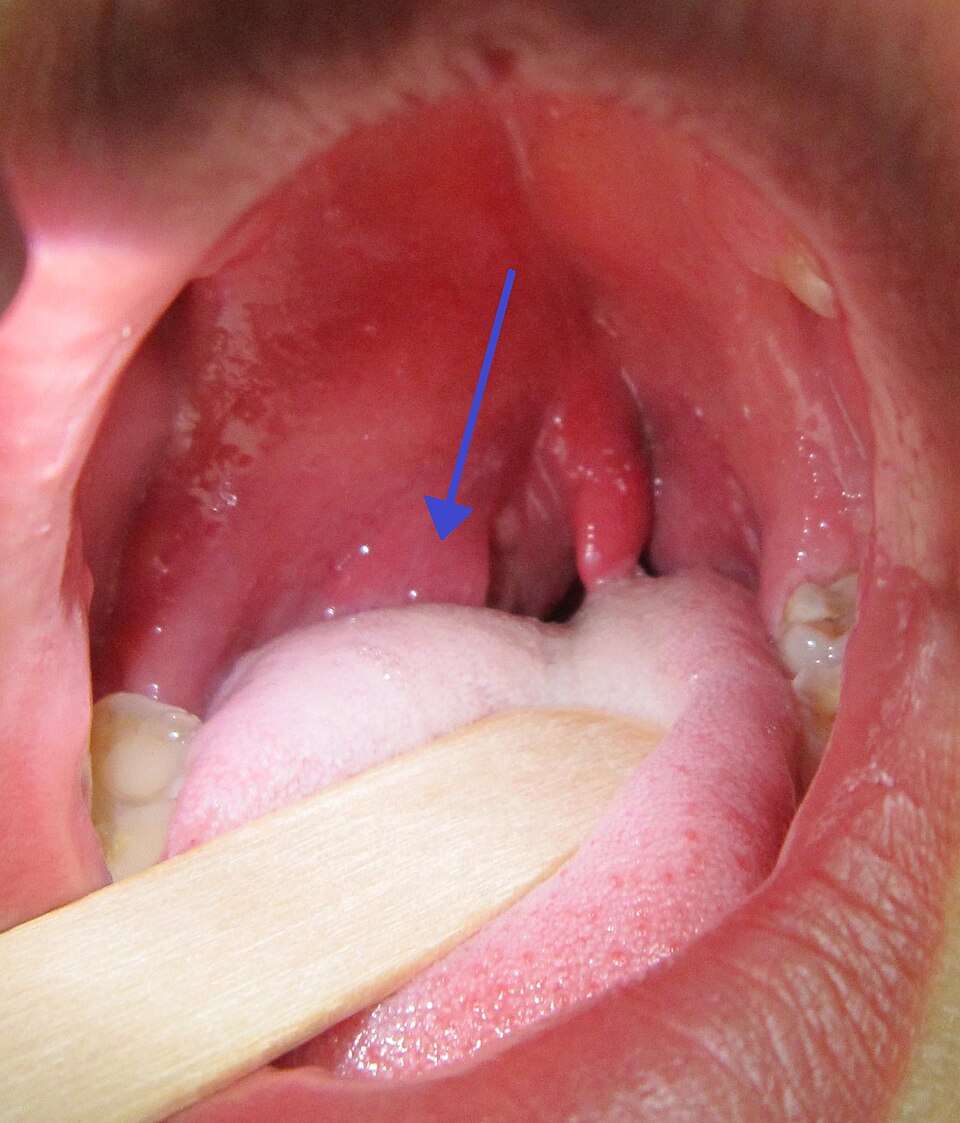
Peritonsillar abscess
- Typical picture: severe sore throat, difficulty and pain swallowing, fever, malaise and trismus.4
- Exam alone is unreliable: about 75% sensitive and 50% specific for an abscess versus cellulitis.3
- Ultrasound (17 studies, 812 patients): sensitivity 86%, specificity 76%, negative likelihood ratio 0.19. Intraoral scanning was more sensitive (91%) than transcervical (80%).3
- Drainage: in 10 trials, recurrence was higher after needle aspiration than after incision and drainage (RR 3.74), but the evidence is very low quality. Needle aspiration was less painful in two studies.4
- Antibiotics after drainage: in 200 healthy adults, adding metronidazole to penicillin did not prevent recurrence or speed recovery, and caused longer nausea and diarrhea.8
- Steroids after drainage: in 3 small trials (n = 153), all showed faster fall in temperature; pain, mouth opening and time to painless eating improved in only one or two.9
Beyond strep
- Fusobacterium necrophorum: found in 20.5% of 312 students aged 15–30 with sore throat, against 10.3% for group A strep. It looked clinically like strep pharyngitis.5 It was also found in 9.4% of students without symptoms.5
- IDSA calls the evidence that it causes pharyngitis "only suggestive", but it causes most Lemierre syndrome, which needs urgent antibiotics.2
- Symptoms beyond 3 days: look for peritonsillar abscess or Lemierre syndrome, and in adults consider mononucleosis or acute HIV.6
Pitfalls
- Treating a high Centor score without a test. Most adults with every feature still don't have strep.2
- Sending a backup culture after a negative rapid test in an adult.2
- Giving a cephalosporin after an anaphylactic penicillin reaction.2
- Missing an abscess because the exam looked like cellulitis.3
- Stopping at strep in a sick young adult whose sore throat is getting worse.2,5
How strong is the evidence?
On-shift teaching
Questions to ask a learner at the bedside. Tap a question to see the answer. Every answer uses facts cited above.
Q1An adult has every classic feature of strep. How likely is strep?
Q2A 30-year-old's rapid strep test is negative. Send a culture?
Q3What is first-line treatment for strep pharyngitis, and for how long?
Q4Which penicillin-allergic patients should not get a cephalosporin?
Q5How good is ultrasound for peritonsillar abscess?
References
What this page is built on
9 sources, cited 76 times. Dots are sources, filled by how far each was read; stronger color means a larger share of the citations. Tap a tier to see its sources.
Checked by the writer, not a physician. The dots show how each source was read, not that anyone has confirmed the claims.
- 1Harris AM, Hicks LA, Qaseem A; High Value Care Task Force of the American College of Physicians and the Centers for Disease Control and Prevention. Appropriate antibiotic use for acute respiratory tract infection in adults: advice for high-value care. Ann Intern Med. 2016;164(6):425–434.
- 2Shulman ST, Bisno AL, Clegg HW, et al. Clinical practice guideline for the diagnosis and management of group A streptococcal pharyngitis: 2012 update by the Infectious Diseases Society of America. Clin Infect Dis. 2012;55(10):e86–e102.
- 3Kim DJ, Burton JE, Hammad A, et al. Test characteristics of ultrasound for the diagnosis of peritonsillar abscess: a systematic review and meta-analysis. Acad Emerg Med. 2023;30(8):859–869.
- 4Chang BA, Thamboo A, Burton MJ, Diamond C, Nunez DA. Needle aspiration versus incision and drainage for the treatment of peritonsillar abscess. Cochrane Database Syst Rev. 2016;12:CD006287.
- 5Centor RM, Atkinson TP, Ratliff AE, et al. The clinical presentation of Fusobacterium-positive and streptococcal-positive pharyngitis in a university health clinic: a cross-sectional study. Ann Intern Med. 2015;162(4):241–247.
- 6MDCalc. Centor score (modified/McIsaac) for strep pharyngitis.
- 7de Cassan S, Thompson MJ, Perera R, et al. Corticosteroids as standalone or add-on treatment for sore throat. Cochrane Database Syst Rev. 2020;5:CD008268.
- 8Wikstén JE, Pitkäranta A, Blomgren K. Metronidazole in conjunction with penicillin neither prevents recurrence nor enhances recovery from peritonsillar abscess when compared with penicillin alone: a prospective, double-blind, randomized, placebo-controlled trial. J Antimicrob Chemother. 2016;71(6):1681–1687.
- 9Hur K, Zhou S, Kysh L. Adjunct steroids in the treatment of peritonsillar abscess: a systematic review. Laryngoscope. 2018;128(1):72–77.
AI-generated draft. Not reviewed by a physician. This page is for education only and may contain errors, including in doses. Do not use it to diagnose, treat or make decisions about any patient. Rely on your own clinical judgment, your institution's protocols and current drug labeling. Reading this page does not create a physician-patient relationship. Full terms