


Minor head injury in adults
Bottom line
- Use the Canadian CT Head Rule (ACEP Level A). It was 100% sensitive for neurosurgical intervention, and far more specific than the New Orleans Criteria.1,2
- It applies only to alert adults with loss of consciousness, amnesia or disorientation who are not on anticoagulants. Outside that group, it can't clear a patient.1
- On an anticoagulant or a non-aspirin antiplatelet drug, scan the head. No decision tool can exclude the need for CT in these patients.1 NICE suggests a scan within 8 hours.3
- A normal CT on an anticoagulant usually means home. ACEP advises against routine repeat CT or observation for patients at their neurologic baseline (Level B).1 Delayed bleeding on a DOAC occurred in 2.43% and rarely had consequences.4
- Discharge with written advice about delayed bleeding and concussion symptoms, given to the patient and whoever will look after them.1,3
First steps
- Confirm the injury is minor: blunt head injury with a GCS of 13–15.2 Ask about anticoagulants and antiplatelet drugs.1
- Look for features that need a CT within the hour: GCS 12 or less, GCS under 15 at 2 hours, suspected open, depressed or basal skull fracture, a post-traumatic seizure, a focal deficit, or more than one episode of vomiting.3
- Scan patients on an anticoagulant or a non-aspirin antiplatelet drug. No decision tool can clear them.1,3
- Apply the Canadian CT Head Rule to everyone else who had loss of consciousness, amnesia or disorientation.1,2
- Be cautious with intoxicated patients. The rule missed injuries in them, so its negative result alone does not exclude a scan.1
- Normal CT and at neurologic baseline: no routine repeat CT or admission for the head injury. Discharge with written advice.1,3
Who needs a CT
| Canadian CT Head Rule factor | Notes |
|---|---|
| High risk (for neurosurgical intervention) | |
| GCS below 15 at 2 hours after injury | 2,1 |
| Suspected open or depressed skull fracture | 2,1 |
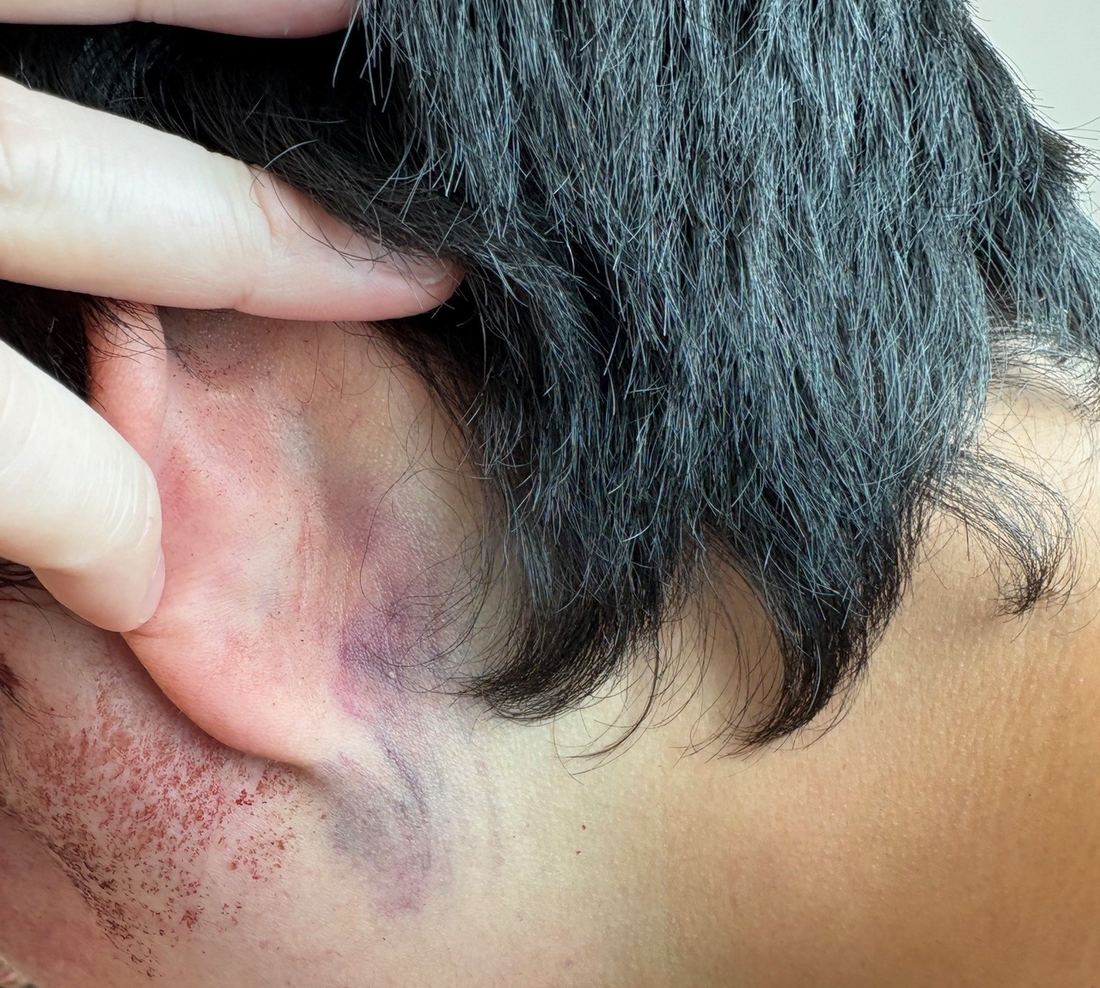
| Any sign of basal skull fracture | Hemotympanum, raccoon eyes, CSF leak from ear or nose, Battle's sign.3 |
| Vomiting more than once | 1 |
| Age 65 or older | 1 |
| Medium risk (for brain injury on CT) | |
| Amnesia for more than 30 minutes before impact | 2 |
| Dangerous mechanism | NICE defines it as a pedestrian or cyclist struck by a vehicle, ejection from a vehicle, or a fall from more than 1 m or 5 stairs.3 |
Derived in 3,121 adults with GCS 13–15 after minor head injury. The high-risk factors were 100% sensitive for neurosurgical intervention; adding the medium-risk factors was 98.4% sensitive for clinically important brain injury.2 The rule excludes patients on oral anticoagulants, and is valid only after loss of consciousness, amnesia or disorientation.1
How the rules compare
| Rule | ACEP level | Sensitivity, neurosurgery | Specificity, neurosurgery |
|---|---|---|---|
| Canadian CT Head Rule | A | 100% | 76.3% |
| New Orleans Criteria | B | 100% | 12.1% |
| NEXUS Head CT | B | 100% | 24.9% |
CCHR and New Orleans figures from 1,822 Canadian patients with GCS 15, in whom the CCHR would have scanned 52.1% vs 88.0% with the New Orleans Criteria.5 NEXUS figures from 11,770 imaged patients.1 ACEP accepts all three, but the lower specificity of the New Orleans Criteria and NEXUS may lead to more unnecessary scans.1
- New Orleans Criteria (GCS 15 with loss of consciousness or amnesia): headache, vomiting, age over 60, intoxication, short-term memory deficit, injury above the clavicles, or post-traumatic seizure.1
- NEXUS Head CT: signs of skull fracture, scalp hematoma, neurologic deficit, abnormal alertness or behavior, persistent vomiting, coagulopathy, or age 65 or older.1
NICE criteria for adults
- CT within 1 hour: GCS 12 or less on arrival, GCS under 15 at 2 hours, suspected open or depressed skull fracture, any sign of basal skull fracture, post-traumatic seizure, focal neurologic deficit, or more than one episode of vomiting.3
- CT within 8 hours after any loss of consciousness or amnesia, if the patient is 65 or older, has a bleeding or clotting disorder, had a dangerous mechanism, or has more than 30 minutes of retrograde amnesia.3
Anticoagulants and antiplatelets
- Higher risk on some drugs. In 9,070 patients with blunt head trauma, the relative risk of significant intracranial injury was 1.88 on warfarin and 2.88 on aspirin plus clopidogrel. Aspirin alone (1.29) and clopidogrel alone (0.75) were not significantly different.1
- Scan them. Don't use decision tools to exclude CT in patients on an anticoagulant or a non-aspirin antiplatelet drug.1 NICE suggests a CT within 8 hours even without other indications, especially if assessment is difficult or the patient might not return.3
- Delayed bleeding is uncommon and seldom matters. Across 12 studies (5,289 patients), delayed hemorrhage after a normal CT occurred in 2.43% on a DOAC and 2.31% on warfarin. 86% of those bleeds had no clinical consequence; 0.36% of patients died from one.4
- After a normal CT, at baseline: don't routinely repeat the CT or admit for observation (Level B). Give advice about rare delayed bleeding, and consider outpatient referral for fall risk and the risks and benefits of anticoagulation (consensus).1
- Aspirin in older patients is less certain. In one study of 100 patients 65 or older on low-dose aspirin, 4% had a delayed bleed; one needed surgery and one died. ACEP suggests older antiplatelet patients with high-risk features may need observation if a repeat scan is not done.1
- Keep the anticoagulant? With so few delayed bleeds, ACEP sees no strong argument for withholding it unless the patient is supratherapeutic.1
European guidelines suggest a period of routine observation after head injury for everyone on an anticoagulant, and one Italian series supported 24-hour observation with a repeat CT.1 ACEP advises against routine observation or repeat imaging in patients at their neurologic baseline after a normal first CT.1 The DOAC meta-analysis also found routine observation or repeat CT may not be warranted.4
Blood biomarkers
In 1,959 adults with GCS 9–15 who were already having a CT, a combined GFAP and UCH-L1 test drawn within 12 hours had a sensitivity of 97.6% and a negative predictive value of 99.6% for intracranial injury on CT. About a third (34%) tested negative; 3 patients had a positive CT despite a negative test.6 ACEP found the data on biomarkers, with or without decision rules, too limited to recommend them for deciding on CT, and advises against using them to predict post-concussive symptoms.1
Discharge and concussion
- Give verbal and printed advice to everyone discharged after a head injury, and to the person who will look after them.3
- Include delayed bleeding and concussion symptoms in the instructions (consensus).1
- Patients who need help at home should have someone who can follow the discharge instructions with them.1
- Consider referral for post-concussive symptoms in patients with female sex, prior psychiatric history, anxiety or depression, GCS under 15, assault, intoxication, or loss of consciousness. No current tool, including biomarkers, reliably predicts who will have prolonged symptoms.1
Pitfalls
- Applying the Canadian CT Head Rule to a patient on an anticoagulant, or one with no loss of consciousness, amnesia or disorientation.1
- Trusting a negative rule in an intoxicated patient.1
- Forgetting that age 65 or older alone is a high-risk factor.1,2
- Admitting every anticoagulated patient with a normal CT for a repeat scan.1
- Sending home an older patient on aspirin with high-risk features without observation or a repeat scan.1
- Discharging without written advice for the patient and carer.3
How strong is the evidence?
ACEP's decision-rule recommendation rests on 5 Class II and 5 Class III studies, with no Class I studies. Its anticoagulant recommendations rest on 1 Class II and 7 Class III studies with small numbers, few patients on aspirin and limited numbers on DOACs. The concussion advice is mostly consensus.1 The DOAC meta-analysis pooled observational studies.4 The biomarker study enrolled only patients who were already having a CT.6
On-shift teaching
Questions to ask a learner at the bedside. Tap a question to see the answer. Every answer uses facts cited above.
Q1Name the five high-risk factors of the Canadian CT Head Rule.
Q2Why does ACEP prefer the Canadian rule to the New Orleans Criteria?
Q3Who can't the Canadian CT Head Rule be used on?
Q4A patient on apixaban fell, has a normal CT and a normal exam. Repeat the CT?
Q5What does a negative GFAP/UCH-L1 test tell you?
Q6Which patients should you consider referring for post-concussive symptoms?
References
What this page is built on
6 sources, cited 82 times. Dots are sources, filled by how far each was read; stronger color means a larger share of the citations. Tap a tier to see its sources.
Checked by the writer, not a physician. The dots show how each source was read, not that anyone has confirmed the claims.
- 1American College of Emergency Physicians Clinical Policies Subcommittee on Mild Traumatic Brain Injury; Valente JH, Anderson JD, et al. Clinical policy: critical issues in the management of adult patients presenting to the emergency department with mild traumatic brain injury. Ann Emerg Med. 2023;81(5):e63–e105.
- 2Stiell IG, Wells GA, Vandemheen K, et al. The Canadian CT Head Rule for patients with minor head injury. Lancet. 2001;357(9266):1391–1396.
- 3National Institute for Health and Care Excellence. Head injury: assessment and early management (NG232). May 2023.
- 4Puzio TJ, Murphy PB, Kregel HR, et al. Delayed intracranial hemorrhage after blunt head trauma while on direct oral anticoagulant: systematic review and meta-analysis. J Am Coll Surg. 2021;232(6):1007–1016.e5.
- 5Stiell IG, Clement CM, Rowe BH, et al. Comparison of the Canadian CT Head Rule and the New Orleans Criteria in patients with minor head injury. JAMA. 2005;294(12):1511–1518.
- 6Bazarian JJ, Biberthaler P, Welch RD, et al. Serum GFAP and UCH-L1 for prediction of absence of intracranial injuries on head CT (ALERT-TBI): a multicentre observational study. Lancet Neurol. 2018;17(9):782–789.
AI-generated draft. Not reviewed by a physician. This page is for education only and may contain errors, including in doses. Do not use it to diagnose, treat or make decisions about any patient. Rely on your own clinical judgment, your institution's protocols and current drug labeling. Reading this page does not create a physician-patient relationship. Full terms