


Laceration repair and wound care
Bottom line
- Irrigate with drinkable tap water. In 715 adults with simple lacerations, infection rates matched sterile saline (4% vs 3.3%).1 Pooled trials of tap water versus saline are very low certainty.2
- The clock matters less than once taught. In 2,663 lacerations, closure after 12 hours did not raise the infection rate.3 Clean wounds can be closed up to 18 hours after injury, head wounds up to 24 hours.4
- Clean nonsterile gloves are fine for uncomplicated repairs. Two randomized trials found no meaningful difference in infection.5,6
- No routine antibiotics for simple nonbite wounds.7 For bites, decide by the animal and the wound: human and cat bites that break the skin and draw blood get prophylaxis.8
- Tetanus: count doses and years. With 3 or more doses, boost if 5 or more years have passed for a dirty wound, or more than 10 years for a clean minor one. Fewer than 3 or unknown doses: vaccine now, plus tetanus immune globulin (TIG) for any wound that isn't clean and minor.9
First steps
- Stop the bleeding with direct pressure, then a clamp, tie or suture if it persists, before you explore.4
- Explore under anesthesia. Look for injured vessels, tendons, nerves, joints, muscle and bone, and remove dead tissue.4
- Look for a foreign body. About a third are missed on first inspection; image if you suspect one you can't see.4
- Numb, irrigate and close (sections below). Most simple wounds can be closed primarily.3,4
- Bites: irrigate and debride, decide on antibiotics, and assess the risk of rabies and bloodborne infection.8
- Tetanus: check the vaccine history against the wound type.9
- Stop bleeding and explore. Check vessels, tendons, nerves, joints, muscle and bone, and look for a foreign body.4
- Tendon, nerve, vessel, joint or bone injury, or a deep eyelid, duct or canaliculus wound?YesRefer. Suspected tendon, nerve, vessel, bone or nail bed injury in the hand goes to a hand surgeon; open fractures and deep eye or duct injuries to the right specialist.4
- No
- Either way
- Is it a bite?YesProphylaxis (NICE) for human or cat bites that drew blood, and for dog bites that drew blood and are deep, crushed, contaminated or reach deep structures: co-amoxiclav 500/125 mg three times daily for 3 days.8
- No, or once that's decided
- No antibiotics for simple nonbite wounds.7
- NoHIV or severe immunodeficiency with a contaminated wound: give TIG whatever the vaccine history.9
- Aftercare: sutures out at 3–5 days on the face up to 14–21 days on palms and soles; return for signs of infection.4
Assess and explore
- Refer to a subspecialist: open fractures, tendon or muscle lacerations of the hand, nerve injuries that impair function, salivary duct or canaliculus injuries, eye or eyelid wounds deeper than the subcutaneous layer, and wounds needing sedation.4
- Eyelids: refer when the wound involves the globe, the tarsal plate or the lid margin. Wounds medial to the punctum often need ophthalmology or plastic surgery.4
- Infection risk rises with diabetes (RR 2.7), lower-extremity wounds (RR 4.1), contamination (RR 2.0) and length over 5 cm (RR 2.9). Overall, 2.6% of 2,663 lacerations became infected.3
- Foreign bodies: in a chicken-leg model, two-view radiographs found 99% of 2 mm glass fragments, 83% of 1 mm and 61% of 0.5 mm. Four views did no better.10
Anesthesia, cleaning and gloves
- Less painful injection: a fine needle, buffering, warming to body temperature and slow injection.4
- Irrigate under pressure: 50–100 mL per cm of wound, at about 5–8 psi (a 35 mL syringe with a 19-gauge needle, or a running faucet).4
- Tap water or saline: equivalent infection rates in a multicenter trial (RR 1.21, 95% CI 0.5–2.7).1 A Cochrane review of 8 trials (2,204 people) found the comparison uncertain (RR 0.84), with very low certainty evidence.2
- Gloves: infection was 4.4% with clean gloves vs 6.1% with sterile gloves in 816 patients,5 and 5.7% vs 6.8% in 1,480 adults (a trial stopped before full enrolment).6 A small benefit of sterile gloves can't be excluded, so they may be reasonable for patients at much higher risk.17
- Don't shave the eyebrow; its edges line up the repair. Scalp shaving is rarely needed.4
Epinephrine in fingers and toes: a family-medicine review calls lidocaine with epinephrine up to 1:100,000 safe for digital repairs and blocks when circulation is not a concern.4 A Cochrane review found only 4 small trials (167 people). It found that epinephrine may prolong the block and reduce bleeding, but none of the trials reported on ischemia, so it could neither recommend nor reject its use.18
Closure
| Method | Use it for | Evidence |
|---|---|---|
| Sutures | Most wounds. 5-0 or 6-0 on the face, 4-0 for most other sites, 3-0 for thick skin (back, scalp, palms, soles).4 | Standard |
| Absorbable sutures | An alternative that needs no removal visit. | In 19 trials (1,748 patients), infection, dehiscence and cosmetic results matched nonabsorbable sutures.19 |
| Tissue adhesive | Short, low-tension wounds. Avoid it for wounds over 12 hours old, across joints or mucocutaneous junctions, in hair, under tension, contaminated, or from bites.4 | Same cosmetic result as sutures, less pain and about 6 minutes faster, but more dehiscence (NNH 25).13 |
| Hair apposition | Linear scalp wounds under 10 cm, hair at least 3 cm long, not bleeding or badly contaminated.14 | In 189 patients, fewer complications than suturing (7.3% vs 21.5%), less pain, and 5 vs 15 minutes.14 |
When is it too late to close?
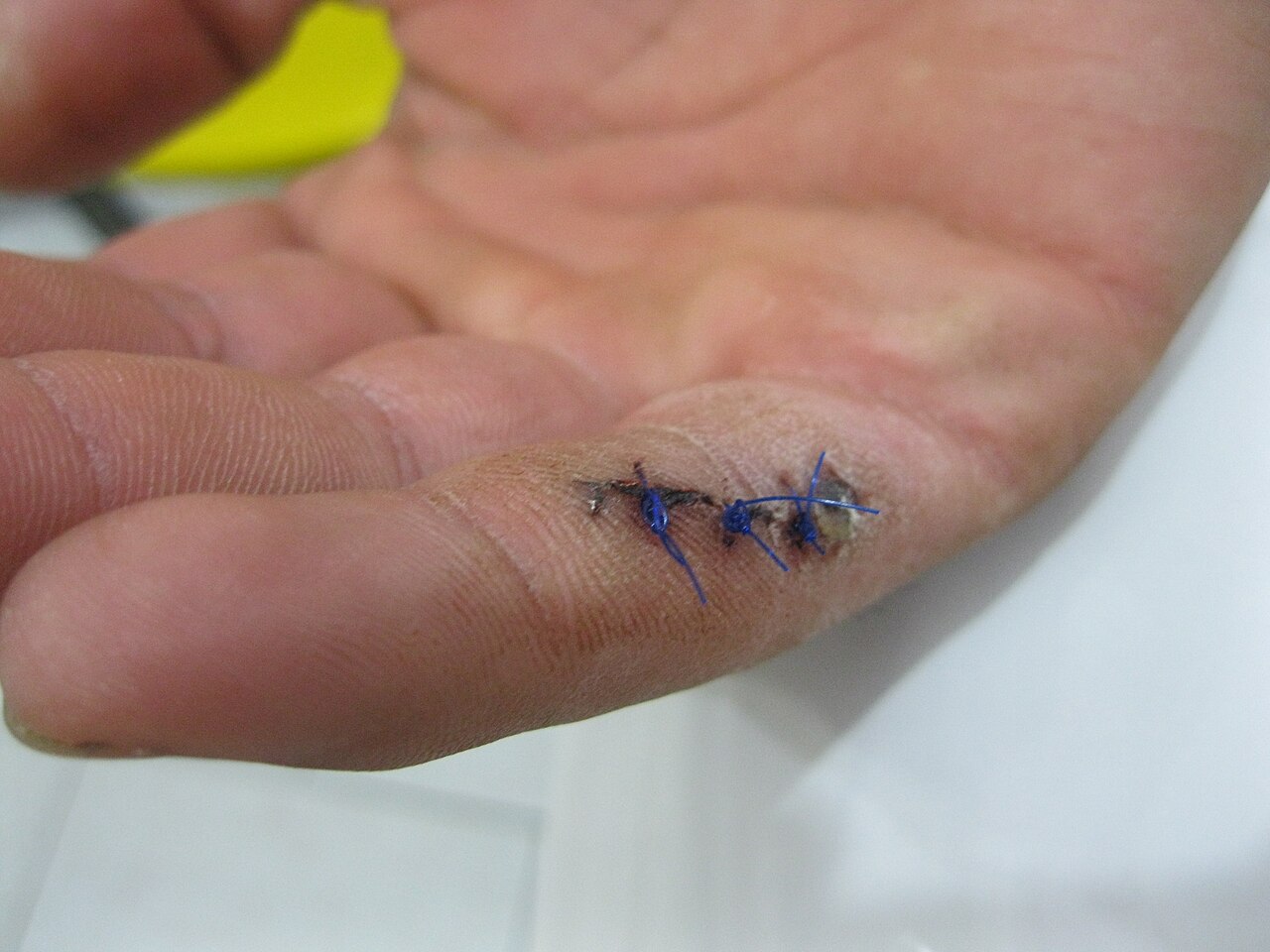
In a prospective study of 2,663 lacerations at three EDs, infection was 3% for wounds closed within 12 hours and 1.2% for those closed later (few late wounds, wide confidence interval).3 A family-medicine review suggests primary closure up to 18 hours for clean, uninfected wounds and up to 24 hours on the head.4
Antibiotics and bites
- Simple nonbite wounds: in a meta-analysis of 7 trials (1,734 patients), antibiotics did not prevent infection (OR 1.16, 95% CI 0.77–1.78).7
- Simple hand lacerations: 4.8% of 125 became infected. Infection was 7% with antibiotics and 4% without, not a significant difference, in an observational study.20
- Human bites: offer prophylaxis if the bite broke the skin and drew blood. Consider it if it broke the skin without blood but involves a high-risk area or a high-risk person.8
- Cat bites: offer prophylaxis if the bite drew blood; consider it if the wound could be deep.8
- Dog and other pet bites that drew blood: offer prophylaxis if the wound is deep, a puncture or crush, reaches bone, joint, tendon or vessels, or is visibly contaminated. Consider it for high-risk areas or people.8
- High-risk areas: hands, feet, face, genitals, skin over cartilage, and areas of poor circulation. High-risk people: diabetes, immunosuppression, asplenia or decompensated liver disease.8
- Closing bites: in trials of dog bites, primary closure did not change the share of wounds that stayed infection-free (RR 1.01, very low certainty).12 In one trial of 168 patients, all of whom got antibiotics, sutured wounds healed with better scar scores, and wounds treated within 8 hours had fewer infections (4.5% vs 22.2%).21
Which bites need antibiotics: NICE offers them for any human or cat bite that drew blood.8 A family-medicine review reserves them for high-risk bites: cat bites, deep punctures and wounds over 3 cm.4 An older Cochrane review found that prophylaxis reduced infection after human bites and hand bites (OR 0.10), but not after cat or dog bites.22
Tetanus
| Previous tetanus doses | Clean, minor wound | All other wounds* |
|---|---|---|
| Unknown or fewer than 3 | Vaccine: yes. TIG: no | Vaccine: yes. TIG: yes |
| 3 or more | Vaccine only if more than 10 years since the last dose. TIG: no | Vaccine only if 5 or more years since the last dose. TIG: no |
Unreviewed doses. Verify against the current label and your institution's protocol before giving anything.
From the CDC/ACIP recommendations.9 *Wounds contaminated with dirt, feces, soil or saliva, punctures, avulsions, and wounds from missiles, crush, burns or frostbite.9
- Treat an unknown or uncertain history as no doses.9
- Which vaccine: Tdap is preferred at age 11 and over if the patient has never had Tdap or doesn't know, and in pregnancy.9 Since 2019, either Td or Tdap may be used for patients who have already had Tdap.23
- TIG and vaccine together: separate syringes, separate sites.9
- HIV or severe immunodeficiency with a contaminated wound: give TIG regardless of vaccine history.9
- After an Arthus reaction to a tetanus vaccine, wait more than 10 years from the last dose, whatever the wound.9
Adult doses
| Drug | Adult dose | Notes |
|---|---|---|
| Local anesthesia | ||
| Lidocaine, plain | Up to 4.5 mg/kg; generally no more than 300 mg total | 1% = 10 mg/mL.11 |
| Lidocaine with epinephrine | Up to 7 mg/kg; generally no more than 500 mg total | See the callout on digits above.11,18 |
| Tetanus | ||
| Tdap | 0.5 mL IM | Indications in the table above. Td is an option if Tdap was given before.9,15,23 |
| Tetanus immune globulin | 250 units deep IM | Different limb and syringe from the vaccine.16 |
| Bites (NICE, adults) | ||
| Co-amoxiclav (amoxicillin-clavulanate) | 250/125 or 500/125 mg PO three times daily | 3 days for prophylaxis, 5 days for infected bites.8 |
| Penicillin allergy: doxycycline + metronidazole | Doxycycline 200 mg on day 1, then 100–200 mg daily; metronidazole 400 mg PO three times daily | Seek specialist advice in pregnancy.8 |
Unreviewed doses. Verify against the current label and your institution's protocol before giving anything.
Lidocaine limits are from the FDA label for healthy adults.11 Bite antibiotic doses are the UK NICE regimen; US tablet strengths differ, so check the label and local guidance.8
Aftercare and disposition
| Site | Remove sutures or staples at |
|---|---|
| Face | 3–5 days |
| Scalp, arms | 7–10 days |
| Trunk, legs, hands, feet | 10–14 days |
| Palms, soles | 14–21 days |
Removal times are expert opinion, from a family-medicine review.4
- Washing: in one study, uncovering wounds to bathe within the first 12 hours did not increase infection.4
- Bites: tell patients to come back if infection appears or worsens quickly, or doesn't improve within 24–48 hours of antibiotics.8
- Refer bites to hospital for severe cellulitis, abscess, bone or joint infection, necrotizing fasciitis, sepsis, or penetration of arteries, joints, nerves, muscle, tendon, bone or the central nervous system.8
Pitfalls
- Refusing to close a clean wound only because several hours have passed since injury.3,4
- Closing over a tendon, nerve or nail bed injury in the hand without referral.4
- Trusting a quick look for a foreign body. About a third are missed on first inspection, and tiny glass fragments can be missed on radiographs.4,10
- Counting an unknown tetanus history as complete, or forgetting TIG for a dirty wound in someone with fewer than 3 doses.9
- Prescribing antibiotics for simple nonbite wounds,7 or not offering them for a human or cat bite that drew blood.8
- Gluing a wound that crosses a joint or is under tension.4
How strong is the evidence?
Tetanus advice is a national recommendation.9 Most other laceration care rests on single trials or older meta-analyses: tap water and glove trials are reasonably large,1,5,6 but the pooled evidence on irrigation fluid is very low certainty.2 Bite closure evidence is very low certainty and covers only dog bites.12 Suture removal times and timing cut-offs are expert opinion.4
On-shift teaching
Questions to ask a learner at the bedside. Tap a question to see the answer. Every answer uses facts cited above.
Q1A patient with a clean forearm laceration arrives 14 hours after injury. Can you close it?
Q2Which wound features predicted infection in the largest prospective cohort?
Q3Tap water or sterile saline for irrigation?
Q4A patient has had 3 tetanus doses, the last one 7 years ago, and has a dirty puncture wound. What do they need?
Q5When does a scalp laceration suit the hair apposition technique?
Q6Which dog bites does NICE say should get antibiotic prophylaxis?
References
What this page is built on
23 sources, cited 111 times. Dots are sources, filled by how far each was read; stronger color means a larger share of the citations. Tap a tier to see its sources.
Checked by the writer, not a physician. The dots show how each source was read, not that anyone has confirmed the claims.
- 1Moscati RM, Mayrose J, Reardon RF, Janicke DM, Jehle DV. A multicenter comparison of tap water versus sterile saline for wound irrigation. Acad Emerg Med. 2007;14(5):404–409.
- 2Fernandez R, Green HL, Griffiths R, Atkinson RA, Ellwood LJ. Water for wound cleansing. Cochrane Database Syst Rev. 2022;9(9):CD003861.
- 3Quinn JV, Polevoi SK, Kohn MA. Traumatic lacerations: what are the risks for infection and has the 'golden period' of laceration care disappeared? Emerg Med J. 2014;31(2):96–100.
- 4Forsch RT, Little SH, Williams C. Laceration repair: a practical approach. Am Fam Physician. 2017;95(10):628–636.
- 5Perelman VS, Francis GJ, Rutledge T, et al. Sterile versus nonsterile gloves for repair of uncomplicated lacerations in the emergency department: a randomized controlled trial. Ann Emerg Med. 2004;43(3):362–370.
- 6Zwaans JJM, Raven W, Rosendaal AV, et al. Non-sterile gloves and dressing versus sterile gloves, dressings and drapes for suturing of traumatic wounds in the emergency department: a non-inferiority multicentre randomised controlled trial. Emerg Med J. 2022;39(9):650–654.
- 7Cummings P, Del Beccaro MA. Antibiotics to prevent infection of simple wounds: a meta-analysis of randomized studies. Am J Emerg Med. 1995;13(4):396–400.
- 8National Institute for Health and Care Excellence. Human and animal bites: antimicrobial prescribing (NG184). NICE; November 2020.
- 9Liang JL, Tiwari T, Moro P, et al. Prevention of pertussis, tetanus, and diphtheria with vaccines in the United States: recommendations of the Advisory Committee on Immunization Practices (ACIP). MMWR Recomm Rep. 2018;67(2):1–44.
- 10Courter BJ. Radiographic screening for glass foreign bodies: what does a "negative" foreign body series really mean? Ann Emerg Med. 1990;19(9):997–1000.
- 11Lidocaine hydrochloride and epinephrine injection, USP. FDA prescribing information (Henry Schein).
- 12Bhaumik S, Kirubakaran R, Chaudhuri S. Primary closure versus delayed or no closure for traumatic wounds due to mammalian bite. Cochrane Database Syst Rev. 2019;12(12):CD011822.
- 13Farion K, Osmond MH, Hartling L, et al. Tissue adhesives for traumatic lacerations in children and adults. Cochrane Database Syst Rev. 2002;(3):CD003326.
- 14Hock MO, Ooi SB, Saw SM, Lim SH. A randomized controlled trial comparing the hair apposition technique with tissue glue to standard suturing in scalp lacerations (HAT study). Ann Emerg Med. 2002;40(1):19–26.
- 15BOOSTRIX (tetanus toxoid, reduced diphtheria toxoid and acellular pertussis vaccine, adsorbed). FDA prescribing information (GlaxoSmithKline).
- 16HyperTET (tetanus immune globulin [human]). FDA prescribing information (Grifols).
- 17Morgenstern J. Are sterile gloves necessary when repairing lacerations in the emergency department? First10EM; November 14, 2022.
- 18Prabhakar H, Rath S, Kalaivani M, Bhanderi N. Adrenaline with lidocaine for digital nerve blocks. Cochrane Database Syst Rev. 2015;(3):CD010645.
- 19Xu B, Xu B, Wang L, et al. Absorbable versus nonabsorbable sutures for skin closure: a meta-analysis of randomized controlled trials. Ann Plast Surg. 2016;76(5):598–606.
- 20Roodsari GS, Zahedi F, Zehtabchi S. The risk of wound infection after simple hand laceration. World J Emerg Med. 2015;6(1):44–47.
- 21Paschos NK, Makris EA, Gantsos A, Georgoulis AD. Primary closure versus non-closure of dog bite wounds: a randomised controlled trial. Injury. 2014;45(1):237–240.
- 22Medeiros I, Saconato H. Antibiotic prophylaxis for mammalian bites. Cochrane Database Syst Rev. 2001;(2):CD001738.
- 23Havers FP, Moro PL, Hunter P, Hariri S, Bernstein H. Use of tetanus toxoid, reduced diphtheria toxoid, and acellular pertussis vaccines: updated recommendations of the Advisory Committee on Immunization Practices — United States, 2019. MMWR Morb Mortal Wkly Rep. 2020;69(3):77–83.
AI-generated draft. Not reviewed by a physician. This page is for education only and may contain errors, including in doses. Do not use it to diagnose, treat or make decisions about any patient. Rely on your own clinical judgment, your institution's protocols and current drug labeling. Reading this page does not create a physician-patient relationship. Full terms