Hypokalemia
Bottom line
- Hypokalemia is potassium under 3.5 mEq/L. It shows up in roughly 5–11% of ED patients. Severe cases are often symptomatic, most often with weakness and muscle pain.1,3
- Get an ECG and a magnesium level. Low magnesium is easy to miss and needs treating alongside the potassium.1
- Oral replacement is safe and preferred when the patient isn't critical.1 IV potassium chloride usually runs at no more than 10 mEq/h. Faster rates need continuous ECG monitoring and frequent potassium checks.2
- Expect a small rise per dose. In ICU patients, each 20 mEq IV raised potassium by about 0.25 mEq/L on average.7
- Find the cause. Diuretics, GI losses and poor intake are common. In periodic paralysis, replace cautiously: potassium can rebound high.1,3,11
Severity
Bands from LITFL.5 KDIGO defines hypokalemia as under 3.5 mmol/L but sets no severity bands, and lists a consensus definition as a research gap.1 Studies use different cutoffs for "severe": under 2.6 in one ED study and under 3.0 in a hospital audit.3,13 For potassium, 1 mmol/L equals 1 mEq/L.
First steps
- Get a 12-lead ECG and a magnesium level.1 Look for U waves, ST depression, flat or inverted T waves, and ectopy.3,5
- Ask about weakness, paralysis and palpitations. Weakness and muscle pain were the most common symptoms of severe hypokalemia in the ED.3
- Choose the route. Oral is preferred when the patient isn't critical. Use IV potassium chloride when hypokalemia is severe or the patient can't take it by mouth.1
- Treat low magnesium alongside the potassium.1
- Look for the cause: drugs (especially thiazides), GI losses, poor intake, and shifts into cells.1,3
- Recheck potassium after replacement. Serial monitoring is part of treatment.1
- ECG changes, arrhythmia, paralysis, or severe hypokalemia?YesIV potassium chloride on a monitor. Usually no more than 10 mEq/h. KDIGO accepts up to 20 mEq/h when hypokalemia is severe and oral intake isn't possible.1,2K under 2 with ECG changes or paralysis: up to 40 mEq/h, only with continuous ECG and frequent potassium checks. The strongest solutions go centrally.2
- No
- Magnesium low?YesReplace magnesium too. KDIGO calls it important to address while correcting potassium.1
- Either wayDKA or HHS?YesHold insulin until K is above 3.5. Replace potassium at 10 mmol/h.9
- No
- Then, for everyone
ECG
Changes include flattened or inverted T waves, ST depression, prominent U waves (best seen in V2–V3), a longer PR interval and an apparent long QT that is really a QU interval. Ectopy, atrial fibrillation, ventricular tachycardia and torsades can follow.5 LITFL notes that changes usually don't appear until potassium is around 2.5–2.9.5
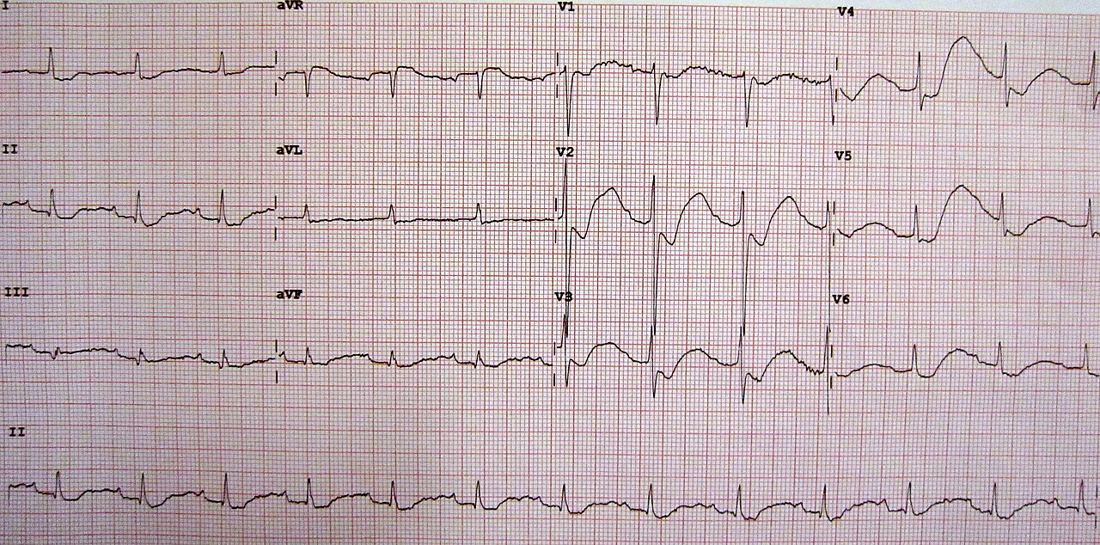
| Study | What the ECG showed |
|---|---|
| 53 ED patients, K < 2.6 | ECG changes in 69%: mostly U waves, then ST depression and ventricular ectopics.3 |
| 79,599 ED patients, four centers | Abnormal ECG in 40% of those with K < 3.5: T-wave flattening 27%, ST depression 16%, long QTc 14%.4 |
| 1,010 ED patients | Below 3.9, each 1 mEq/L drop lengthened QTc by 43 ms in women and 29.5 ms in men.6 |
The ECG is a poor guide to short-term risk. In the four-center cohort, ECG abnormalities carried about the same risk of 7-day death or ICU admission in hypokalemic patients as in patients with normal potassium. Below 3.0, only a heart rate over 100 predicted both.4 KDIGO puts U waves and ventricular arrhythmias at 25–66% of severe cases.1
Replacement
| Route | Adult dose | Notes |
|---|---|---|
| Oral (preferred when not critical) | ||
| Potassium chloride, oral | 40–100 mEq/day for depletion; ≤ 20 mEq per dose | Divide doses above 20 mEq a day. Take with food and water.1,8 |
| IV potassium chloride | ||
| Usual (K > 2.5) | ≤ 10 mEq/h; ≤ 200 mEq/24 h | Use an infusion pump at a slow, controlled rate.2 |
| Severe, can't take oral | Up to 20 mEq/h | KDIGO calls this a safe alternative.1 20 mEq in 100 mL over 1 hour was used peripherally and centrally in an ICU series.7 |
| Urgent (K < 2 with ECG changes or paralysis) | Up to 40 mEq/h; ≤ 400 mEq/24 h | Only with continuous ECG and frequent potassium checks.2 |
| Concentrations of 300–400 mEq/L | Central line only | Peripheral infusion can cause pain and vein damage.1,2 |
Unreviewed doses. Verify against the current label and your institution's protocol before giving anything.
For a true deficit, each 0.3 mEq/L drop in serum potassium reflects roughly 100 mEq of lost body potassium.1 The oral label puts the loss needed to cause hypokalemia at 200 mEq or more.8 Serum potassium doesn't necessarily reflect tissue potassium.2
How fast IV potassium can run: the FDA label says rates should not usually exceed 10 mEq/h when potassium is above 2.5.2 KDIGO calls up to 20 mEq/h a safe alternative in severe hypokalemia when oral intake isn't possible.1 An ICU series of 495 infusion sets at 20 mEq/h found no life-threatening arrhythmias, but 10 episodes of mild hyperkalemia.7
Magnesium
- KDIGO calls low magnesium underrecognized and important to address when correcting hypokalemia. It may be harder to fix in patients taking proton pump inhibitors.1
- LITFL suggests replacing potassium to at least 4.0 mmol/L and magnesium to at least 1.0 mmol/L (about 2.4 mg/dL).5 Observational studies suggest an optimal potassium range of 4–5 mmol/L.1
- We found no magnesium dose in the sources we read. Dose per institutional protocol and label.
Special situations
Diabetic ketoacidosis and HHS
If potassium is under 3.5, start replacement at 10 mmol/h and delay insulin until potassium is above 3.5. Insulin, fixing acidosis and fluids all lower potassium.9
Periodic paralysis
- Potassium moves into cells rather than being lost. KDIGO stresses telling hypokalemic periodic paralysis apart from other causes, because of the risk of rebound hyperkalemia after treatment.1
- Thyrotoxic periodic paralysis clues: an adult man with no family history, systolic hypertension and tachycardia. Many patients have no obvious thyroid symptoms. Potassium can restore strength quickly but risks rebound hyperkalemia; nonselective beta-blockers are an alternative.10
- In 33 US patients with thyrotoxic periodic paralysis, all were men (median age 28; 85% Hispanic), and 23% had rebound hyperkalemia after treatment. The authors advise cautious repletion.11
Low sodium too
Giving potassium can raise serum sodium. Take care when correcting hypokalemia in a patient with severe hyponatremia.1
Causes
- Drugs: a common cause in adults, especially thiazide diuretics (about 5-fold higher risk).1
- GI losses and poor intake: malnutrition and diuretics were the main causes of severe hypokalemia in the ED.3 Nearly a quarter of high-risk patients become hypokalemic after colonoscopy bowel preparation.1
- Shift into cells: insulin, catecholamine excess and hypokalemic periodic paralysis.1
- Aldosterone excess: suspect it in hypertension with normal kidney function. An aldosterone-to-renin ratio may make the diagnosis.1
- Tubulopathies: in normotensive patients with no obvious cause, a spot urine sodium and chloride helps separate tubulopathy from hidden vomiting, laxative or diuretic use.1
KDIGO advises against relying on urine potassium alone, which varies within patients and is not specific. It does not recommend the transtubular potassium gradient.1
Disposition
- No agreed thresholds. KDIGO notes that potassium levels for starting treatment and for ED referral have not been defined.1
- Needs fast IV replacement: a monitored bed. Rates above the usual 10 mEq/h need continuous ECG monitoring and frequent potassium checks.2
- Mild and well: in a 724-patient matched cohort with potassium 3.0–3.4, replacing it in the ED did not change hospital mortality (adjusted OR 0.81, 95% CI 0.36–1.79).12
- Before discharge, plan a recheck. In a hospital audit of potassium under 3.0, 30% of patients went home with low potassium, and 6.4% never had it retested.13
Pitfalls
- Replacing potassium and forgetting magnesium.1
- Running IV potassium fast without a monitor. Above the usual rate, the label requires continuous ECG monitoring.2
- Giving the strongest solutions (300–400 mEq/L) through a peripheral line.2
- Starting insulin in DKA while potassium is under 3.5.9
- Treating thyrotoxic periodic paralysis like a deficit. Rebound hyperkalemia is common.11
- Discharging without a plan to recheck.13
How strong is the evidence?
Weak. KDIGO covered chronic hypokalemia and diagnosis but did not address emergency management, and links between hypokalemia and outcomes come from observational studies.1 Rate limits come from the drug label and an old ICU series.2,7 The evidence for ED replacement of mild hypokalemia is one retrospective cohort.12
On-shift teaching
Questions to ask a learner at the bedside. Tap a question to see the answer. Every answer uses facts cited above.
Q1What's the usual maximum IV potassium chloride rate, and when can it go higher?
Q2How much does 20 mEq of IV potassium chloride raise the serum level?
Q3Which ECG findings are typical of hypokalemia?
Q4Potassium is 3.1 in a patient with DKA. What happens to the insulin?
Q5A young man has sudden leg weakness, tachycardia and a potassium of 1.9. Why be careful with replacement?
Q6Why check magnesium?
References
What this page is built on
14 sources, cited 94 times. Dots are sources, filled by how far each was read; stronger color means a larger share of the citations. Tap a tier to see its sources.
Checked by the writer, not a physician. The dots show how each source was read, not that anyone has confirmed the claims.
- 1Clase CM, Carrero JJ, Ellison DH, et al.; KDIGO Conference Participants. Potassium homeostasis and management of dyskalemia in kidney diseases: conclusions from a Kidney Disease: Improving Global Outcomes (KDIGO) Controversies Conference. Kidney Int. 2020;97(1):42–61.
- 2Potassium Chloride Injection (ICU Medical). US prescribing information. DailyMed.
- 3Marti G, Schwarz C, Leichtle AB, et al. Etiology and symptoms of severe hypokalemia in emergency department patients. Eur J Emerg Med. 2014;21(1):46–51.
- 4Kildegaard H, Brabrand M, Forberg JL, et al. Prevalence and prognostic value of electrocardiographic abnormalities in hypokalemia: a multicenter cohort study. J Intern Med. 2024;295(4):544–556.
- 5Burns E, Buttner R. Hypokalaemia. Life in the Fast Lane, ECG Library; updated October 2024.
- 6Marill KA, Miller ES. Hypokalemia in women and methadone therapy are the strongest non-cardiologic factors associated with QT prolongation in an emergency department setting. J Electrocardiol. 2017;50(4):416–423.
- 7Kruse JA, Carlson RW. Rapid correction of hypokalemia using concentrated intravenous potassium chloride infusions. Arch Intern Med. 1990;150(3):613–617.
- 8Klor-Con M (potassium chloride) extended-release tablets. US prescribing information. DailyMed.
- 9Umpierrez GE, Davis GM, ElSayed NA, et al. Hyperglycemic crises in adults with diabetes: a consensus report. Diabetes Care. 2024;47(8):1257–1275.
- 10Lin SH. Thyrotoxic periodic paralysis. Mayo Clin Proc. 2005;80(1):99–105.
- 11Gulde A, Zhang S, Hussain I. Thyrotoxic periodic paralysis: an under-recognized cause of paralysis in young Hispanic men. J Emerg Med. 2023;64(2):200–207.
- 12Wongtanasarasin W, Meelarp N. Replacing potassium in the emergency department may not decrease the hospital mortality in mild hypokalemia: a propensity score matching analysis. Medicina (Kaunas). 2023;59(11):1912.
- 13Paltiel O, Salakhov E, Ronen I, Berg D, Israeli A. Management of severe hypokalemia in hospitalized patients: a study of quality of care based on computerized databases. Arch Intern Med. 2001;161(8):1089–1095.
- 14Farkas J. Hypokalemia. Internet Book of Critical Care, EMCrit. Further reading; not used for any claim above.
AI-generated draft. Not reviewed by a physician. This page is for education only and may contain errors, including in doses. Do not use it to diagnose, treat or make decisions about any patient. Rely on your own clinical judgment, your institution's protocols and current drug labeling. Reading this page does not create a physician-patient relationship. Full terms