

Hand fractures and tendon injuries
Bottom line
- Look for what turns a simple injury into a surgical one. Malrotation (scissoring) needs surgery.1,2 Look at the tendon through its full range in every wound, because a partial cut can hide when the hand is at rest.1
- Same-day hand surgery referral for open fractures, fight bites and flexor sheath infection. Each needs surgery within 24 hours.3,4,5
- Cut tendons and nerves: hand clinic ideally within 24 hours, and repair within 4 days.6,7,8
- Buddy tape the boxer's fracture. For a fifth metacarpal neck fracture without rotation, buddy taping gave the same function as a cast, with less time off work.9,10,11 Reduction does not improve the outcome.2
- Mallet finger: splint the DIP joint straight, around the clock. Get an X-ray, leave the PIP joint free, and refer within 72 hours, or the same day if the wound is open.12
First steps
- Watch the fingers as the patient slowly makes a fist. All of them should point toward the scaphoid. A finger that crosses its neighbor means malrotation, and that needs surgery.1
- Explore every wound for foreign bodies, and see the tendon through its full excursion. Extend the wound if you need to.1
- X-ray suspected fractures and every mallet finger, to look for a fracture and joint subluxation.1,12 Check the lateral view for a dislocated MCP joint next to a proximal metacarpal fracture.1
- Sort by urgency (FIG 2): open fractures, fight bites and flexor sheath infections the same day; cut tendons and nerves to hand clinic ideally within 24 hours; closed fractures within 72 hours.3,4,5,6,13
- Splint and give written advice. Tell the patient when and how to get help.2,12
- Open fracture (not a tuft fracture), fight bite, or suspected flexor sheath infection?
- No
- No
- NoMalrotation, or an unstable thumb or PIP joint injury?
- No
How fast, and where
| Injury | Referral | Surgery, if needed |
|---|---|---|
| Same day (BSSH category orange) | ||
| Open fracture (not a tuft fracture) | Same-day review; may be admitted for elevation and antibiotics | Within 24 h, or washout and closure within 24 h3 |
| Fight bite (punch against teeth) | Urgent surgical exploration is mandatory | Within 24 h of injury, and sooner for fight bites4 |
| Flexor sheath infection | Unit with a consultant hand surgeon | Within 24 h of the decision to operate5 |
| Open mallet injury | Same day | Washout within 24 h12 |
| Next soft-tissue hand clinic, ideally within 24 hours (category green) | ||
| Flexor tendon laceration | Hand clinic, ideally ≤ 24 h | Within 4 days, in an operating theatre6 |
| Extensor tendon laceration | Hand clinic, preferably ≤ 24 h | Within 4 days for open wounds7 |
| Nerve laceration | Hand clinic, preferably ≤ 24 h | Within 4 days, with a microscope available8 |
| Next fracture clinic, within 72 hours (category green) | ||
| Closed hand fracture | Clinic within 72 h | Within 7 days if fixation is the first choice13 |
| Closed mallet injury | Hand surgeon or therapist within 72 h | Usually none; see below12 |
Categories and time targets from the British Society for Surgery of the Hand (BSSH) standards of care in hand trauma.3,4,5,6,7,8,12,13 They describe UK services; local hand-surgery pathways may differ.
Fractures
Most closed hand fractures are treated without surgery. Surgery is chosen only when it will beat non-operative care.13
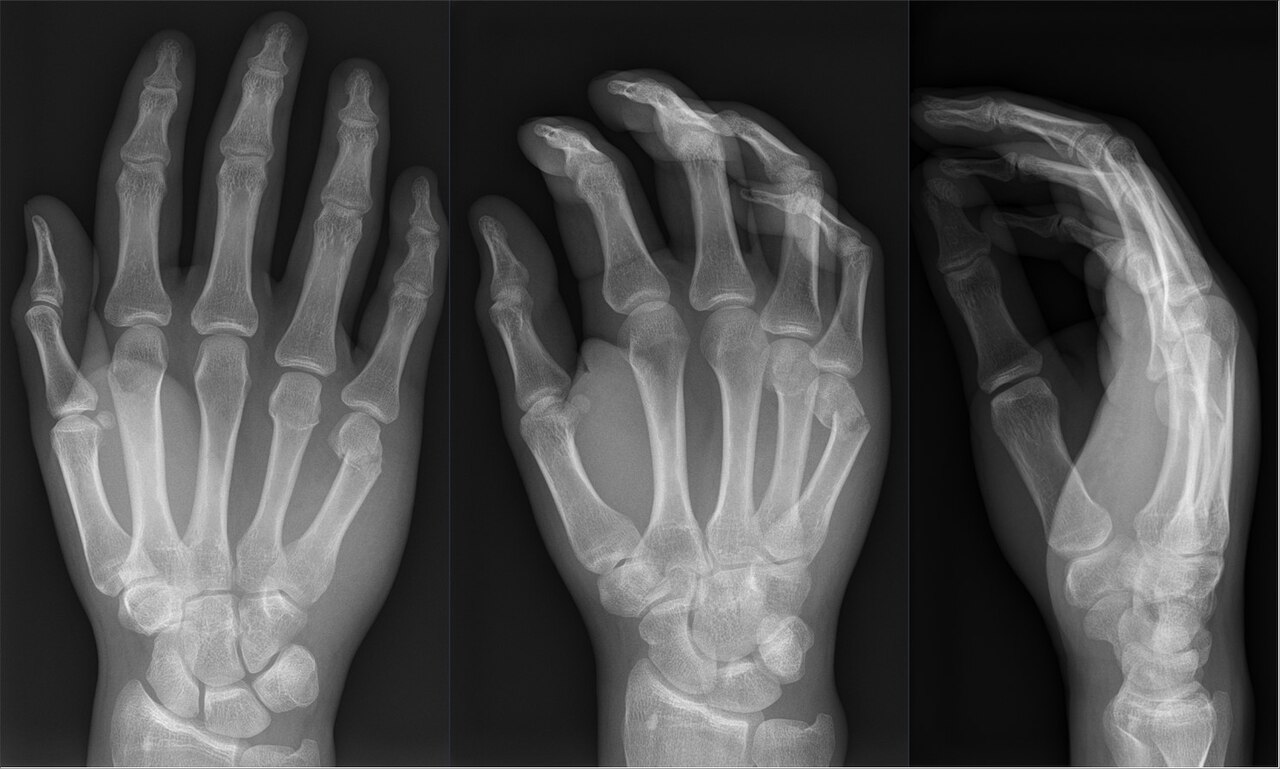
Boxer's fracture (fifth metacarpal neck)
- Treat simple impacted fractures conservatively. They heal without a significant loss of grip strength. Manipulation does not improve the outcome unless it is part of an operation.2
- Buddy taping and early movement is the usual treatment, and needs only one visit. Use an ulnar gutter splint in the position of safe immobilization, then hand therapy, for excessive pain or swelling or an MCP extension lag over 45°.2
- Consider surgery for rotational deformity, an oblique or unusual fracture, a distal fragment completely off-ended, an open wound, or a job where a prominent knuckle in the palm would get in the way.2
| Trial | Who | Result |
|---|---|---|
| Pellatt 2019, two Australian hospitals | 97 adults analyzed, uncomplicated boxer's fracture; buddy tape vs plaster | Median quickDASH 0 in both groups at 12 weeks. Work missed: median 0 vs 2 days.9 |
| Martínez-Catalán 2020 | 72 adults, volar angulation under 70°, no rotation; buddy tape vs reduction and cast | Better function at 3 weeks (DASH 19.7 vs 44.6), 28 fewer days off work, fewer complications.10 |
| van Aaken 2016, four centers | 68 patients, angulation ≤ 70°, no rotation; soft wrap and buddy tape vs reduction and cast | Noninferior at 4 months; 11 fewer days off work. Patients must accept losing the knuckle.11 |
Metacarpal shaft and base
- Single displaced spiral or oblique shaft fracture: in a trial of 42 patients, non-operative care with unrestricted movement matched screw fixation for grip strength at 1 year (104% vs 96% of the other hand). Sick leave was shorter (12 vs 35 days), and surgery cost 2.8 times as much.15
- Proximal metacarpal fractures are easy to miss because the bones overlap on X-ray. Check the lateral view for a dislocated MCP joint next to them.1
- Two or more metacarpal fractures from a high-energy injury raise the risk of compartment syndrome.1
- Splinting: a deep ulnar gutter for metacarpals 3 to 5 and a deep radial gutter for 1 and 2. A wrist block avoids the distortion a hematoma block causes during reduction.1
Thumb and finger joints
- Bennett fracture (intra-articular fracture at the base of the thumb metacarpal): displaced ones need surgical fixation. Rolando fracture (comminuted version): unstable, needs fixation. Check the thenar compartment in both.1
- Skier's thumb (ulnar collateral ligament of the thumb MCP joint): a complete tear is usually operative. Splint in a thumb spica with slight adduction.1
- PIP dislocations: most are dorsal, and most of those can be reduced in the ED. A volar plate avulsion fragment, instability after reduction, or a volar dislocation needs hand follow-up; a volar dislocation can tear the central slip and lead to a boutonnière deformity.1
Open fractures
- Refer the same day for surgery within 24 hours. If definitive fixation can't happen in that time, washout and closure should.3
- Antibiotics while awaiting surgery, stopped at 72 hours or at definitive closure, whichever is sooner, subject to clinical judgment.3 The standard gives no drug or dose; follow your local protocol.
- Open distal phalanx (tuft) fractures are the exception. The BSSH open fracture standard excludes them.3 In 4 trials (353 fractures), antibiotics did not change superficial infection rates, and no osteomyelitis occurred in 164 untreated fractures. Prompt irrigation and debridement matter more.14
Tendon and nerve injuries
- Examine the tendon through its full range of motion. A partial tear can hide in the resting position.1
- Danger zones: the back of the hand, where tendons lie just under the skin, and the palm proximal to the MCP joints, where the palmar arches sit.1
- Bedside ultrasound was more accurate than examination in 34 ED patients: sensitivity 100% and specificity 95%, against 100% and 76% for examination. It took less time than exploration, MRI or a consult.16 It is a small study.
- Splint tendon lacerations from the fingertips to the elbow so the proximal end does not retract.1
- Flexor tendons: next hand clinic, ideally within 24 hours, and repair within 4 days by a surgeon competent in flexor repair, in an operating theatre. Without rupture or infection, the patient can expect a functional range of motion at 3 months.6
- Extensor tendons: hand clinic preferably within 24 hours, and repair within 4 days for open wounds, in a theatre or at least a procedures room.7
- Digital nerves: hand clinic preferably within 24 hours, and microsurgical repair within 4 days.8
- Jersey finger (FDP avulsion, classically the ring finger): the injured fingertip lies straight in the resting cascade, with swelling and tenderness on the palm side of the DIP joint. X-ray, splint, and refer for repair within 7–14 days.1
Who repairs tendons, and where. The experts on Emergency Medicine Cases suggest considering ED repair of extensor tendon cuts when both ends are visible and little tissue is lost, and of flexor tendon cuts distal to the DIP joint.1 The BSSH standards call for repair by a surgeon competent in tendon repair, in a theatre or at least a procedures room, within 4 days.6,7 Follow your local hand service.
Mallet finger
- Splint the DIP joint in extension and leave the PIP joint free to move. X-ray for a fracture and subluxation.12
- No fracture, or a small fragment (under a third of the joint surface): splint 24/7, fitted by a hand therapist, with written advice.12
- Larger fragment without subluxation: splint, then get a lateral X-ray in the splint to confirm the joint has not slipped toward the palm.12
- Subluxed joint: discuss surgery versus manipulation and re-splinting.12 Open injury: surgical washout of the wound and DIP joint, and closure.12
- Duration: full time for 8 weeks after a tendon injury or 6 weeks after a bony one, then 2 more weeks during risky activities. If the droop comes back, restart full-time splinting in 2-week blocks.12
- Splint or surgery? A 2004 Cochrane review found too little evidence to say which splint is best, or when surgery is indicated; it stressed adherence.17 A 2023 meta-analysis found no high-level evidence that surgery beats splinting for tendinous or bony mallet finger.18
How long to splint. The BSSH standard says 8 weeks full time for tendon injuries and 6 for bony ones, then 2 weeks of protection.12 The "rule of 6s" on Emergency Medicine Cases is 6 weeks full time, then 6 weeks at night, and about 6 months to normal function.1 Both agree the splint must stay on around the clock in the first phase.
Anesthesia and antibiotics
| Agent | Adult dose | Notes |
|---|---|---|
| Lidocaine, plain | Max 4.5 mg/kg; generally ≤ 300 mg total | Label maximum for a healthy adult.19 |
| Lidocaine with epinephrine | Max 7 mg/kg; generally ≤ 500 mg total | The label urges caution in areas supplied by end arteries.19 See below for the evidence on fingers. |
Unreviewed doses. Verify against the current label and your institution's protocol before giving anything.
- Digital block technique: across 21 trials and 2 prospective studies, onset (mean 4.5 minutes), duration (mean 187 minutes) and injection pain did not differ between techniques. Patients and clinicians may prefer a single volar injection. Two dorsal injections may numb the proximal back of the finger better.20
- Antibiotics for simple hand wounds that need surgery: no reduction in infection (13 studies, 2,578 patients; RR 0.89, 95% CI 0.65–1.23). Open fractures, crush injuries and bites were excluded.21
- A 2025 network meta-analysis of hand trauma surgery (15 studies, 3,898 patients) found a pooled infection rate of 3.6%. Antibiotics did not significantly lower it, but the authors call the evidence inconclusive.22
Epinephrine in fingers. The lidocaine-with-epinephrine label urges caution with vasoconstrictors in areas supplied by end arteries, and warns that ischemic injury or necrosis may result.19 In 3,110 consecutive elective hand and finger injections of low-dose epinephrine (1:100,000 or less), none caused tissue loss and none needed phentolamine.23 A Cochrane review found too little evidence to recommend for or against it; none of its 4 small trials reported on ischemia.24
Pitfalls
- Missing malrotation. Check the cascade before and after any reduction.1
- Closing a wound over a partly cut tendon that was only examined at rest.1
- Treating a cut over the knuckle as a simple laceration. A fight bite needs urgent surgical exploration because of the high risk of joint sepsis.4
- Missing flexor sheath infection. Most need urgent washout. A 24-hour trial of IV antibiotics is reserved for very early, mild cases, a decision that may need senior surgical review.5
- Sending a mallet finger home without an X-ray, or with a splint that also holds the PIP joint.12
- Missing a Seymour fracture in a child: a physeal fracture of the distal phalanx with a nail bed injury. It needs surgery.12 A clue is the nail plate lying on top of the eponychial fold.1
How strong is the evidence?
The BSSH standards are professional consensus; the mallet standard is labeled that way.12 They set service standards and do not grade the evidence behind them. Several were due for revision in 2023–2025.5,6,13 Buddy taping of boxer's fractures rests on three small randomized trials.9,10,11 The ultrasound accuracy data come from 34 patients.16 The evidence on antibiotics for hand trauma surgery is inconclusive.22
On-shift teaching
Questions to ask a learner at the bedside. Tap a question to see the answer. Every answer uses facts cited above.
Q1How do you check for malrotation after a metacarpal fracture?
Q2Does a boxer's fracture without rotation need reduction and a cast?
Q3A patient cut their palm. When does the flexor tendon need to be repaired?
Q4How long does a mallet finger stay in the splint?
Q5Why is a small cut over the knuckle after a punch an emergency?
Q6Do simple hand wounds that need surgery need prophylactic antibiotics?
References
What this page is built on
24 sources, cited 146 times. Dots are sources, filled by how far each was read; stronger color means a larger share of the citations. Tap a tier to see its sources.
Checked by the writer, not a physician. The dots show how each source was read, not that anyone has confirmed the claims.
- 1Helman A, Distefano M, Sayal A. Episode 179 Hand injuries: finger tip injuries, jersey finger, finger dislocations, metacarpal fractures, thumb injuries, tendon lacerations. Emergency Medicine Cases; February 2023.
- 2British Society for Surgery of the Hand. Fifth metacarpal neck fractures. BSSH Standards of Care in Hand Trauma. BSSH; 2021.
- 3British Society for Surgery of the Hand. Open fractures (other than tuft fractures). BSSH Standards of Care in Hand Trauma. BSSH; 2021.
- 4British Society for Surgery of the Hand. Human and animal bites to the hand. BSSH Standards of Care in Hand Trauma. BSSH; 2021.
- 5British Society for Surgery of the Hand. Flexor sheath infection. BSSH Standards of Care in Hand Trauma. BSSH; 2021.
- 6British Society for Surgery of the Hand. Lacerations with flexor tendon involvement. BSSH Standards of Care in Hand Trauma. BSSH; 2021.
- 7British Society for Surgery of the Hand. Lacerations with extensor tendon involvement. BSSH Standards of Care in Hand Trauma. BSSH; 2021.
- 8British Society for Surgery of the Hand. Lacerations with nerve involvement. BSSH Standards of Care in Hand Trauma. BSSH; 2021.
- 9Pellatt R, Fomin I, Pienaar C, et al. Is buddy taping as effective as plaster immobilization for adults with an uncomplicated neck of fifth metacarpal fracture? A randomized controlled trial. Ann Emerg Med. 2019;74(1):88–97.
- 10Martínez-Catalán N, Pajares S, Llanos L, et al. A prospective randomized trial comparing the functional results of buddy taping versus closed reduction and cast immobilization in patients with fifth metacarpal neck fractures. J Hand Surg Am. 2020;45(12):1134–1140.
- 11van Aaken J, Fusetti C, Luchina S, et al. Fifth metacarpal neck fractures treated with soft wrap/buddy taping compared to reduction and casting: results of a prospective, multicenter, randomized trial. Arch Orthop Trauma Surg. 2016;136(1):135–142.
- 12British Society for Surgery of the Hand. Mallet injuries: standards for treatment. BSSH Standards of Care in Hand Trauma. BSSH; 2020.
- 13British Society for Surgery of the Hand. Closed hand fractures. BSSH Standards of Care in Hand Trauma. BSSH; 2021.
- 14Metcalfe D, Aquilina AL, Hedley HM. Prophylactic antibiotics in open distal phalanx fractures: systematic review and meta-analysis. J Hand Surg Eur Vol. 2016;41(4):423–430.
- 15Peyronson F, Ostwald CS, Hailer NP, et al. Nonoperative versus operative treatment for displaced finger metacarpal shaft fractures: a prospective, noninferiority, randomized controlled trial. J Bone Joint Surg Am. 2023;105(2):98–106.
- 16Wu TS, Roque PJ, Green J, et al. Bedside ultrasound evaluation of tendon injuries. Am J Emerg Med. 2012;30(8):1617–1621.
- 17Handoll HH, Vaghela MV. Interventions for treating mallet finger injuries. Cochrane Database Syst Rev. 2004;(3):CD004574.
- 18Peng C, Huang RW, Chen SH, et al. Comparative outcomes between surgical treatment and orthosis splint for mallet finger: a systematic review and meta-analysis. J Plast Surg Hand Surg. 2023;57(1–6):54–63.
- 19Xylocaine (lidocaine HCl and epinephrine) injection. US prescribing information. DailyMed.
- 20Borbón TY, Qu P, Coleman-Satterfield TT, et al. Digital nerve blocks: a systematic review and meta-analysis. JACEP Open. 2022;3(4):e12753.
- 21Murphy GR, Gardiner MD, Glass GE, et al. Meta-analysis of antibiotics for simple hand injuries requiring surgery. Br J Surg. 2016;103(5):487–492.
- 22Yusuf S, Zhang C, Takenoshita M, et al. Prophylactic antibiotics in hand trauma surgery: a network meta-analysis. Br J Surg. 2025;112(9):znaf191.
- 23Lalonde D, Bell M, Benoit P, et al. A multicenter prospective study of 3,110 consecutive cases of elective epinephrine use in the fingers and hand: the Dalhousie Project clinical phase. J Hand Surg Am. 2005;30(5):1061–1067.
- 24Prabhakar H, Rath S, Kalaivani M, Bhanderi N. Adrenaline with lidocaine for digital nerve blocks. Cochrane Database Syst Rev. 2015;(3):CD010645.
AI-generated draft. Not reviewed by a physician. This page is for education only and may contain errors, including in doses. Do not use it to diagnose, treat or make decisions about any patient. Rely on your own clinical judgment, your institution's protocols and current drug labeling. Reading this page does not create a physician-patient relationship. Full terms