

Fever in children 3 to 36 months
Bottom line
- How the child looks matters more than the number. Use the traffic light signs: color, activity, breathing, circulation and hydration. Over 6 months, the height of the fever alone does not identify serious illness.1
- Shock, an unrousable child or signs of meningococcal disease need IV antibiotics now. Give a third-generation cephalosporin and a 10 mL/kg fluid bolus for shock.1
- Urinary tract infection is now the most common serious bacterial infection in febrile children under 2, at about 5–7%, and higher in some groups.2,3 Consider urine testing in any well-appearing child aged 2 months to 2 years with fever and no source, especially at higher risk.2
- A viral illness lowers the risk of UTI but does not exclude it.2 Occult bacteremia has become rare since conjugate vaccines.2
- Don't send a well child home on oral antibiotics for fever without a source. Send them home with clear advice on warning signs.1
Assess
- First, look for immediately life-threatening features: airway, breathing, circulation and level of consciousness. Ask whether this could be sepsis.1
- Record temperature, heart rate, respiratory rate and capillary refill time. Check blood pressure if heart rate or capillary refill is abnormal.1
- Take a parent's report of fever seriously.1 Fever in the ACEP policy is 38°C (100.4°F) or higher.2 NICE advises an axillary electronic or tympanic thermometer from 4 weeks to 5 years, and not routinely the oral or rectal route.1
- Antipyretic response doesn't help. Whether the fever falls after an antipyretic does not separate serious from minor illness.1
- Fever duration does not predict serious illness, but fever for 5 days or more should prompt an assessment for Kawasaki disease.1
| Green · low risk | Amber · intermediate | Red · high risk | |
|---|---|---|---|
| Color | Normal | Pallor reported by parent | Pale, mottled, ashen or blue |
| Activity | Responds normally, content or smiles, stays awake or wakes quickly, strong cry | Not responding normally, no smile, wakes only with prolonged stimulation, less active | No response to social cues, looks ill to a clinician, does not wake or stay awake, weak, high-pitched or continuous cry |
| Breathing | — | Nasal flaring; RR > 50 (6–12 mo) or > 40 (> 12 mo); SpO₂ ≤ 95%; crackles | Grunting; RR > 60; moderate or severe chest indrawing |
| Circulation, hydration | Normal skin and eyes, moist mucous membranes | Tachycardia (> 160 under 12 mo, > 150 at 12–24 mo, > 140 at 2–5 y); capillary refill ≥ 3 s; dry mucous membranes; poor feeding; less urine | Reduced skin turgor |
| Other | None of the amber or red signs | Age 3–6 mo with temperature ≥ 39°C; fever ≥ 5 days; rigors; swollen limb or joint; not using a limb | Non-blanching rash; bulging fontanelle; neck stiffness; status epilepticus; focal neurological signs or seizures |
Simplified from the NICE traffic light system for children under 5. Any red sign puts the child at high risk; any amber sign with no red sign, at intermediate risk.1 Interpret the table in light of a child's learning disability.1
Look for a source
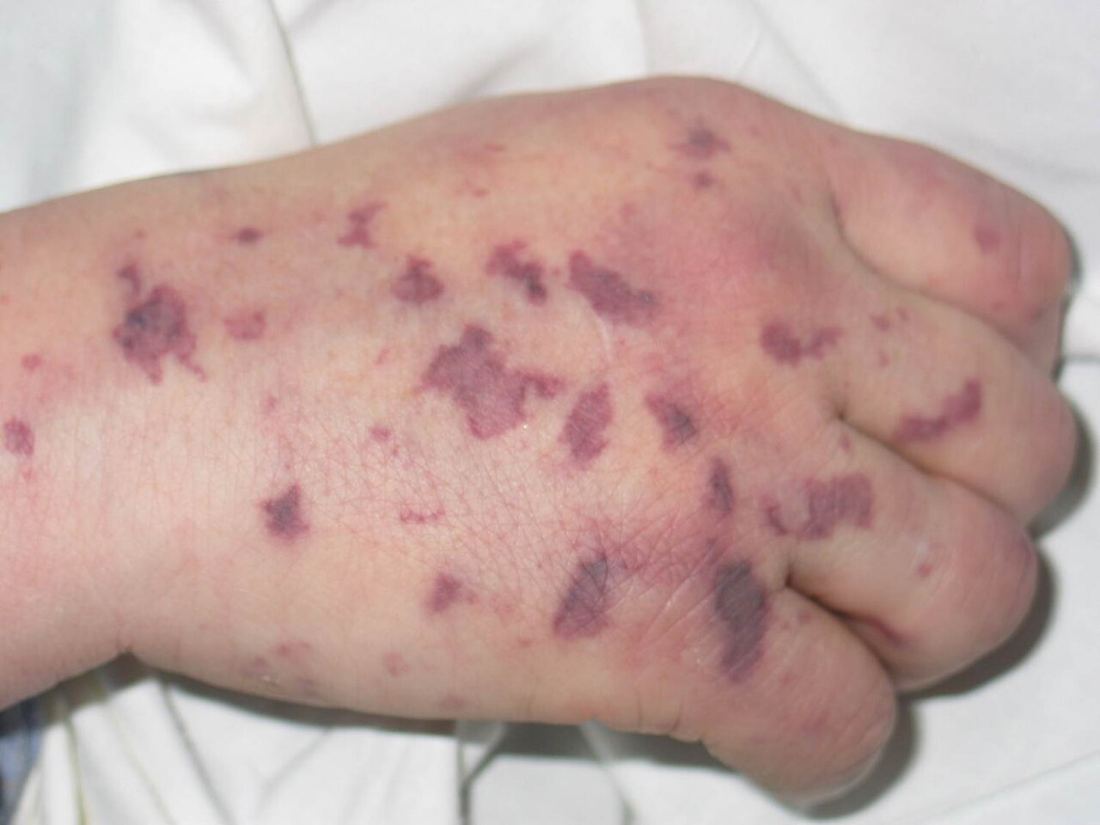
- Meningococcal disease: fever with a non-blanching rash, especially with an ill-looking child, lesions over 2 mm (purpura), capillary refill ≥ 3 seconds or neck stiffness.1
- Bacterial meningitis: neck stiffness, bulging fontanelle, decreased consciousness or convulsive status epilepticus. Classic signs are often absent in infants.1
- Herpes simplex encephalitis: focal neurological signs, focal seizures or decreased consciousness.1
- Pneumonia: fast breathing for age, crackles, nasal flaring, chest indrawing, cyanosis, or SpO₂ ≤ 95% on air.1
- Septic arthritis or osteomyelitis: a swollen limb or joint, not using a limb, or not bearing weight.1
- Kawasaki disease: fever for 5 days or more with red eyes without discharge, red cracked lips or strawberry tongue, swollen red hands and feet, rash, or neck nodes. Ask about features that have already faded. Children under 1 may show fewer features but have more coronary risk.1
- Travel: ask about recent travel and consider imported infections.1
Tests by risk group
| Group (no source found) | Tests | Also consider |
|---|---|---|
| Red | Blood count, blood culture, CRP, urine for UTI | Lumbar puncture, chest x-ray (whatever the temperature or WBC), electrolytes and blood gas1 |
| Amber | Urine for UTI; blood count, CRP and blood culture, unless an experienced pediatrician judges them unnecessary | Lumbar puncture under 1 year; chest x-ray if fever > 39°C and WBC > 20 × 10⁹/L1 |
| Green | Urine for UTI; assess for pneumonia | No routine blood tests or chest x-ray1 |
From NICE, for children 3 months and older seen by pediatric specialists.1 In hospital, reassess every child with amber or red features after 1–2 hours. A period of observation can help separate serious from minor illness.1
- Check airway, breathing, circulation and consciousness, and ask whether this could be sepsis. Record temperature, heart rate, respiratory rate and capillary refill.1
- No
- No
- NoAny amber feature?YesUrine, plus blood count, CRP and culture unless an experienced pediatrician deems them unnecessary. Consider lumbar puncture under 1 year. Reassess in 1–2 hours.1
- Then, for everyone without a source
- Leukocyte esterase, nitrite, pyuria or Gram stain positive?YesSend a urine culture when you start antibiotics, and treat as a presumed UTI.2
- No
- Green and no source: home with written warning signs. No oral antibiotics for fever without a source.1
Urinary tract infection
- How common: 7.0% of febrile infants overall. In girls, 8.3% at 6–12 months and 2.1% over 12 months.3
- Higher risk (ACEP): girls under 12 months, uncircumcised boys, fever over 24 hours, fever ≥ 39°C, a negative test for respiratory viruses, and no obvious source.2 Uncircumcised male infants under 3 months had a 20.1% prevalence.3
- Preliminary diagnosis: a positive leukocyte esterase, nitrite, urine white cell count or Gram stain.2 Dipstick accuracy was higher on catheter specimens than bag specimens.2
- Confirm with culture. Send a culture when starting antibiotics, and when the dipstick is negative but UTI is still suspected.2 The AAP definition needs both pyuria and at least 50,000 colonies/mL of one uropathogen in an appropriately collected sample.6
- After treatment: the AAP advises 7–14 days of antibiotics, renal and bladder ultrasound, and close follow-up; a voiding cystourethrogram is not routine after a first UTI.6
Risk calculators
- UTICalc estimates UTI risk from clinical features, then updates it with urine results. In its derivation, the clinical model reduced testing by 8.1% compared with the AAP algorithm without missing more UTIs.7
- In a 2026 prospective validation in 2,561 febrile children aged 2–24 months, 4% had a UTI. At a 2% risk threshold, the clinical model was 96.4% sensitive and 34.1% specific. It did not beat experienced clinicians (98.2% sensitive, 57.3% specific).8
A teaching blog makes the practical point: in a child with an obvious viral illness and only a day of fever, it is reasonable to defer a catheter specimen, but persistent fever needs a fresh look for a UTI.5
Pneumonia and bacteremia
- Chest x-ray: consider it in a well-appearing child with fever and no source who has cough, hypoxia, crackles, fever ≥ 39°C, fever over 48 hours, or tachycardia and tachypnea out of proportion to the fever. Don't order one for wheeze or likely bronchiolitis.2
- Occult pneumonia: in children under 5 with fever ≥ 39°C and WBC ≥ 20,000/µL, occult pneumonia was 15% before pneumococcal vaccination and 9% after (not statistically significant). It did not disappear.10
- Occult bacteremia: in the pre-vaccine era, about 12% of well-appearing children aged 3–36 months with fever ≥ 40°C had positive blood cultures. Since conjugate vaccines, reported rates are 2% or lower.2
Treatment
| Situation | Treatment | Notes |
|---|---|---|
| Immediate parenteral antibiotics | ||
| Shocked, unrousable, or signs of meningococcal disease | Third-generation cephalosporin (cefotaxime or ceftriaxone) | Consider also with reduced consciousness, and look for meningitis and encephalitis.1 |
| Ceftriaxone, possible meningitis | 100 mg/kg IV first dose (max 4 g), then 100 mg/kg/day (max 4 g/day) | Label dose.4 |
| Ceftriaxone, other serious infection | 50–75 mg/kg/day, divided every 12 hours (max 2 g/day) | Label dose.4 |
| Suspected herpes simplex encephalitis | IV aciclovir | Dose per institutional protocol and label.1 |
| Supportive | ||
| Shock | 0.9% saline 10 mL/kg IV, repeated as needed | Monitor actively.1 |
| SpO₂ < 92% on air, or shock | Oxygen | Consider it above 92% as clinically indicated.1 |
| Distressed child | Acetaminophen (paracetamol) or ibuprofen | Dose by weight per label. Not to lower temperature alone.1 |
Antipyretics
- Use acetaminophen or ibuprofen only while the child seems distressed, not just to bring the number down.1
- Don't give both at once. Switch to the other if distress continues, and alternate only if distress returns before the next dose is due.1
- Antipyretics do not prevent febrile seizures. Tepid sponging is not recommended.1
Disposition
- Green features only: care at home with advice on when to come back.1
- Amber or red features, not admitted, no diagnosis: provide a safety net: written warning signs, a set follow-up time and place, or direct access back to care.1
- Beyond the clinical picture, consider: social and family circumstances, parental anxiety and instinct, repeated visits for the same illness, recent travel, and an illness lasting longer than expected.1
- Shocked, unrousable or meningococcal signs: urgent review by an experienced pediatrician and consider intensive care.1
Pitfalls
- Being reassured because the fever came down after acetaminophen.1
- Stopping the search at a runny nose. A viral illness does not exclude UTI.2,5
- Relying on a negative dipstick when UTI is still suspected. Send a culture.2
- Starting antibiotics for a presumed UTI without sending a culture.2
- Missing Kawasaki disease after 5 days of fever because its features have faded. Ask about them.1
- Prescribing oral antibiotics for fever without a source.1
How strong is the evidence?
The ACEP policy has no Level A recommendations for this age group; most of its recommendations are Level B or C, based on lower-class studies or consensus.2 Many NICE fever recommendations date from 2007 and 2013.1 Bacteremia estimates come from older series, while the UTI calculator now has a prospective validation.2,8
On-shift teaching
Questions to ask a learner at the bedside. Tap a question to see the answer. Every answer uses facts cited above.
Q1Name four red features in the NICE traffic light system.
Q2Which child needs parenteral antibiotics immediately?
Q3What is now the most common serious bacterial infection in febrile children under 2, and how common is it?
Q4The dipstick is negative but you still suspect UTI. What next?
Q5When does ACEP suggest a chest x-ray in a febrile child with no source?
Q6The fever fell after ibuprofen. Does that make serious illness less likely?
References
What this page is built on
10 sources, cited 90 times. Dots are sources, filled by how far each was read; stronger color means a larger share of the citations. Tap a tier to see its sources.
Checked by the writer, not a physician. The dots show how each source was read, not that anyone has confirmed the claims.
- 1National Institute for Health and Care Excellence. Fever in under 5s: assessment and initial management (NG143). November 2019, updated 2021.
- 2American College of Emergency Physicians Clinical Policies Subcommittee on Pediatric Fever; Mace SE, Gemme SR, Valente JH, et al. Clinical policy for well-appearing infants and children younger than 2 years of age presenting to the emergency department with fever. Ann Emerg Med. 2016;67(5):625–639.e13.
- 3Shaikh N, Morone NE, Bost JE, Farrell MH. Prevalence of urinary tract infection in childhood: a meta-analysis. Pediatr Infect Dis J. 2008;27(4):302–308.
- 4Ceftriaxone sodium for injection. Prescribing information (Hospira). DailyMed.
- 5Fox SM. UTI and duration of fever. Pediatric EM Morsels; October 19, 2012.
- 6Subcommittee on Urinary Tract Infection, American Academy of Pediatrics; Roberts KB. Urinary tract infection: clinical practice guideline for the diagnosis and management of the initial UTI in febrile infants and children 2 to 24 months. Pediatrics. 2011;128(3):595–610. Reaffirmed 2016.
- 7Shaikh N, Hoberman A, Hum SW, et al. Development and validation of a calculator for estimating the probability of urinary tract infection in young febrile children. JAMA Pediatr. 2018;172(6):550–556.
- 8Kinlin C, Gravel J, Barrowman N, et al.; PERC Network. Diagnosing urinary tract infection in young febrile children in the emergency department. JAMA Netw Open. 2026;9(3):e261741.
- 9Shaikh N, Lee MC, Stokes LR, et al. Reassessment of the role of race in calculating the risk for urinary tract infection: a systematic review and meta-analysis. JAMA Pediatr. 2022;176(6):569–575.
- 10Rutman MS, Bachur R, Harper MB. Radiographic pneumonia in young, highly febrile children with leukocytosis before and after universal conjugate pneumococcal vaccination. Pediatr Emerg Care. 2009;25(1):1–7.
AI-generated draft. Not reviewed by a physician. This page is for education only and may contain errors, including in doses. Do not use it to diagnose, treat or make decisions about any patient. Rely on your own clinical judgment, your institution's protocols and current drug labeling. Reading this page does not create a physician-patient relationship. Full terms