


Digoxin toxicity
Bottom line
- Think of it in any older patient on digoxin with nausea, confusion, visual changes or a new arrhythmia. Most cases are chronic toxicity as kidney function declines.1
- The level supports the diagnosis; it does not make it. Toxicity occurs even within the usual therapeutic range, and a level drawn less than 6 hours after the last dose is hard to interpret.1,2
- Give digoxin immune Fab now for life-threatening signs: ventricular tachycardia or fibrillation, asystole or symptomatic high-grade AV block, potassium over 6.5 mEq/L, or hypotension with end-organ dysfunction. Don't wait for the level.1
- Dosing is disputed. The European consensus gives 5 vials in cardiac arrest and 1–2 vials otherwise, repeated to effect.1 The FDA label's calculated doses aim for full neutralization and are larger.2
- After Fab, watch potassium closely; it can fall fast. Routine digoxin levels mean little until the Fab clears, and dialysis does not help.2,1,3
First steps
- Monitor and get a 12-lead ECG. Every patient with suspected toxicity needs serial ECGs, with continuous monitoring when the ECG is abnormal.1
- Send potassium, magnesium, calcium, creatinine and a digoxin level. Draw the level when you first suspect toxicity, and before any Fab is given.1,2
- Decide whether toxicity is life-threatening. If it is, give Fab immediately. Do not wait for the level.1
- Ask about the dose, the timing, and acute versus chronic exposure. The time of ingestion and the type of exposure shape the work-up.4,1
- Look for what tipped the patient over: worsening renal function, dehydration, low potassium or magnesium, high calcium, and interacting drugs.1
- Get expert toxicology advice for very large ingestions and for toxicity that persists after Fab.1
- NoVT or VF, asystole or symptomatic high-grade AV block, potassium over 6.5, or hypotension with organ dysfunction?
- NoLevel over 12 ng/mL, or troublesome toxicity (marked vomiting, bradycardia without high-grade block)?
- NoMild chronic toxicity with a normal ECG: stop or reduce digoxin, and keep monitoring. Treat potassium under 2.5 with IV potassium, watching for rebound.1
- No response to an adequate dose? Question the diagnosis and look for another drug.2
Recognize
- It is still common. US emergency departments saw an estimated 5,156 visits a year for digoxin toxicity in 2005–2010, and 78.8% ended in hospital admission.7
- Who: mostly older adults on long-term digoxin, usually with worsening renal function. Relative to prescriptions, ED visits were 2.4 times as frequent at age 85 and over as at 40–84, and 2.3 times as frequent in women as in men.1,7
- Symptoms are vague: loss of appetite, nausea, vomiting, diarrhea, headache, confusion and lethargy. Blurred vision, halos and altered color vision are more characteristic.1
- Cardiac toxicity is the main danger: bradycardia, any degree of AV block, ventricular ectopy, ventricular tachycardia, hypotension and cardiogenic shock.1
| Raises the risk | Examples |
|---|---|
| Patient | Advanced age, renal insufficiency, dehydration, hypoxemia, myocardial ischemia1 |
| Electrolytes | Low potassium, low magnesium, high calcium1 |
| Interacting drugs | Calcium channel blockers, NSAIDs, diuretics, macrolide antibiotics1 |
| Acute overdose | Chronic toxicity | |
|---|---|---|
| Typical patient | Intentional or accidental ingestion | Older patient on digoxin whose renal function is declining; develops slowly1 |
| Potassium | Hyperkalemia marks severity1 | May be high or low; low potassium and magnesium worsen toxicity1 |
| Label's indication by level or dose | 10 mg or more ingested, or a likely steady-state level of 10 ng/mL or more2 | Steady-state level over 6 ng/mL2 |
| Fab use in a French cohort (n = 838) | Far more likely to get Fab (OR 15.7) | Fab underused; higher mortality8 |
Unreviewed doses. Verify against the current label and your institution's protocol before giving anything.
ECG
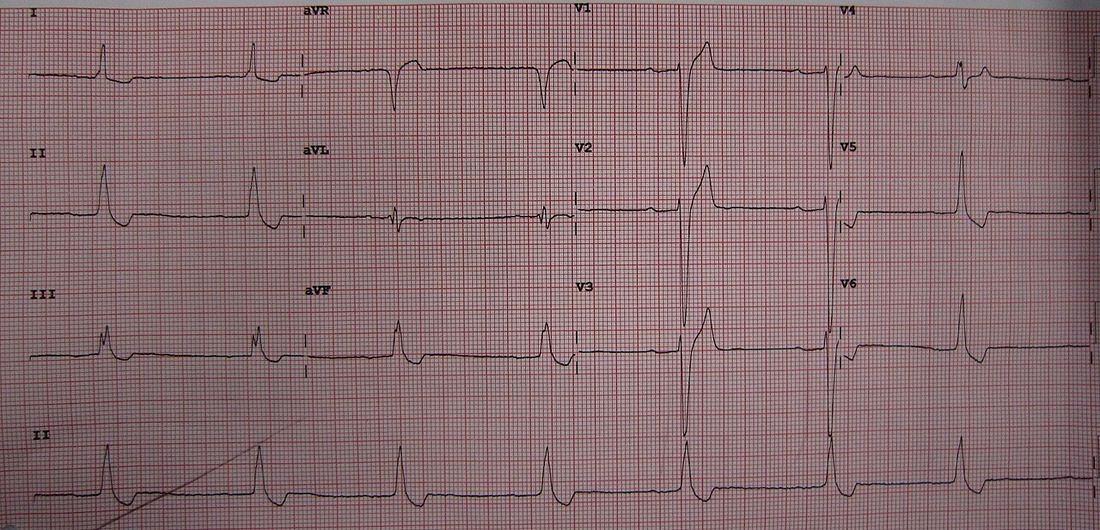
- Digoxin effect: down-sloping, "scooped" ST depression, flat or inverted T waves and larger U waves. These also appear in patients taking digoxin who are not toxic, so they do not prove toxicity.1
- Toxic rhythms: frequent premature ventricular complexes, including bigeminy, are the most common abnormality. A fast atrial rhythm with a slow ventricular response (atrial tachycardia with block) is the classic pattern.9
- Others: sinus bradycardia, slow atrial fibrillation, any AV block, and ventricular tachycardia, including bidirectional VT.9 "Regularized" atrial fibrillation is AF with complete heart block and a junctional or ventricular escape.9
- No rhythm is specific to digoxin.1 See the LITFL ECG library for examples of each.9
The digoxin level
- The usual therapeutic range is 0.8–2.0 ng/mL, with 0.5–0.8 ng/mL increasingly preferred in heart failure. Levels do not track toxicity reliably, and toxicity can occur within the therapeutic range.1
- Timing matters. Digoxin takes hours to distribute into tissue. Wait at least 6 hours, ideally 8–12, after the last dose for a level that reflects severity.1 The label gives 6–8 hours.2 A level drawn earlier overestimates the body load.10
- Draw one anyway when you first suspect toxicity, and before giving Fab.1,2
- Very high levels need dilution. Most assays are designed for levels under 5 ng/mL.2
- After Fab, the total level rises sharply, but almost all of it is bound to Fab and inactive. Standard assays mislead until the Fab clears: several days, a week or more with poor renal function.2 The consensus says up to 3 weeks.1
- Units: 1 ng/mL equals 1 µg/L, or about 1.3 nmol/L (2 µg/L is 2.6 nmol/L).1,10
Digoxin immune Fab
Fab is the mainstay of treatment for life-threatening toxicity.1 Each 40 mg vial binds about 0.5 mg of digoxin.2 Free digoxin falls to almost zero within minutes, and toxicity usually reverses in 30–45 minutes.10
| Give Fab immediately for | Source |
|---|---|
| Ventricular tachycardia or fibrillation | Consensus1 |
| Asystole, or symptomatic high-grade AV block (or bradycardia that does not respond to atropine) | Consensus1 |
| Potassium over 6.5 mEq/L | Consensus1 |
| Hypotension with end-organ dysfunction | Consensus1 |
| Consider it, once a level is back | |
| Level over 12 ng/mL, even without life-threatening signs | Consensus1 |
| Raised level with troublesome toxicity, such as moderate to severe vomiting or bradycardia without high-grade block | Consensus1 |
| Situation | Adult dose | Source |
|---|---|---|
| European consensus (2023) | ||
| Cardiac arrest | 5 vials (200 mg) IV at once, or as many as available up to 5; 5 more if no response after 30 min | 1 |
| Life-threatening, not in arrest | 1–2 vials IV, then 1–2 vials at a time until toxicity resolves | 1 |
| Not life-threatening, selected patients | Level (ng/mL) × weight (kg) × 0.005 vials, rounded up (half neutralization) | 1 |
| FDA label (DigiFab) | ||
| Acute ingestion, amount and level unknown | 20 vials, starting with 10 and adding 10 more if needed, to avoid a febrile reaction | 2 |
| Chronic toxicity, no level | 6 vials | 2 |
| Acute ingestion, known amount | Body load (mg) ÷ 0.5 vials. For tablets, body load ≈ mg ingested × 0.8 | 2 |
| Known steady-state level | Level (ng/mL) × weight (kg) ÷ 100 vials, usually rounded up | 2 |
| Giving it | Infuse over at least 30 min; bolus if cardiac arrest is imminent | 2 |
Unreviewed doses. Verify against the current label and your institution's protocol before giving anything.
The consensus formula is exactly half of the label's level-based formula.1,2 The consensus panel chose half neutralization because full neutralization may not be needed for symptom relief and can harm patients who depend on digoxin's therapeutic effect.1
How much Fab. The FDA label calculates full neutralization doses and gives 20 vials empirically for an acute ingestion of unknown size.2 The European consensus gives 1–2 vials outside cardiac arrest and repeats to effect.1 A toxicology review suggests 80 mg (2 vials) repeated as needed after acute overdose, and 1 vial repeated after 60 minutes in chronic toxicity, noting that 1–3 vials usually suffice.10 The lowest effective dose has not been established.10
What the evidence shows
- There are no randomized trials of Fab. Case series of 2,080 patients report response rates from 50% to 80–90%, better in acute than chronic poisoning.10
- In the label's 15-patient study, free digoxin became undetectable in all patients. Toxicity fully resolved within 4 hours in 7 (47%) and by 20 hours in 14 (93%).2
- In chronic toxicity (n = 36), 1–2 vials bound all free digoxin. Gastrointestinal symptoms resolved in all 22 patients who had them, but heart rate rose by a median of only 8 beats/min and potassium fell by a median of 0.3 mmol/L.11
- In 838 French patients with raised digitalis levels, only 8% received Fab. Mortality was 6% with Fab and 15% without, an observational association.8
Safety
- The most common adverse reactions on the label are worsening heart failure (13%), hypokalemia (13%) and worsening atrial fibrillation (7%).2
- Allergy is possible. Patients allergic to sheep protein, papain, papaya or bromelain, or previously given ovine Fab, are at higher risk.2
- Adverse events can occur up to 14 days after treatment. Hypersensitivity reactions, including serum sickness, are rare.1
Potassium and calcium
- Hyperkalemia signals severity, especially after an acute overdose.1 Each 1 mEq/L rise in potassium was associated with higher odds of death (OR 1.5) in one cohort of digoxin-toxic patients.5
- Mild to moderate hyperkalemia (5.5–6.5) should resolve with Fab without other measures.1
- Expect potassium to fall after Fab. It shifts back into cells, and hypokalemia can develop quickly. Patients can have a high serum potassium with a total-body deficit.2 Check potassium regularly, especially in the first 6 hours.1
- Severe hypokalemia (under 2.5) can be treated with IV potassium, with care to avoid rebound hyperkalemia.1
The potassium level that calls for Fab. Over 6.5 mEq/L in the European consensus1, over 6 in a toxicology review10, and over 5.5 with rapidly progressive toxicity on the FDA label.2
Is calcium dangerous?
- The "stone heart" warning rests on about five case reports, mostly from the 1930s–1950s, and on animal models. A 2004 pig study found no harm.6
- In 159 digoxin-toxic patients, 23 received IV calcium. None had a life-threatening dysrhythmia within 1 hour, and mortality was similar (22% vs 20%).5
- That cohort included only one acute overdose, so the risk after acute ingestion is unknown.6
- Fab is still the preferred treatment for hyperkalemia from digoxin. When potassium is life-threatening and digoxin toxicity is suspected but unconfirmed, don't withhold calcium for fear of a stone heart.6
Other treatment
- Mild chronic toxicity (mild symptoms, no ECG changes or arrhythmia): stop or reduce digoxin and watch for worsening heart failure or arrhythmia.1
- Ventricular arrhythmias: lidocaine or magnesium sulfate, alongside Fab or while it is coming. Dose per institutional protocol and label.1
- Bradycardia: atropine. Avoid epinephrine and isoproterenol, which can trigger ventricular fibrillation.1
- Pacing needs extreme caution. Use it only when Fab is not immediately available, by experienced clinicians in a coronary or cardiac intensive care setting.1
- Activated charcoal can be considered within 2 hours of an acute ingestion. It does not replace Fab, and it risks aspiration in a drowsy or confused patient.1
- No dialysis or hemoperfusion. Digoxin is only slightly dialyzable. EXTRIP recommends against extracorporeal treatment when Fab is available (1D) and suggests against it when Fab is not (2D). It does not remove the digoxin-Fab complex either.3
After Fab and disposition
- Monitor potassium, temperature, blood pressure, the ECG and renal function during and after Fab.2 Continue until potassium, the ECG and renal function are back to baseline.1
- Watch for loss of digoxin's benefit: worsening heart failure or a faster ventricular rate in atrial fibrillation.1,2 Involve cardiology early.1
- Renal failure prolongs everything. Fab's half-life of 15–20 hours can be up to 10 times longer, so watch for recurrent toxicity for longer.2
- Restarting digoxin: delay it until the Fab has cleared, which may take several days, or a week or more with impaired renal function.2
- Most patients are admitted. In US data, 78.8% of ED visits for digoxin toxicity ended in hospitalization.7
- Stock: the consensus advises that EDs can get at least 5 vials of Fab within about 1 hour.1
Pitfalls
- Waiting for a digoxin level before giving Fab for life-threatening toxicity.1
- Ruling out toxicity because the level is "therapeutic".1
- Calculating a Fab dose from a level drawn less than 6 hours after the last dose.1,10
- Treating digoxin bradycardia with epinephrine or isoproterenol.1
- Missing the fall in potassium after Fab.2
- Sending a repeat digoxin level after Fab and acting on it.2
- Calling nephrology for dialysis.3
- Blaming digoxin when Fab doesn't work. Look for another drug or cause.2
How strong is the evidence?
Weak. There are no randomized trials of Fab, and its use rests on case series.10 The EXTRIP recommendations rest on very low quality evidence.3 The European consensus drew on clinical experience more than its authors would like, came from Western European clinicians only, and had a medical writer funded by Fab's manufacturer.1 A 2025 US consensus built 33 statements from 114 studies by a Delphi process and agreed that Fab for life-threatening exposure lowers the risk of death, while naming several areas of continued uncertainty.4
On-shift teaching
Questions to ask a learner at the bedside. Tap a question to see the answer. Every answer uses facts cited above.
Q1Which findings call for digoxin immune Fab right now, before the level comes back?
Q2Why can a digoxin level mislead you?
Q3A 70 kg patient with chronic toxicity and persistent vomiting has a level of 4 ng/mL. How many vials does each formula give?
Q4Is IV calcium contraindicated in a digoxin-toxic patient with severe hyperkalemia?
Q5What happens to potassium after Fab, and why?
Q6Should you dialyze a digoxin-toxic patient with renal failure?
References
What this page is built on
12 sources, cited 143 times. Dots are sources, filled by how far each was read; stronger color means a larger share of the citations. Tap a tier to see its sources.
Checked by the writer, not a physician. The dots show how each source was read, not that anyone has confirmed the claims.
- 1Andrews P, Anseeuw K, Kotecha D, et al. Diagnosis and practical management of digoxin toxicity: a narrative review and consensus. Eur J Emerg Med. 2023;30(6):395–401.
- 2DigiFab (digoxin immune fab [ovine]) prescribing information. BTG International Inc. DailyMed.
- 3Mowry JB, Burdmann EA, Anseeuw K, et al.; EXTRIP Workgroup. Extracorporeal treatment for digoxin poisoning: systematic review and recommendations from the EXTRIP Workgroup. Clin Toxicol (Phila). 2016;54(2):103–114.
- 4Hack JB, Wingate S, Zolty R, Rich MW, Hauptman PJ. Expert consensus on the diagnosis and management of digoxin toxicity. Am J Med. 2025;138(1):25–33.e14.
- 5Levine M, Nikkanen H, Pallin DJ. The effects of intravenous calcium in patients with digoxin toxicity. J Emerg Med. 2011;40(1):41–46.
- 6Nickson C. Calcium, digoxin toxicity and "stone heart" theory. Life in the Fast Lane; 2019.
- 7See I, Shehab N, Kegler SR, Laskar SR, Budnitz DS. Emergency department visits and hospitalizations for digoxin toxicity: United States, 2005 to 2010. Circ Heart Fail. 2014;7(1):28–34.
- 8Lapostolle F, Borron SW, Verdier C, et al. Assessment of digoxin antibody use in patients with elevated serum digoxin following chronic or acute exposure. Intensive Care Med. 2008;34(8):1448–1453.
- 9Burns E, Buttner R. Digoxin toxicity. Life in the Fast Lane ECG Library; 2018.
- 10Chan BS, Buckley NA. Digoxin-specific antibody fragments in the treatment of digoxin toxicity. Clin Toxicol (Phila). 2014;52(8):824–836.
- 11Chan BS, Isbister GK, O'Leary M, Chiew A, Buckley NA. Efficacy and effectiveness of anti-digoxin antibodies in chronic digoxin poisonings from the DORA study (ATOM-1). Clin Toxicol (Phila). 2016;54(6):488–494.
- 12Cao D, Arens AM, Chow SL, et al. Part 10: Adult and pediatric special circumstances of resuscitation: 2025 American Heart Association Guidelines for Cardiopulmonary Resuscitation and Emergency Cardiovascular Care. Circulation. 2025;152(16 Suppl 2):S578–S672. Further reading; not used for any claim above.
AI-generated draft. Not reviewed by a physician. This page is for education only and may contain errors, including in doses. Do not use it to diagnose, treat or make decisions about any patient. Rely on your own clinical judgment, your institution's protocols and current drug labeling. Reading this page does not create a physician-patient relationship. Full terms