

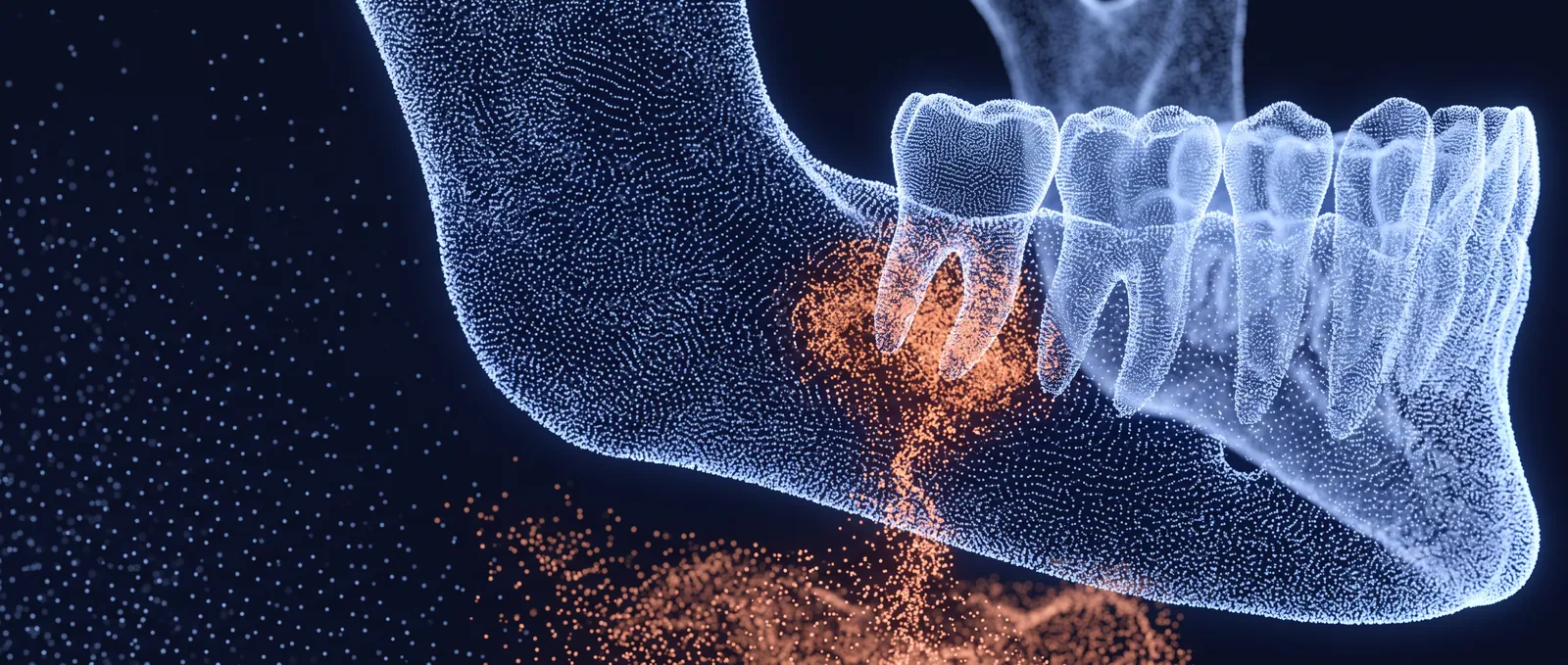
Dental pain and odontogenic infection
Bottom line
- Find the infection that can kill first. Ludwig angina shows as a firm, woody floor of the mouth with swelling under the jaw. Trismus is a late sign.1 Swelling spreading into the neck or systemic illness are red flags, and trismus with a mouth opening under 2.5 cm suggests a deep space infection that needs a CT.2
- A toothache alone rarely needs antibiotics. For irreversible pulpitis, the American Dental Association (ADA) strongly recommends against them. The pulp is inflamed, not infected.3
- Swelling, an abscess or fever, and no dentist soon: amoxicillin or penicillin VK. Amoxicillin 500 mg three times daily or penicillin VK 500 mg four times daily, for 3–7 days, plus urgent dental referral.3,4
- Treat pain with an NSAID plus acetaminophen, not an opioid. NSAIDs alone or with acetaminophen relieve dental pain better than opioids, with fewer harms.5,6 A long-acting dental block extends relief until dental care.4,5
- Every visit ends with a dentist. ED treatment is a bridge. Drainage, root canal treatment or extraction treats the cause.4 Patients should call back if they cannot see a dentist within 1–2 days.5
First steps
- Look for danger: a firm floor of the mouth, swelling under the jaw or into the neck, trismus, and systemic illness.1,2
- Suspected deep space infection: plan the airway first, then image, give IV antibiotics and call for surgical drainage.1
- Otherwise, place the tooth problem in the guideline's categories by signs and symptoms. Pulp tests used by dentists are not available in the ED.3
- Treat pain with ibuprofen plus acetaminophen, and consider a dental block.3,5
- Give antibiotics only for an abscess, swelling or systemic signs when a dentist is not available soon.3,4
- Arrange a dentist within 1–2 days.5
- Deep space infection or Ludwig angina?
- NoName the dental problem by signs and symptoms; pulp tests are not available in the ED.3
- Localized abscess or swelling, or fever or malaise?YesAmoxicillin 500 mg three times daily or penicillin VK 500 mg four times daily, 3–7 days, and urgent dental referral.3Penicillin allergy: cephalexin, azithromycin or clindamycin.3 Drain in the ED only if the abscess is buccal or vestibular.2Reassess at 3 days. Stop 24 hours after symptoms fully resolve.3
- NoPulpitis: no antibiotics. For a likely dead pulp with no swelling, a delayed prescription only if dental care is not feasible, filled after 24–48 hours if worse.3
- Either way
Red flags: deep space infection
- Ludwig angina is a fast-spreading infection of the floor of the mouth. It is more common with poor dentition or immunosuppression. Look for a woody, indurated floor of the mouth and submandibular swelling. Trismus comes late.1
- Signs of deep spread: swelling extending into the neck or chest, or systemic symptoms.2 Blunting of the lower border of the mandible, or trismus with a maximum mouth opening under 2.5 cm, suggests a deep space infection and the need for CT.2
- Periorbital swelling or pain with headache, ptosis, chemosis or limited eye movements suggests septic cerebral venous thrombosis.2
- Where it spreads: in 262 hospitalized adults with deep odontogenic infection, the submandibular (74%), buccal (37%) and sublingual (26%) spaces were most often involved. Retropharyngeal, mediastinal and danger-space spread were rare (1% each).7
Imaging and airway
- CT of the neck soft tissues with contrast is preferred, but only if the patient can safely leave the ED and tolerate lying flat. Point-of-care ultrasound can help in those who cannot.1
- Airway: consult anesthesia and otolaryngology early. Flexible intubating endoscopy is the first-line approach, with preparation for a surgical airway.1
- Treatment: broad-spectrum antibiotics and surgical source control, then ICU admission for airway observation.1
| CT finding (n = 262) | Need for ventilation after surgery |
|---|---|
| Compromised airway on CT | OR 5.6 (2.9–10.9) |
| Infection crossing the midline | OR 3.3 (1.2–8.8) |
| Extension to or below the hyoid | OR 2.4 (1.2–5.1) |
Multivariable analysis of hospitalized adults with deep odontogenic infection and a preoperative contrast CT. Patient background factors did not predict ventilation.7
What is wrong with the tooth?
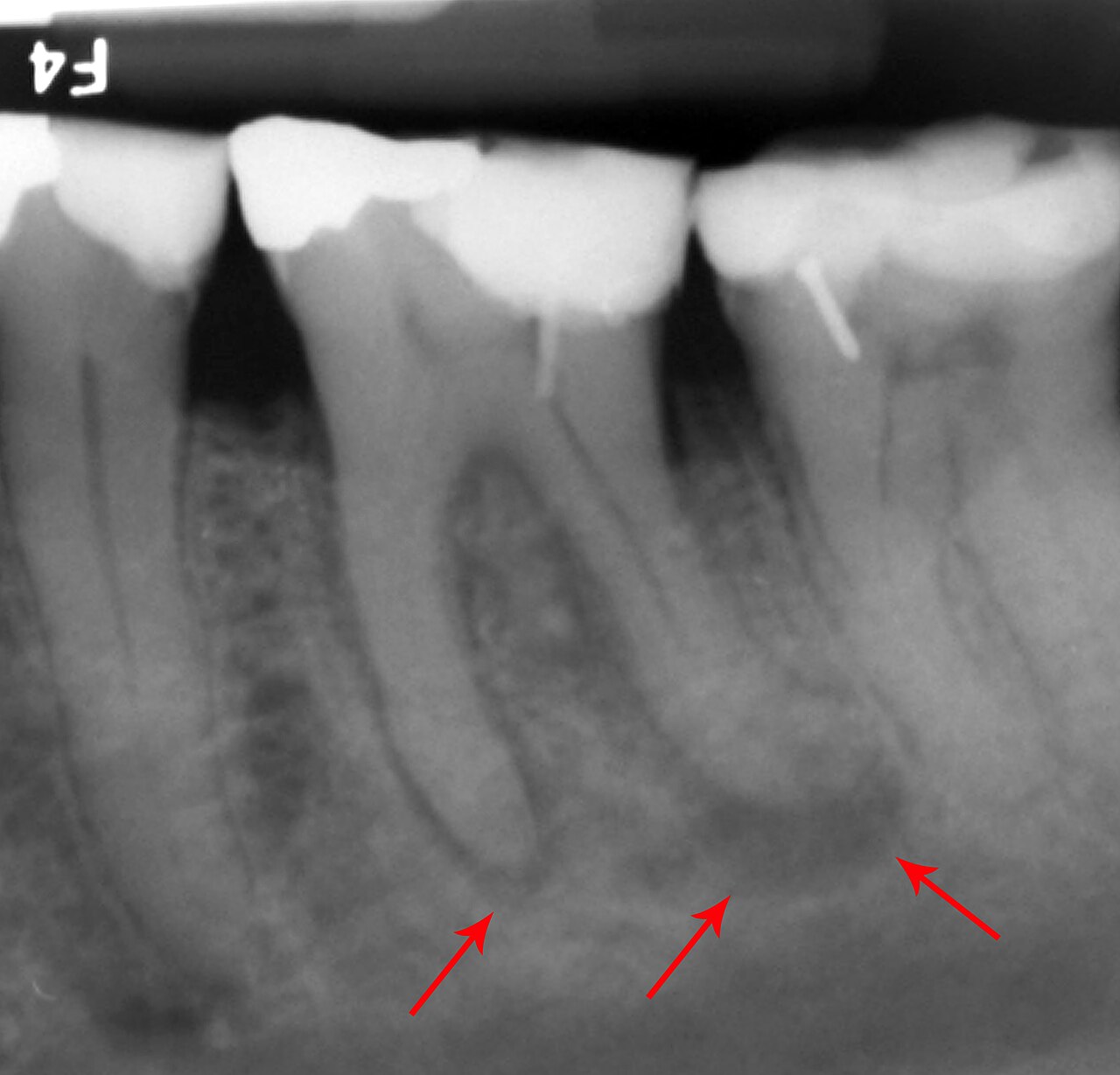
Most dental pain comes from caries. Inflamed pulp can progress to a dead pulp, then to infection through the bone into the soft tissue around the jaw, and in some patients to systemic infection.3 The ADA guideline sorts patients into the groups below. In medical settings, judge them by signs and symptoms.3
| Condition | Typical picture | Antibiotics if no dentist soon |
|---|---|---|
| Symptomatic irreversible pulpitis (± apical periodontitis) | Sharp pain, often triggered by temperature change; can become spontaneous and constant | No (strong, low certainty)3 |
| Pulp necrosis with symptomatic apical periodontitis | Dead pulp with inflammation at the root tip; no swelling | Not routinely (conditional, very low). Delayed prescription if dental care is not feasible3 |
| Pulp necrosis with localized acute apical abscess | Infection has reached the soft tissue around the jaw; intraoral swelling | Yes, plus urgent referral (conditional, very low)3 |
| Acute apical abscess with systemic involvement | Fever, malaise | Yes, plus urgent referral (good practice statement)3 |
| Cellulitis, or an immunocompromised patient | — | Outside the guideline's scope3 |
Antibiotics
| Agent | Adult dose | Notes |
|---|---|---|
| First line | ||
| Amoxicillin | 500 mg PO three times daily, 3–7 days | Abscess, swelling or systemic signs.3 |
| Penicillin VK | 500 mg PO four times daily, 3–7 days | Same indications.3 |
| Penicillin allergy | ||
| Cephalexin, azithromycin or clindamycin | Dose per label | Clindamycin carries a higher risk of C. difficile infection.3 |
| Not improving | ||
| Add metronidazole, or switch to amoxicillin-clavulanate | Dose per label | Better cover for gram-negative anaerobes.3 |
Unreviewed doses. Verify against the current label and your institution's protocol before giving anything.
- Duration: reassess after 3 days. Stop 24 hours after symptoms fully resolve.3
- Penicillin allergy labels: about 10% of people report one, but fewer than 1% are truly allergic. Use a non-penicillin drug until a true allergy is confirmed.3
- Delayed prescription: for a likely dead pulp without swelling, give a prescription to fill 24–48 hours after the visit only if symptoms worsen or dental treatment has not happened.3
- Ask about access to a dentist. The guideline notes that for patients with no access, an immediate prescription may be the best course, even without an abscess.3
- The ED summary's rule: prescribe an antibiotic for localized or generalized swelling, a draining abscess or systemic symptoms when the patient cannot reach definitive care within 48 hours.4
- Antibiotics do not treat pain. In pulpitis they made little to no difference to pain, while the harms of antibiotic use (resistance, C. difficile, anaphylaxis) are large at population level.3
- Once a dentist treats the tooth, adding antibiotics to treatment of a dead pulp or localized abscess is strongly recommended against.3
Overuse is common. In US claims data, 55% of patients filled an antibiotic and about 40% an opioid within 7 days of a dental ED visit. The data could not show which prescriber wrote them.8
Emergency Medicine Cases lists clindamycin as a first-line option and says most guidelines see no role for antibiotics in an uncomplicated periapical abscess.2 The ADA keeps clindamycin for penicillin allergy because of C. difficile, and suggests antibiotics for a localized abscess when dental treatment is not available.3
Pain control
| Option | Adult dose | Notes |
|---|---|---|
| First line | ||
| Ibuprofen plus acetaminophen | Ibuprofen 400–600 mg + acetaminophen 1,000 mg | More effective and less harmful than opioid-containing options.3,6 |
| Daily maximums | Ibuprofen 2,400 mg · naproxen sodium 1,100 mg · acetaminophen 4,000 mg | Use the lowest dose that works.5 |
| Add-ons | ||
| Long-acting local anesthetic (e.g., bupivacaine) by block or infiltration | Dose per label | Extended temporary relief before dental care.4,5 |
| Topical benzocaine 10% or 20% | Apply to the tooth and surrounding gum | 20% is probably no better than 10%.5 |
| Only if first-line treatment fails | ||
| Opioid add-on | NSAID + acetaminophen 325 mg + one tablet of acetaminophen 325 mg with hydrocodone 7–7.5 mg or oxycodone 5 mg | Lowest dose, fewest tablets, rarely more than 3 days.4 |
Unreviewed doses. Verify against the current label and your institution's protocol before giving anything.
- The evidence: in 82 trials after surgical extraction, NSAIDs alone or with acetaminophen reduced pain more than opioids (high to moderate certainty). Opioids caused more dizziness, drowsiness, nausea and vomiting.5
- Toothache recommendations are indirect. No trial tested analgesics for pulpitis or periapical disease, so the guideline borrows the extraction data.5
- An overview of systematic reviews found ibuprofen with acetaminophen gave the most benefit in adults, and opioid-containing drugs the most acute adverse events.6
- Opioids are for when first-line therapy is not enough or NSAIDs are contraindicated. Avoid just-in-case prescriptions.4,5 Discuss naloxone with patients at higher overdose risk.5
- Corticosteroids for swelling or trismus from infection are outside the analgesic guideline's scope.5
Pain after an extraction
- Breakthrough pain on day 2 or 3: find out what pain plan the patient already has before prescribing, and send them back to the dentist who extracted the tooth to look for causes such as alveolar osteitis (dry socket).4
- Already on an NSAID plus acetaminophen: an opioid may be added at the lowest dose and shortest duration. Do not add one for patients taking gabapentinoids, benzodiazepines or other CNS-active drugs, or already on opioids.4
- Severe pain 72 hours after a dental procedure is unusual and may mean infection or another complication. Refer back to the dentist.4
Disposition
- Ludwig angina or deep space infection: ICU for airway observation after airway, antibiotics and source control.1
- Worsening, or concern for deeper infection: urgent evaluation.3
- Abscess: drain in the ED only if it is buccal or vestibular, avoiding the mental nerve in the front of the lower jaw. Refer abscesses elsewhere to a dentist or oral surgeon.2
- Everyone else: dentist within 1–2 days, and call back if that is not possible or the pain does not ease.5 If an antibiotic was started, reassess at 3 days.3
Pitfalls
- Waiting for trismus before thinking of Ludwig angina. It is a late finding.1
- Sending an unstable airway to CT. Image only patients who can safely leave the ED and lie flat.1
- Prescribing antibiotics for pulpitis, which is inflammation, not infection.3
- Treating a dental visit with the opioid-plus-antibiotic pair. NSAIDs with acetaminophen work better for pain, and antibiotics add little for it.3,5
- Choosing clindamycin by default. It is a penicillin-allergy option with a higher C. difficile risk.3
- Discharging without a plan to reach a dentist.4,5
How strong is the evidence?
The ADA antibiotic recommendations rest on low or very low certainty evidence of benefit, weighed against moderate certainty evidence of harm.3 Analgesic advice for toothache is extrapolated from extraction trials.5 Ludwig angina guidance comes from a narrative review,1 and the CT predictors from one cohort of hospitalized patients.7 The ADA antibiotic guideline covers immunocompetent adults only.3
On-shift teaching
Questions to ask a learner at the bedside. Tap a question to see the answer. Every answer uses facts cited above.
Q1Why doesn't irreversible pulpitis need antibiotics?
Q2A patient has a localized dental abscess and no dentist for days. What do you prescribe?
Q3What is the best first-line analgesic for toothache?
Q4Which findings should make you worry about a deep space infection?
Q5How should you secure the airway in Ludwig angina?
Q6Which CT findings predicted the need for ventilation after surgery for a deep odontogenic infection?
References
What this page is built on
8 sources, cited 105 times. Dots are sources, filled by how far each was read; stronger color means a larger share of the citations. Tap a tier to see its sources.
Checked by the writer, not a physician. The dots show how each source was read, not that anyone has confirmed the claims.
- 1Bridwell R, Gottlieb M, Koyfman A, Long B. Diagnosis and management of Ludwig's angina: an evidence-based review. Am J Emerg Med. 2021;41:1–5.
- 2Helman A, Ngo R, Nash R. Ep 185 Atraumatic dental emergencies. Emergency Medicine Cases; August 2023.
- 3Lockhart PB, Tampi MP, Abt E, et al. Evidence-based clinical practice guideline on antibiotic use for the urgent management of pulpal- and periapical-related dental pain and intraoral swelling: a report from the American Dental Association. J Am Dent Assoc. 2019;150(11):906–921.e12.
- 4Green VG, Polk DE, Turturro MA, et al. Evidence-based clinical practice guidelines for the management of acute dental pain. Am J Emerg Med. 2025;89:247–253.
- 5Carrasco-Labra A, Polk DE, Urquhart O, et al. Evidence-based clinical practice guideline for the pharmacologic management of acute dental pain in adolescents, adults, and older adults: a report from the American Dental Association Science and Research Institute, the University of Pittsburgh, and the University of Pennsylvania. J Am Dent Assoc. 2024;155(2):102–117.e9.
- 6Moore PA, Ziegler KM, Lipman RD, et al. Benefits and harms associated with analgesic medications used in the management of acute dental pain: an overview of systematic reviews. J Am Dent Assoc. 2018;149(4):256–265.e3.
- 7Rautaporras N, Uittamo J, Furuholm J, Marinescu Gava M, Snäll J. Deep odontogenic infections: computed tomography imaging-based spreading routes and risk for airway obstruction. J Stomatol Oral Maxillofac Surg. 2023;124(4):101424.
- 8Roberts RM, Bohm MK, Bartoces MG, et al. Antibiotic and opioid prescribing for dental-related conditions in emergency departments: United States, 2012 through 2014. J Am Dent Assoc. 2020;151(3):174–181.e1.
AI-generated draft. Not reviewed by a physician. This page is for education only and may contain errors, including in doses. Do not use it to diagnose, treat or make decisions about any patient. Rely on your own clinical judgment, your institution's protocols and current drug labeling. Reading this page does not create a physician-patient relationship. Full terms