

Constipation
Bottom line
- Rule out the dangerous causes first. In bowel obstruction, a history of constipation is one of the more reliable findings, and plain films cannot exclude it.1 Reduced perineal sensation, painless urinary retention and loss of anal tone point to cauda equina syndrome.2
- Fecal impaction in an older adult is a sick patient until proven otherwise. In one ED cohort (mean age 73), nearly 90% of visits ended in admission, 40.6% of patients had a serious complication and 21.9% died in hospital.3 Stercoral colitis often comes without abdominal pain.4
- Simple constipation needs no imaging. Even so, imaging for ED constipation visits in the US rose by 15% between 2006 and 2017.5
- Start PEG 3350 17 g daily (strong recommendation, moderate certainty). Use bisacodyl short term or as rescue.6,7 Avoid magnesium in renal insufficiency, and phosphate enemas in kidney disease, heart disease or dehydration.6,8
- Consider a laxative with every opioid prescription. Only 0.9% of US adults discharged from the ED with an opioid in 2010 also got a laxative.9 Laxatives come first for opioid-induced constipation; peripheral opioid antagonists (PAMORAs) are for patients who fail them, and never with suspected obstruction.10,11
First steps
- Pin down what the patient means. Constipation can mean infrequent stools, straining, hard stools or a sense of incomplete emptying.12
- Take a medication history. Opioids, anticholinergics, diuretics, calcium channel blockers, antiparkinson drugs and oral iron are all linked to constipation.13
- Look for obstruction: abdominal distension, abnormal bowel sounds and prior abdominal surgery. Fever, hypotension, diffuse pain and peritonitis suggest strangulation.1
- Do a rectal exam. It shows stool in the vault and anal tone.12 With back pain or bladder symptoms, check perineal sensation and a post-void residual.2
- In older adults, think beyond the bowel. Constipation and impaction can present as paradoxical diarrhea, incontinence, urinary retention, delirium, poor intake or syncope.13
- Image only for a reason. Simple constipation does not need imaging.5 For suspected obstruction, CT is reliable and plain films cannot exclude it.1 For suspected stercoral colitis, CT with IV contrast is the test of choice.14
- NoReduced perineal sensation, painless urinary retention or lax anal tone?YesUrgent MRI and a spine surgeon for possible cauda equina syndrome.2
- No
- No, or once cleared
- Either way
- Then, for everyoneAlarm features (blood in stool, unexplained anemia, weight loss, a mass, a new change in bowel habit after 50): arrange colon evaluation.12
Red flags
| Finding | Think of | Do |
|---|---|---|
| Distension, abnormal bowel sounds, prior abdominal surgery | Bowel obstruction | CT; surgical review. Plain films cannot exclude it.1 |
| Fever, hypotension, diffuse pain, peritonitis | Strangulation or perforation | Resuscitate; surgery.1,14 |
| Reduced perineal sensation, painless urinary retention, lax anal tone, bilateral sciatica | Cauda equina syndrome | Urgent MRI; spine surgery.2 |
| Large stool mass in an older, bedbound or institutionalized patient | Impaction or stercoral colitis | Disimpact. CT with IV contrast if colitis is possible.14,4 |
| Blood in stool, unexplained anemia, weight loss ≥ 10 lb, abdominal or rectal mass | Colorectal cancer | Colon evaluation (endoscopy or imaging).12 |
| Hypothyroidism, hypercalcemia, neurologic disease | Secondary constipation | Treat the cause where possible.12 |
Fecal impaction and stercoral colitis
- Impaction marks a sick patient. In 32 ED patients with impaction (mean age 72.9), 88.1% of visits ended in admission, 40.6% of patients had stercoral colitis or proctitis or bowel obstruction, and 21.9% died in hospital. Four of the 7 deaths were plausibly related to the impaction.3
- Clearing it is harder than it looks. Disimpaction was attempted in the ED in under half of those visits, and complete disimpaction was recorded in only a third (12 of 37).3 Treatment options are digital disimpaction, enemas, suppositories and oral laxatives, but there is little systematic research on which works best.3
- Stercoral colitis is inflammation from pressure of impacted stool, which can cause ischemic ulceration, usually in the rectosigmoid. Risk factors include older age, dementia, nursing home residence, being bedbound, chronic opioid use and psychiatric illness.14
- It is easy to miss. In 269 ED patients with stercoral colitis on CT (median age 76), abdominal pain was documented as absent in 62.1%. Of the 84 sent home, 53.6% got no enema, laxative or disimpaction. At 3 months, 3.3% had needed surgery and 3.3% had died of a related cause; 10.0% returned to the ED within 72 hours.4
- Management: stable patients get laxatives, enemas and disimpaction, sometimes endoscopic. Perforation, extensive involvement or failed conservative care needs surgery. Reported mortality with perforation is 32–60%.14
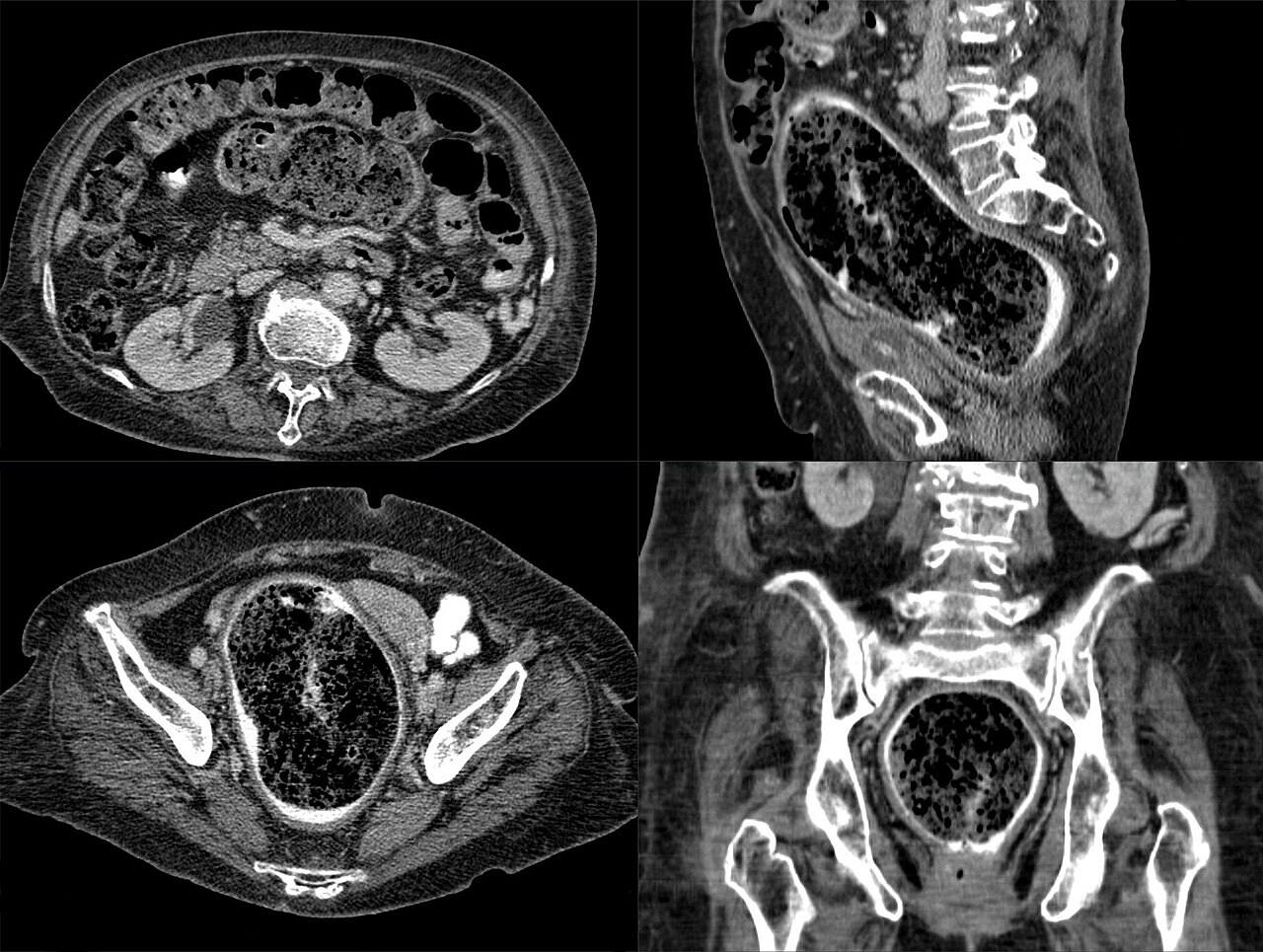
How dangerous is stercoral colitis, and must everyone be admitted? A systematic review of 58 published cases found 22.4% in-hospital or 30-day mortality.19 ED cohorts found less: 3.3% related deaths at 3 months in 269 patients4, and related adverse outcomes in under 1% of 358 patients in a 2026 multicenter cohort, whose authors favor individualized admission decisions.20 Core EM advises admitting all patients.14
Treatment
| Agent | Adult dose | Works in | Notes |
|---|---|---|---|
| Oral, first line | |||
| PEG 3350 | 17 g in 4–8 oz of fluid once daily | 1–3 days | Strong recommendation, moderate certainty. Label: not over 7 days without a doctor's advice; ask a doctor first in kidney disease.6,7 |
| Senna (sennosides 17.2 mg tablet) | 1 tablet at bedtime; max 2 tablets twice daily | 6–12 h | Conditional recommendation, low certainty.6,16 |
| Bisacodyl, oral | 5 mg to start; 10 mg was the trial dose | 6–12 h | Short term or rescue (strong, moderate). Diarrhea and cramps are common at 10 mg.6 |
| Psyllium | Dose per label | — | Fiber is suggested (conditional, low); psyllium is the only fiber with evidence of benefit.6 |
| Rectal | |||
| Bisacodyl suppository | 10 mg PR once daily | 15–60 min | Fast rescue option.6,21 |
| Sodium phosphate enema | One 118 mL enema; no more than one in 24 h | 1–5 min | Avoid in kidney disease, heart disease, dehydration and frail older adults.8,15 |
| Second line | |||
| Lactulose | 15–30 mL (10–20 g) daily; up to 60 mL (40 g) | — | After OTC agents fail (conditional, very low). Bloating and gas limit use.6 |
| Magnesium oxide | Dose per label | — | Conditional, very low certainty. Avoid in renal insufficiency (hypermagnesemia).6 |
| Opioid-induced, after laxatives fail | |||
| Naldemedine | 0.2 mg PO once daily | — | High-quality evidence. May work less well if on opioids under 4 weeks.10,18 |
| Naloxegol | 25 mg PO once daily; 12.5 mg if CrCl < 60 mL/min | — | Moderate-quality evidence. Stop maintenance laxatives before starting.10,11 |
| Methylnaltrexone | 12 mg SC once daily (chronic non-cancer pain) | — | Low-quality evidence. 6 mg SC if CrCl < 60 mL/min. Weight-based, every other day, in advanced illness.10,22 |
Unreviewed doses. Verify against the current label and your institution's protocol before giving anything.
All PAMORAs are contraindicated in known or suspected GI obstruction.11,18,22 Bisacodyl is contraindicated in ileus, obstruction, severe dehydration and acute inflammatory bowel conditions.6 Doses are from the labels and the guideline; check them against your own formulary.
What the guideline says
- PEG gave about 2.9 more complete bowel movements a week than placebo, and the response lasted over 6 months. Expect bloating, loose stool, gas and nausea.6
- Bisacodyl is for short-term (up to 4 weeks) or rescue use. At 10 mg, diarrhea occurred in 53.4% vs 1.7% on placebo, so a 5 mg start is common.6
- Prescription agents (linaclotide, plecanatide and prucalopride, strong; lubiprostone, conditional) are for patients who do not respond to over-the-counter treatment. These are follow-up decisions, not ED ones.6
- Docusate has little supporting data.6 In 74 hospice patients, adding docusate to senna did not improve stool frequency, volume or consistency.23
Enemas
- The sodium phosphate enema label warns that more than one enema in 24 hours can be harmful, and that patients with kidney disease, heart problems or dehydration should ask a doctor first.8
- A review of reports since 2005 found 7 adult deaths from phosphate enemas. Toxicity followed high doses or enema retention, and older adults with comorbidity or renal impairment were most at risk. The authors advise non-phosphate enemas at the extremes of age.15
Opioid-induced constipation
- It starts early. In 386 ED patients discharged with opioids for acute pain, those who took them were more likely to report constipation within 2 weeks (OR 7.5), with a dose-response trend.17
- Laxatives are first-line. Direct trial evidence in opioid users is thin, but indirect evidence supports them (moderate quality).10
- PAMORAs for those who fail. Naldemedine had the strongest evidence (response 52.1% vs 34.6% on placebo), naloxegol moderate (41.9% vs 29.4%), methylnaltrexone low.10
- Stop the PAMORA if the opioid stops.11,18 The AGA 2019 guideline built on this technical review; its full text could not be read for this page, so its recommendation strengths are not given here.24
Disposition
- Obstruction, strangulation or perforation: admit under surgery.1
- Impaction in a frail older adult: most were admitted in the ED cohort.3 For stercoral colitis, sources differ on routine admission (see above).14,20
- Discharge with a daily regimen and follow-up. Constipation management needs consistent outpatient treatment.5
- Alarm features: arrange colon evaluation. Routine colonoscopy is not needed for most patients with constipation.12
- Not responding to over-the-counter treatment: refer for prescription agents and testing for a defecation disorder.6,12
Pitfalls
- Calling an obstruction "constipation". A history of constipation is common in bowel obstruction.1
- Being reassured by a soft abdomen in a bedbound patient with impaction. Pain was absent in 62.1% of stercoral colitis cases.4
- Sending a patient with stercoral colitis home with no enema, laxative or disimpaction. Over half of discharged patients in one cohort got none.4
- Giving a phosphate enema, or a second one, to a patient with kidney disease or dehydration.8,15
- Prescribing opioids without a laxative.9
- Relying on docusate alone.23
How strong is the evidence?
The guideline recommendations come from trials of at least 4 weeks in outpatients with chronic constipation, and the most commonly used agents (fiber, lactulose, senna, docusate) have the least data.6 No guideline addresses ED management. Impaction and stercoral colitis data are retrospective cohorts or case reports.3,4,19 Evidence for laxatives in opioid users is indirect.10
On-shift teaching
Questions to ask a learner at the bedside. Tap a question to see the answer. Every answer uses facts cited above.
Q1A bedbound 80-year-old with impaction has a soft, nontender abdomen. Does that rule out stercoral colitis?
Q2Why reach for a bisacodyl suppository rather than oral bisacodyl in the ED?
Q3A dialysis patient is constipated. Which treatments should you avoid?
Q4How often do US EDs prescribe a laxative with a discharge opioid?
Q5Laxatives have failed for opioid-induced constipation. What next, and when is it contraindicated?
Q6Which features mean a constipated patient needs a colon evaluation?
References
What this page is built on
24 sources, cited 119 times. Dots are sources, filled by how far each was read; stronger color means a larger share of the citations. Tap a tier to see its sources.
Checked by the writer, not a physician. The dots show how each source was read, not that anyone has confirmed the claims.
- 1Long B, Robertson J, Koyfman A. Emergency medicine evaluation and management of small bowel obstruction: evidence-based recommendations. J Emerg Med. 2019;56(2):166–176.
- 2Long B, Koyfman A, Gottlieb M. Evaluation and management of cauda equina syndrome in the emergency department. Am J Emerg Med. 2020;38(1):143–148.
- 3Sommers T, Petersen T, Singh P, et al. Significant morbidity and mortality associated with fecal impaction in patients who present to the emergency department. Dig Dis Sci. 2019;64(5):1320–1327.
- 4Keim AA, Campbell RL, Mullan AF, et al. Stercoral colitis in the emergency department: a retrospective review of presentation, management, and outcomes. Ann Emerg Med. 2023;82(1):37–46.
- 5Zhou AZ, Lorenz D, Simon NJ, Florin TA. Emergency department diagnosis and management of constipation in the United States, 2006–2017. Am J Emerg Med. 2022;54:91–96.
- 6Chang L, Chey WD, Imdad A, et al. American Gastroenterological Association-American College of Gastroenterology clinical practice guideline: pharmacological management of chronic idiopathic constipation. Gastroenterology. 2023;164(7):1086–1106.
- 7MiraLAX (polyethylene glycol 3350) powder for solution. Drug Facts label. Bayer HealthCare LLC. DailyMed.
- 8Sodium phosphate enema (Good Neighbor Pharmacy). Drug Facts label. AmerisourceBergen. DailyMed.
- 9Hunold KM, Smith SA, Platts-Mills TF. Constipation prophylaxis is rare for adults prescribed outpatient opioid therapy from U.S. emergency departments. Acad Emerg Med. 2015;22(9):1118–1121.
- 10Hanson B, Siddique SM, Scarlett Y, et al. American Gastroenterological Association Institute technical review on the medical management of opioid-induced constipation. Gastroenterology. 2019;156(1):229–253.e5.
- 11Movantik (naloxegol) tablets. Prescribing information. Averitas Pharma. DailyMed.
- 12Bharucha AE, Pemberton JH, Locke GR 3rd. American Gastroenterological Association technical review on constipation. Gastroenterology. 2013;144(1):218–238.
- 13Salvi F, Petrino R, Conroy SP, et al. Constipation: a neglected condition in older emergency department patients. Intern Emerg Med. 2024;19(7):1977–1986.
- 14Grabinski Z. Stercoral colitis. Core EM; March 9, 2022.
- 15Hamilton Smith R, Eddleston M, Bateman DN. Toxicity of phosphate enemas: an updated review. Clin Toxicol (Phila). 2022;60(6):672–680.
- 16Senokot (standardized senna concentrate) tablets. Drug Facts label. Atlantis Consumer Healthcare. DailyMed.
- 17Daoust R, Paquet J, Cournoyer A, et al. Side effects from opioids used for acute pain after emergency department discharge. Am J Emerg Med. 2020;38(4):695–701.
- 18Symproic (naldemedine) tablets. Prescribing information. BioDelivery Sciences International. DailyMed.
- 19Stirrat T, Bejugam D, Kim S, et al. Stercoral colitis from constipation to complication: a systematic review. Am J Med Sci. 2026;371(3):267–273.
- 20Ryu AJ, Ayanian S, O'Connor H, et al. Characteristics and outcomes among patients with stercoral colitis: a retrospective cohort study. Postgrad Med. 2026;138(4):443–449.
- 21Walgreens Gentle Laxative (bisacodyl suppository). Drug Facts label. Walgreens. DailyMed.
- 22Relistor (methylnaltrexone bromide) tablets and injection. Prescribing information. Salix Pharmaceuticals. DailyMed.
- 23Tarumi Y, Wilson MP, Szafran O, Spooner GR. Randomized, double-blind, placebo-controlled trial of oral docusate in the management of constipation in hospice patients. J Pain Symptom Manage. 2013;45(1):2–13.
- 24Crockett SD, Greer KB, Heidelbaugh JJ, et al. American Gastroenterological Association Institute guideline on the medical management of opioid-induced constipation. Gastroenterology. 2019;156(1):218–226.
AI-generated draft. Not reviewed by a physician. This page is for education only and may contain errors, including in doses. Do not use it to diagnose, treat or make decisions about any patient. Rely on your own clinical judgment, your institution's protocols and current drug labeling. Reading this page does not create a physician-patient relationship. Full terms