


Blunt chest trauma
Bottom line
- NEXUS Chest decides who needs imaging. With none of its 7 criteria, chest imaging can be skipped: the rule caught 99.7% of clinically major injuries.1
- Rib fractures are dangerous in older adults. Age 65 or older (OR 2.11), 3 or more rib fractures (OR 1.96) and pre-existing disease (OR 2.86) predicted death.2 In older patients, each extra fractured rib raised the odds of death by 19%.3
- Treat pain early and in layers. EAST conditionally recommends multimodal analgesia and epidurals.4 Adding a serratus anterior plane block in the ED doubled the share of patients with meaningful pain relief at 4 hours (41% vs 19.6%) and halved opioid use.5
- Rule out blunt cardiac injury with an ECG and troponin I together. Both normal rules it out; either abnormal means admission with monitoring.6
- eFAST rules a pneumothorax in, not out (sensitivity 69%, specificity 99%).7 A stable hemothorax can be drained with a 14F pigtail catheter rather than a large chest tube.8,9
First steps
- Primary survey. In adults with severe respiratory compromise, consider an immediate chest X-ray and/or eFAST as part of it.10
- Decompress a tension pneumothorax before imaging only if there is hemodynamic instability or severe respiratory compromise. Use open thoracostomy followed by a chest drain.10
- Decide on imaging with NEXUS Chest.1 In major trauma, NICE suggests considering immediate CT for stable adults with suspected chest injury.10
- ECG and troponin I for anyone with suspected cardiac injury.6
- Treat pain early. Intravenous morphine is NICE's first-line analgesic in major trauma, with ketamine second-line; consider a regional block.5,10
- Weigh the risk of delayed complications before deciding where the patient goes: age, number of rib fractures, chronic lung disease, anticoagulants and oxygen saturation.11
- Primary survey; chest X-ray and/or eFAST if breathing is badly compromised. Decompress a tension pneumothorax before imaging only if unstable or in severe respiratory compromise.10
- None of the 7 NEXUS Chest criteria?YesChest imaging can be skipped. Sensitivity was 99.7% for clinically major injury.1
- No: image the chest
- Suspected cardiac injury: new ECG change or raised troponin I?YesAdmit with cardiac monitoring. Echo only if hypotensive or arrhythmic.6
- No: both normal rules it out
- Either way
- Flail chest?YesAsk a surgeon about rib fixation.17
- Either way
- NoLow risk and pain controlled: discharge can be reasonable. Respiratory complications can appear 48–72 hours after injury.11
Who needs imaging
| Rule | Criteria (any one present means image) | Performance |
|---|---|---|
| NEXUS Chest: whether to image at all (age over 14) | ||
| NEXUS Chest | Age over 60 · rapid deceleration · chest pain · intoxication · abnormal alertness or mental status · distracting painful injury · chest wall tenderness | Sensitivity 98.8% for any injury on imaging, 99.7% for major injury; specificity 13.3%1 |
| NEXUS Chest CT: whether to add a CT | ||
| Chest CT-All | Abnormal chest X-ray · rapid deceleration · distracting injury · chest wall, sternal, thoracic spine or scapular tenderness | Major injury: sensitivity 99.2%, specificity 20.8%12 |
| Chest CT-Major | The same, without rapid deceleration | Major injury: sensitivity 99.2%, specificity 31.7%12 |
Rapid deceleration means a fall from more than 20 feet (6.1 m) or a vehicle crash at more than 40 mph (64 km/h) with sudden deceleration. An abnormal chest X-ray includes any thoracic injury, a clavicle fracture or a widened mediastinum.12
- NEXUS Chest was validated in 9,905 patients at 9 US level I trauma centers. Its negative predictive value for major injury was 99.9%.1
- One criterion is not a mandate to scan. With a single criterion, major injury was found in 1.9–3.8% of patients; with 2 or 3, in 1.7–16.6%, depending on which ones.18
- The CT rules could avoid about 25–37% of chest CTs. They missed one major injury in the validation phase, an isolated pneumothorax in an 80-year-old.12
- eFAST is a rule-in test. For pneumothorax, pooled sensitivity was 69% and specificity 99%.7 A negative eFAST of the chest does not exclude a pneumothorax.10
- Stable adults with major trauma: NICE suggests considering immediate CT for suspected chest trauma without severe respiratory compromise.10
Rib fractures, flail chest and contusion
- Age changes the picture. Older patients with rib fractures had twice the mortality of younger patients with similar injuries (22% vs 10%) and more pneumonia (31% vs 17%).3
- Count the ribs. In older patients, each extra fracture raised the odds of death (OR 1.19 per rib).3 Across 73 studies, 3 or more rib fractures roughly doubled the odds of death (OR 1.96).2
- Other risk factors for death: age 65 or older (OR 2.11) and pre-existing disease (OR 2.86).2
The STUMBL score
Built in Wales to predict complications after blunt chest wall trauma: death, pulmonary complications, ICU admission or a hospital stay of 7 days or more. Its five predictors are age, the number of rib fractures, chronic lung disease, anticoagulant use and oxygen saturation.11
| Item | Points |
|---|---|
| Age | 1 per decade of age (67 years scores 6) |
| Each rib fracture | 3 |
| Chronic lung disease | 5 |
| Pre-injury anticoagulant | 4 |
| Oxygen saturation | 2 per 5% fall, starting at 94% (87% scores 4) |
| Total and risk of complications | |
| 0–10 | 13% |
| 11–15 | 29% |
| 16–20 | 52% |
| 21–25 | 70% |
| 26 or more | 80–88% |
The authors' cut-offs: 11 or more for admission, 26 or more for ICU. A 67-year-old with 3 rib fractures, chronic lung disease and a saturation of 87% scores 24.11
In the derivation study, a score of 11 or more was the best cut-off for admission.11 In a later cohort of 369 ED patients at a UK university hospital, it performed no better than the clinician's decision to admit (AUC 0.84 vs 0.85) and would have admitted 117 patients instead of 95.19 Use it to support judgement, not replace it.
Flail chest and rib fixation
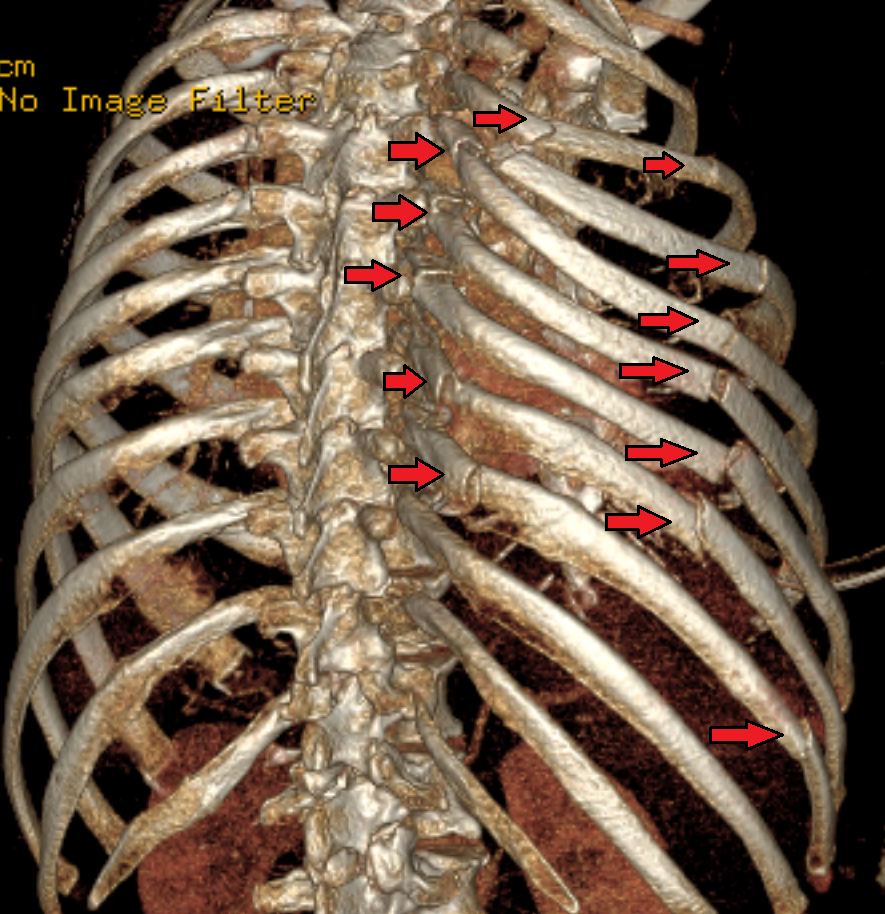
- EAST conditionally recommends operative fixation in adults with flail chest. In its meta-analysis (986 patients, very low-quality evidence), fixation was linked to lower mortality, shorter ventilation and stays, and less pneumonia and tracheostomy. It made no recommendation for patients without a flail segment.17
- A Cochrane review of 3 small trials (123 patients) found less pneumonia with surgery (RR 0.36) but no clear difference in mortality.20
Pulmonary contusion
- Don't restrict fluid excessively. Resuscitate to signs of adequate tissue perfusion.21
- Avoid intubating just for the injury. Mechanical ventilation without respiratory failure should be avoided. Consider a trial of mask CPAP in alert patients with marginal breathing.21
- No steroids for pulmonary contusion. Diuretics only for fluid overload in a stable patient or known heart failure.21
Analgesia
| Option | What the evidence shows | Notes |
|---|---|---|
| IV morphine | NICE's first-line analgesic in major trauma, titrated to effect10 | Ketamine at analgesic doses is NICE's second-line choice10 |
| Multimodal analgesia | Conditionally recommended by EAST (very low-quality evidence)4 | — |
| Serratus anterior plane block | SABRE trial (n = 210): meaningful pain relief at 4 h in 41% vs 19.6%; 24 h opioid use 45 vs 91 mg morphine equivalents5 | Pneumonia, length of stay and 30-day mortality were similar5 |
| Epidural | Conditionally recommended by EAST4; preferred for severe flail chest in the 2012 EAST guideline, with paravertebral block a possible alternative21 | No effect on pneumonia, ventilation, stay or mortality in older adults16 |
| Ketamine | No significant fall in pain scores in older adults; a trend toward less opioid use16 | EAST makes no recommendation for or against16 |
No doses are given here because none of the sources this page could read state them for chest trauma. Dose per institutional protocol and label.
- SABRE ran in 8 Australian EDs and enrolled patients 16 or older with suspected or proven rib fractures; the median age was 71. Patients with a major injury outside the chest were excluded.5
- It was open-label and analyzed complete cases.5,22 Even with the block, most patients had not reached the pain target at 4 hours; St Emlyn's calls it a bridge, not a complete solution.5,22
EAST's 2016 guideline conditionally recommends epidural analgesia for blunt chest trauma.4 Its 2023 guideline for older adults found that epidurals and other regional techniques did not change pneumonia, ventilation, length of stay or mortality, and makes no recommendation for or against them.16 Both rest on very low-quality evidence.
Pneumothorax and hemothorax
- Occult pneumothorax (seen on CT, not on X-ray): in the OPTICC trial of ventilated patients, respiratory distress occurred in 38% observed vs 25% drained, not significantly different, with no difference in mortality. About a quarter of observed patients needed a drain, rising to 40% when ventilated for more than 5 days.14
- Observation works for small hemothoraces. In 340 patients, 66% of those initially observed needed no tube, and 98% of those were small (under 300 mL on CT). Older age, a large hemothorax, a pneumothorax as well, and fewer ventilator-free days predicted failure.15
- Pigtail first in stable patients. EAST conditionally recommends pigtail catheters for traumatic hemothorax in hemodynamically stable patients.8
- In the only randomized trial, 14F pigtails and 28–32F chest tubes failed equally often (10% vs 17%), and patients found the pigtail far easier to tolerate.9 It excluded emergency placement for instability, so it does not apply to the patient in shock.9
- Retained hemothorax: EAST conditionally recommends early thoracoscopic drainage (within 4 days) over thrombolytics.8
Blunt cardiac injury
- Get an admission ECG and troponin I for every patient in whom blunt cardiac injury is suspected. The ECG alone is not enough.6
- Both normal rules it out. Adding troponin I to the ECG raised the negative predictive value to 100% in four studies.6
- New ECG changes or a raised troponin I: admit for monitoring.6
- Echo is not a screening test. Reserve it for hypotension or arrhythmia.6
- A sternal fracture alone does not predict cardiac injury.6
In 350 stable patients admitted with possible cardiac injury or a sternal fracture, all 12 adverse cardiac events were arrhythmias, and none occurred with a normal ECG and a raised troponin. The authors suggest that troponin may not be needed in stable patients who are already being admitted.23 This single-center retrospective study does not change the EAST advice for patients you are thinking of sending home.6
Blunt aortic injury
- It is lethal. Blunt aortic injury is the second most common cause of death in trauma, and 80% of patients die before reaching a trauma center.13
- CT of the chest with IV contrast is strongly recommended for diagnosis.13
- A normal X-ray doesn't exclude it. In the NEXUS Chest CT cohort, the chest X-ray was normal, including the mediastinal width, in 8 of 21 aortic or great vessel injuries (38%), and 7 had no rapid deceleration mechanism. The CT rules caught all 21.12
- Repair: endovascular repair is strongly recommended when there is no contraindication. Delayed repair is suggested, provided blood pressure is effectively controlled.13
Disposition
- Suspected cardiac injury with a new ECG change or raised troponin I: admit with monitoring.6
- Older adults with multiple rib fractures: EAST does not recommend for or against routine ICU admission. Poor incentive spirometry was linked to longer stays, pulmonary complications and unplanned ICU admission, so use it to help decide the level of care.16
- NIPPV in suitable older patients without a risk of airway loss was linked to 85% lower odds of pneumonia and 81% lower odds of death; EAST conditionally recommends it.16
- High STUMBL score or high-risk features: admit. A score of 11 or more was the authors' admission cut-off and 26 or more their ICU cut-off.11
- Low risk with pain controlled: discharge can be reasonable, but respiratory complications can develop 48–72 hours after injury.11
Pitfalls
- Calling a pneumothorax excluded on a negative eFAST. It misses about a third.7,10
- Trusting a normal mediastinum on the X-ray to exclude aortic injury.12
- Ruling out cardiac injury with the ECG alone, or ordering echo as a screening test.6
- Sending home an older patient with several rib fractures because they look well in the ED. Complications can appear 48–72 hours later.3,11
- Treating rib fracture pain with opioids alone when a regional block can halve opioid use.5
- Fluid-restricting a patient with pulmonary contusion to the point of poor perfusion.21
How strong is the evidence?
The imaging rules are the strongest part: NEXUS Chest and NEXUS Chest CT were validated prospectively in more than 20,000 patients combined.1,12 Almost everything else is weak. The EAST guidelines on analgesia, rib fixation, hemothorax and older adults all describe very low-quality evidence.4,8,16,17 The cardiac injury advice rests on institutional studies.6 The analgesia picture is improving: SABRE is a multicenter randomized trial in ED patients.5
On-shift teaching
Questions to ask a learner at the bedside. Tap a question to see the answer. Every answer uses facts cited above.
Q1What are the 7 NEXUS Chest criteria, and how good is the rule?
Q2Why do rib fractures matter more in a 75-year-old than a 35-year-old?
Q3How do you rule out blunt cardiac injury?
Q4The eFAST shows lung sliding on both sides. Is a pneumothorax excluded?
Q5What size of drain does a stable patient with a traumatic hemothorax need?
References
What this page is built on
23 sources, cited 116 times. Dots are sources, filled by how far each was read; stronger color means a larger share of the citations. Tap a tier to see its sources.
Checked by the writer, not a physician. The dots show how each source was read, not that anyone has confirmed the claims.
- 1Rodriguez RM, Anglin D, Langdorf MI, et al. NEXUS Chest: validation of a decision instrument for selective chest imaging in blunt trauma. JAMA Surg. 2013;148(10):940–946.
- 2Battle C, Carter K, Newey L, et al. Risk factors that predict mortality in patients with blunt chest wall trauma: an updated systematic review and meta-analysis. Emerg Med J. 2023;40(5):369–378.
- 3Bulger EM, Arneson MA, Mock CN, Jurkovich GJ. Rib fractures in the elderly. J Trauma. 2000;48(6):1040–1047.
- 4Galvagno SM Jr, Smith CE, Varon AJ, et al. Pain management for blunt thoracic trauma: a joint practice management guideline from the Eastern Association for the Surgery of Trauma and Trauma Anesthesiology Society. J Trauma Acute Care Surg. 2016;81(5):936–951.
- 5Partyka C, Asha S, Berry M, et al. Serratus anterior plane blocks for early rib fracture pain management: the SABRE randomized clinical trial. JAMA Surg. 2024;159(7):810–817.
- 6Clancy K, Velopulos C, Bilaniuk JW, et al. Screening for blunt cardiac injury: an Eastern Association for the Surgery of Trauma practice management guideline. J Trauma Acute Care Surg. 2012;73(5 Suppl 4):S301–S306.
- 7Netherton S, Milenkovic V, Taylor M, Davis PJ. Diagnostic accuracy of eFAST in the trauma patient: a systematic review and meta-analysis. CJEM. 2019;21(6):727–738.
- 8Patel NJ, Dultz L, Ladhani HA, et al. Management of simple and retained hemothorax: a practice management guideline from the Eastern Association for the Surgery of Trauma. Am J Surg. 2021;221(5):873–884.
- 9Bauman ZM, Kulvatunyou N, Joseph B, et al. Randomized clinical trial of 14-French (14F) pigtail catheters versus 28–32F chest tubes in the management of patients with traumatic hemothorax and hemopneumothorax. World J Surg. 2021;45(3):880–886.
- 10National Institute for Health and Care Excellence. Major trauma: assessment and initial management (NG39). February 2016.
- 11Battle C, Hutchings H, Lovett S, et al. Predicting outcomes after blunt chest wall trauma: development and external validation of a new prognostic model. Crit Care. 2014;18(3):R98.
- 12Rodriguez RM, Langdorf MI, Nishijima D, et al. Derivation and validation of two decision instruments for selective chest CT in blunt trauma: a multicenter prospective observational study (NEXUS Chest CT). PLoS Med. 2015;12(10):e1001883.
- 13Fox N, Schwartz D, Salazar JH, et al. Evaluation and management of blunt traumatic aortic injury: a practice management guideline from the Eastern Association for the Surgery of Trauma. J Trauma Nurs. 2015;22(2):99–110.
- 14Clements TW, Sirois M, Parry N, et al. OPTICC: a multicentre trial of occult pneumothoraces subjected to mechanical ventilation: the final report. Am J Surg. 2021;221(6):1252–1258.
- 15Demetri L, Martinez Aguilar MM, Bohnen JD, et al. Is observation for traumatic hemothorax safe? J Trauma Acute Care Surg. 2018;84(3):454–458.
- 16Mukherjee K, Schubl SD, Tominaga G, et al. Non-surgical management and analgesia strategies for older adults with multiple rib fractures: a systematic review, meta-analysis, and joint practice management guideline from the Eastern Association for the Surgery of Trauma and the Chest Wall Injury Society. J Trauma Acute Care Surg. 2023;94(3):398–407.
- 17Kasotakis G, Hasenboehler EA, Streib EW, et al. Operative fixation of rib fractures after blunt trauma: a practice management guideline from the Eastern Association for the Surgery of Trauma. J Trauma Acute Care Surg. 2017;82(3):618–626.
- 18Raja AS, Lanning J, Gower A, et al. Prevalence of chest injury with the presence of NEXUS Chest criteria: data to inform shared decisionmaking about imaging use. Ann Emerg Med. 2016;68(2):222–226.
- 19Callisto E, Costantino G, Tabner A, Kerslake D, Reed MJ. The clinical effectiveness of the STUMBL score for the management of ED patients with blunt chest trauma compared to clinical evaluation alone. Intern Emerg Med. 2022;17(6):1785–1793.
- 20Cataneo AJ, Cataneo DC, de Oliveira FH, et al. Surgical versus nonsurgical interventions for flail chest. Cochrane Database Syst Rev. 2015;(7):CD009919.
- 21Simon B, Ebert J, Bokhari F, et al. Management of pulmonary contusion and flail chest: an Eastern Association for the Surgery of Trauma practice management guideline. J Trauma Acute Care Surg. 2012;73(5 Suppl 4):S351–S361.
- 22Carley S. JC: Serratus anterior plane blocks for rib fractures in the ED. St Emlyn's; May 24, 2024.
- 23Cleary HL, Bernard MD, Davenport DL, Bernard AC. Diagnostic value of serum troponin in stable patients at risk for blunt cardiac injury. Injury. 2026;57(9):113448.
AI-generated draft. Not reviewed by a physician. This page is for education only and may contain errors, including in doses. Do not use it to diagnose, treat or make decisions about any patient. Rely on your own clinical judgment, your institution's protocols and current drug labeling. Reading this page does not create a physician-patient relationship. Full terms