


Blunt abdominal trauma
Bottom line
- Hemodynamic status picks the path. Instability that doesn't respond to resuscitation, peritonitis, evisceration or impalement means the operating room; nonoperative management is contraindicated.1,2
- A positive FAST makes injury very likely (LR 69); a negative FAST does not rule it out. For abdominal injury, ultrasound sensitivity was only 0.68.3,4
- Stable patients get a contrast CT. If it shows a solid-organ injury and nothing else needs surgery, try nonoperative management whatever the grade.1,2
- Take the seat belt sign seriously. It raised the likelihood of injury more than any other exam finding (LR 5.6–9.9). Abdominal tenderness alone neither confirms nor excludes injury.3
- Bleeding? Tranexamic acid within 3 hours and a systolic target of 80–90 mm Hg until bleeding is controlled, unless there is brain injury.5,6
First steps
- Let hemodynamic status choose the tests.1,2
- FAST in the primary survey. It detects free fluid quickly.1,5
- Bleeding patient: give tranexamic acid as soon as possible within 3 hours, and restrict fluid to a systolic pressure of 80–90 mm Hg unless there is brain or spinal injury.5
- Unstable despite resuscitation, or peritonitis: operating room.1,2
- Stable or stabilized: contrast-enhanced CT to find the injury and its grade.1,2,5
- Re-examine. Hollow-organ injuries are the ones most often missed.5
- No: stable or stabilizedPeritonitis, evisceration or impalement?YesLaparotomy.1
- NoAll low-risk: normal mental status, no abdominal or costal margin tenderness, systolic ≥ 90, fewer than 25 RBC/hpf, hematocrit ≥ 30%?YesSignificant injury is very unlikely (LR 0.02). Observe with serial abdominal exams.3
- No
- Either wayKeep re-examining. Hollow-organ injuries were the ones most often missed even after a full trauma workup.5
History, exam and labs
In adult ED patients with blunt abdominal trauma, 13% had an intra-abdominal injury and about 4.7% a clinically significant one.3
| Finding | Likelihood ratio |
|---|---|
| Raise the likelihood | |
| Positive FAST | 69 |
| Base deficit < −6 mEq/L | 18 |
| Seat belt sign | 5.6–9.9 |
| Rebound tenderness | 6.5 |
| Systolic < 90 mm Hg on arrival | 5.2 |
| Hematuria (> 25–50 RBC/hpf) | 3.7–4.1 |
| Abdominal distention | 3.8 |
| Hematocrit < 30% | 3.3 |
| Femur fracture | 2.9 |
| Lower the likelihood | |
| Low-risk combination (see below) | 0.02 |
| Base deficit −6 mEq/L or better | 0.12 |
| Negative FAST | 0.18 |
| No abdominal tenderness | 0.61 |
| Normal chest or pelvic x-ray | 0.70–0.96 |
For any intra-abdominal injury, from the JAMA Rational Clinical Examination review.3 Abdominal tenderness on its own (LR 1.4) and its absence are of little help.3
No abdominal tenderness, no costal margin tenderness, systolic pressure ≥ 90 mm Hg, fewer than 25 RBC/hpf, hematocrit ≥ 30% and a normal mental status together best ruled out a clinically significant injury (LR 0.02).3
FAST and CT
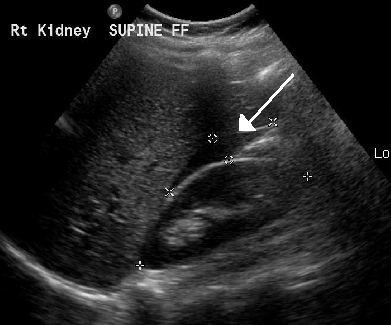
- FAST rules in. Across 34 studies (n = 8,635), ultrasound had sensitivity 0.74 and specificity 0.96 for thoracoabdominal injury, but sensitivity was only 0.68 for abdominal injury.4
- A negative FAST must be confirmed with a reference test such as CT.4,5 In 317 hypotensive patients, 22 with a negative FAST needed a laparotomy within 6 hours.5
- FAST is operator-dependent. Proficiency takes 20–50 examinations, and publication bias may flatter the published negative likelihood ratio.3
- Contrast-enhanced CT is the gold standard in stable or stabilized patients (WSES grade 1A), and is needed before nonoperative management.1,2
- Early whole-body CT is recommended to find the injury and the bleeding source (grade 1B).5 The only randomized trial, REACT-2, found no survival benefit from immediate whole-body CT.5
- CT grade does not predict failure of nonoperative management of the spleen, nor does the amount of free fluid.1
Bleeding and resuscitation
| Treatment | Adult dose or target | Notes |
|---|---|---|
| Tranexamic acid | 1 g IV over 10 min, then 1 g IV over 8 h | As soon as possible, within 3 h of injury (grade 1A).5 |
| Fluid strategy | Systolic 80–90 mm Hg (MAP 50–60) | Until major bleeding stops. Not with brain or spinal injury (grade 1B).5 |
Unreviewed doses. Verify against the current label and your institution's protocol before giving anything.
- CRASH-2 (n = 20,211 bleeding trauma patients): tranexamic acid lowered all-cause death (14.5% vs 16.0%; RR 0.91) and death from bleeding (4.9% vs 5.7%).6
- Shock index (heart rate divided by systolic pressure) of 0.9–1.0 or more was linked to massive transfusion and to radiological and operative intervention.5
- Restrictive fluids came from a trial in penetrating trauma; the evidence should be read with caution.5
Spleen and liver injuries
- Nonoperative management first for hemodynamically stable patients with no other injury needing surgery, whatever the grade (spleen and liver, grade 2A).1,2
- Only where it is safe: moderate and severe injuries need intensive monitoring, angiography and embolization, an immediately available operating room and blood, or fast transfer.1,2
- Angioembolization may be first-line for stable patients with an arterial blush on CT (grade 2B).1,2
- Higher risk of failure with the spleen: age over 55, a high injury severity score and moderate to severe injuries.1
- Observe moderate and severe splenic injuries clinically and with labs for the first 48–72 hours.1 Serial exams and labs are mandatory during nonoperative liver management.2
- After splenectomy, vaccinate against pneumococcus, H. influenzae and meningococcus, starting no sooner than 14 days after surgery.1
Pitfalls
- Clearing the abdomen with a negative FAST.4
- Being reassured by a soft, nontender abdomen (LR 0.61 when absent).3
- Sending an unstable, non-responding patient to CT instead of the operating room.1,2
- Starting nonoperative management where there is no angiography, operating room or monitoring.1
- Missing a hollow-organ injury after a normal-looking workup. Keep examining.5
- Giving permissive hypotension to a patient with brain injury.5
How strong is the evidence?
On-shift teaching
Questions to ask a learner at the bedside. Tap a question to see the answer. Every answer uses facts cited above.
Q1Which single exam finding most raises the likelihood of intra-abdominal injury?
Q2The FAST is negative in a stable patient with a seat belt sign. Done?
Q3A stable patient has a grade IV splenic laceration with a blush. Surgery?
Q4What is the tranexamic acid dose and time window?
Q5When is permissive hypotension wrong?
Q6Which findings together make a significant injury very unlikely?
References
What this page is built on
6 sources, cited 80 times. Dots are sources, filled by how far each was read; stronger color means a larger share of the citations. Tap a tier to see its sources.
Checked by the writer, not a physician. The dots show how each source was read, not that anyone has confirmed the claims.
- 1Coccolini F, Montori G, Catena F, et al. Splenic trauma: WSES classification and guidelines for adult and pediatric patients. World J Emerg Surg. 2017;12:40.
- 2Coccolini F, Coimbra R, Ordonez C, et al. Liver trauma: WSES 2020 guidelines. World J Emerg Surg. 2020;15(1):24.
- 3Nishijima DK, Simel DL, Wisner DH, Holmes JF. Does this adult patient have a blunt intra-abdominal injury? JAMA. 2012;307(14):1517–1527.
- 4Stengel D, Leisterer J, Ferrada P, et al. Point-of-care ultrasonography for diagnosing thoracoabdominal injuries in patients with blunt trauma. Cochrane Database Syst Rev. 2018;12:CD012669.
- 5Rossaint R, Afshari A, Bouillon B, et al. The European guideline on management of major bleeding and coagulopathy following trauma: sixth edition. Crit Care. 2023;27(1):80.
- 6CRASH-2 trial collaborators; Shakur H, Roberts I, et al. Effects of tranexamic acid on death, vascular occlusive events, and blood transfusion in trauma patients with significant haemorrhage (CRASH-2): a randomised, placebo-controlled trial. Lancet. 2010;376(9734):23–32.
AI-generated draft. Not reviewed by a physician. This page is for education only and may contain errors, including in doses. Do not use it to diagnose, treat or make decisions about any patient. Rely on your own clinical judgment, your institution's protocols and current drug labeling. Reading this page does not create a physician-patient relationship. Full terms