


Acute headache
Bottom line
- Most sudden, severe headaches are benign, but not all. About 10–15% have a serious cause, most often subarachnoid hemorrhage (SAH). Of headaches that peak within an hour, 6–7% are SAH.1
- Use the Ottawa SAH Rule only in alert patients with a normal neurologic exam and a headache that peaked within 1 hour. Any one criterion means imaging. It missed no SAH in its derivation or validation, but specificity was only 13.6–15.3%.1,2,3
- A normal noncontrast CT within 6 hours of onset rules out SAH in a neurologically intact patient (Level B). If the patient is still at risk after that, choose LP or CT angiography with them (Level C).1
- Treat primary headache without opioids (Level A).1 The 2025 American Headache Society update says IV prochlorperazine and greater occipital nerve blocks must be offered, and IV hydromorphone must not.4
- Plan for the headache coming back. It returned after discharge in 73% of patients in one trial.1 Dexamethasone lowers the chance of a moderate or severe headache over the next 1–3 days.5 Relief after treatment does not prove the cause is benign.1
First steps
- Take a focused history. Note when the pain started, how fast it peaked, what the patient was doing, and whether it is like previous headaches.1,6
- Examine the neck and the nervous system. A focal deficit or reduced consciousness takes the patient outside the SAH decision rules: image emergently.1,2
- Screen for red flags (table below). Each raises the chance of a secondary cause.6
- If the headache peaked within 1 hour, apply the Ottawa SAH Rule. Any positive criterion means a noncontrast head CT.1,7
- Treat the pain while you work it up, with nonopioid drugs.1 Pain relief should not be used to decide whether the cause is serious.1
- Before discharge, plan for recurrence and give a discharge medication.1
- Focal deficit or reduced consciousness?YesImage emergently. The Ottawa SAH Rule and the 6-hour CT rule apply only with a normal neurologic exam.1
- NoPeaked within 1 hour, with any Ottawa SAH Rule criterion?
- No
- No: likely a primary headache
Red flags for a secondary headache
| Red flag | Notes |
|---|---|
| Fever or other systemic symptoms | Fever may call for tests beyond the SAH workup.6,1 |
| History of cancer6 | — |
| Neurologic deficit or reduced consciousness | Outside the SAH decision rules; image emergently.6,1 |
| Sudden or abrupt onset | SAH and other thunderclap causes.6,8 |
| Onset after age 656 | — |
| New headache, or a change in pattern6 | — |
| Positional, or set off by sneezing, coughing or exercise6 | — |
| Papilledema6 | — |
| Pregnancy or postpartum | A wider differential; outside the ACEP policy.1,8 |
| Immune compromise, such as HIV | Consider imaging.6,8 |
| Recent head trauma | Consider imaging.6,8 |
| Painkiller overuse, or a new drug at onset6 | — |
From the SNNOOP10 list. Few red flags have been studied prospectively, so their accuracy is largely unknown.6
- No single sign rules SAH out. In a meta-analysis cited by ACEP, 17 individual features had an average sensitivity of 39%. Calling the headache "thunderclap" had a sensitivity of 58% and a specificity of 50%.1
- SAH is not the only cause of a thunderclap headache. In one prospective series the causes included SAH, cerebral infarction, intracerebral hemorrhage, aseptic meningitis and sinus thrombosis.8
- Consider imaging in the peripartum and postpartum period, with immune compromise, after recent head trauma, and with cardiovascular disease, as the American Headache Society commentary suggests.8
- Fever or severe back pain may call for testing beyond the SAH workup.1
Ruling out subarachnoid hemorrhage
| Ottawa SAH Rule: image if any is present |
|---|
| Age 40 or older |
| Neck pain or stiffness |
| Witnessed loss of consciousness |
| Onset during exertion |
| Thunderclap headache (instantly peaking pain) |
| Limited neck flexion on examination |
Applies to alert adults with a normal neurologic exam and a nontraumatic headache that peaked within 1 hour (Level B).1,2 It is not meant for patients with recurrent similar headaches (at least three over more than 6 months), a brain shunt, a known brain tumor or a previous SAH.9
- Derivation: 2,131 patients, 132 with SAH (6.2%). Sensitivity 100% (95% CI 97.2–100%), specificity 15.3%.2
- Validation: 1,153 patients, 67 with SAH. Sensitivity 100% (95% CI 94.6–100%), specificity 13.6%. Imaging rates stayed about the same, near 87%.3
- It rules out; it does not rule in. Only about 18% of patients with a positive rule had SAH.1
Noncontrast CT
- Within 6 hours of onset: in 953 neurologically intact patients scanned in that window, CT found all 121 SAHs (sensitivity 100%, 95% CI 97.0–100%). Across all times, CT sensitivity was 92.9%.14
- Pooled data: across 8,907 patients scanned within 6 hours, 13 SAHs were missed (1.46 per 1,000). Sensitivity was 98.7%, with a negative likelihood ratio of 0.010.15
- The scanner and the reader matter. ACEP requires at least a third-generation scanner.1 The key study used scans read by qualified radiologists, which may not hold everywhere.14,8
- Anemia: a hemoglobin under 10 g/dL may reduce the contrast between blood and brain.1 EM Ottawa advises against relying on CT alone in moderate to severe anemia.9
Still at risk after a negative CT: LP or CTA?
After a negative CT, roughly 1% of patients still have a consequential SAH. ACEP accepts either LP or CT angiography, chosen by shared decision-making (Level C).1
| Lumbar puncture | CT angiography | |
|---|---|---|
| What it finds | Blood in the CSF. A final-tube red cell count under 2,000 × 10⁶/L with no xanthochromia excluded SAH in one cohort.1 | Aneurysms, with pooled sensitivity about 97%. It does not show bleeding itself.1 |
| Other diagnoses | Alternative diagnoses in 10.6% after a negative CT, including viral (6.3%) and bacterial (1.7%) meningitis and intracranial hypertension (2.0%).1 | Can miss what an LP would have found.1 |
| Downsides | Traumatic taps, uninterpretable results and post-LP headache (4–30%). About 116 LPs per SAH found.1 | Incidental aneurysms (about 2% of adults have one), which can lead to unneeded procedures. Roughly doubles the radiation of a head CT.1 |
| Patient preference | — | 79.2% of surveyed ED patients preferred CTA.1 |
Treating a primary headache
ACEP's one Level A recommendation: use nonopioid drugs first for acute primary headache.1 Opioids are still common: they were ordered at 35.8% of 1,222 ED visits for migraine in one study.1 Most of the treatment evidence comes from migraine.1,4
| AHS 2025 level | Parenteral treatments for migraine in the ED |
|---|---|
| A: must offer | Prochlorperazine IV; greater occipital nerve block4 |
| B: should offer | Ketorolac IV, metoclopramide IV, sumatriptan SC, dexketoprofen IV, supraorbital nerve block4 |
| C: may offer | Chlorpromazine IV, dexamethasone IV, valproate IV4 |
| U: no recommendation | Ketamine, lidocaine, normal saline, propofol, caffeine, granisetron, ibuprofen, sphenopalatine ganglion block4 |
| C: should not offer | Acetaminophen IV4 |
| A: must not offer | Hydromorphone IV4 |
| Drug | Adult dose | Notes |
|---|---|---|
| First line | ||
| Prochlorperazine | 10 mg slow IV, no faster than 5 mg/min | The label's maximum single IV dose. The label indication is severe nausea, not migraine.10 |
| Metoclopramide | 10 mg IV over 1–2 min | Given fast, it can cause intense anxiety and restlessness.11 20 or 40 mg worked no better than 10 mg.16 |
| Alternatives or add-ons | ||
| Ketorolac | 30 mg IV once; 15 mg if 65 or older, renal impairment, or under 50 kg | Single-dose label regimen.12 About as effective as metoclopramide or phenothiazines at 1 hour.17 |
| Sumatriptan | 6 mg SC; may repeat after ≥ 1 h, max 12 mg/24 h | Not with coronary disease, stroke or TIA, hemiplegic or basilar migraine, uncontrolled hypertension, or an ergot within 24 h.13 |
| Greater occipital nerve block | Technique and dose per institutional protocol | Level A in the 2025 guideline; see the trial below.4,18 |
| To reduce recurrence | ||
| Dexamethasone IV | Dose per institutional protocol and label | Level C.4 Lowers moderate or severe headache at 24–72 h.5 |
| At discharge, for a returning headache | ||
| Naproxen or sumatriptan, oral | Naproxen 500 mg or sumatriptan 100 mg | Relieved post-ED headache equally well.1 |
| Avoid | ||
| Hydromorphone IV, other opioids | — | Use nonopioids first (Level A).1 Must not offer hydromorphone.4 Less effective than prochlorperazine.19 |
| Acetaminophen IV | — | Likely ineffective.4 |
| Butalbital combinations | — | The American Headache Society commentary advises against them in the ED.8 |
Unreviewed doses. Verify against the current label and your institution's protocol before giving anything.
Dopamine antagonists
- Prochlorperazine beat hydromorphone. Sustained relief for 48 hours: 60% vs 31% (number needed to treat 4). The trial was stopped early for this result.19
- Akathisia is the main side effect. The prochlorperazine trial gave diphenhydramine with it to prevent akathisia.19 In a metoclopramide dose trial, 33 of 356 patients developed it, and 17% had drowsiness that impaired function.16
- Routine diphenhydramine added nothing to metoclopramide: sustained relief 40% vs 37%, with similar rates of akathisia.20
Greater occipital nerve block
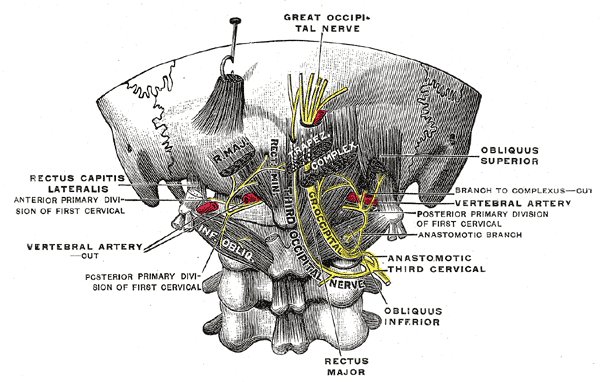
The 2025 American Headache Society update rates the greater occipital nerve block highly likely to be effective and says it must be offered (Level A).4 In an ED trial of 99 patients, though, a bupivacaine block was not as effective as IV metoclopramide as first-line treatment: sustained relief 22% vs 38%, and rescue medication 33% vs 17%.18 A block is a reasonable option, but it may not replace a dopamine antagonist.
Preventing the bounce-back
- Recurrence is the rule. In one trial, 73% of patients had a headache again after discharge.1
- Dexamethasone: across 7 ED trials (742 patients), adding it to standard treatment lowered moderate or severe headache at 24–72 hours (RR 0.87; absolute reduction 9.7%). Side effects of a single dose were infrequent and mild.5
- Discharge medication: oral naproxen 500 mg and sumatriptan 100 mg relieved a returning headache equally well.1
- Opioids in the ED are linked to more return visits.8
Disposition
- Alert, normal exam, no red flags, and SAH ruled out by the rule or an early CT: no further SAH workup is needed. Treat, and discharge with a medication and advice for recurrence.1
- Still at risk for SAH after a negative CT: complete the workup with LP or CTA before discharge, chosen with the patient.1
- A red flag or an abnormal exam: the disposition follows the cause you find. A negative SAH workup does not clear other secondary causes.1,8
- Pregnant or postpartum patients are outside the ACEP policy because the differential is wider.1
Pitfalls
- Applying the Ottawa SAH Rule to a patient with a deficit, a headache that built over more than an hour, or trauma.1,2
- Relying on one feature, such as "thunderclap" or "worst ever", to rule SAH in or out.1
- Trusting a negative CT more than 6 hours after onset, or one in a patient with significant anemia.1,9
- Stopping at "not SAH." Other thunderclap causes include infarction, hemorrhage, meningitis and sinus thrombosis.8
- Reading relief after treatment as proof of a benign headache.1
- Reaching for hydromorphone. It is less effective than prochlorperazine and the guideline says it must not be offered.19,4
- Pushing metoclopramide fast. Give 10 mg over 1–2 minutes.11
How strong is the evidence?
The SAH recommendations rest on large Canadian cohorts: Level B for the Ottawa SAH Rule and the 6-hour CT, and only Level C for choosing LP or CTA, because just one small study compared them directly.1 No newer ACEP headache policy was found, and the American Board of Emergency Medicine reconfirmed its summary of the 2019 policy in July 2025.7 Treatment advice comes from randomized ED trials, almost all in migraine; the 2025 American Headache Society update added 26 new trials.4 Red flags are mostly unvalidated.6
On-shift teaching
Questions to ask a learner at the bedside. Tap a question to see the answer. Every answer uses facts cited above.
Q1Name the six Ottawa SAH Rule criteria, and who the rule applies to.
Q2How specific is the Ottawa SAH Rule, and what does a positive rule mean?
Q3When does a normal noncontrast CT rule out SAH without an LP?
Q4A patient is still at risk after a negative CT. What are the trade-offs between LP and CTA?
Q5Which parenteral migraine treatments must be offered, and which must not, per the 2025 American Headache Society update?
Q6How can you reduce the chance that the patient returns with the same headache?
References
What this page is built on
20 sources, cited 143 times. Dots are sources, filled by how far each was read; stronger color means a larger share of the citations. Tap a tier to see its sources.
Checked by the writer, not a physician. The dots show how each source was read, not that anyone has confirmed the claims.
- 1American College of Emergency Physicians Clinical Policies Subcommittee on Acute Headache; Godwin SA, Cherkas DS, Panagos PD, Shih RD, Byyny R, Wolf SJ. Clinical policy: critical issues in the evaluation and management of adult patients presenting to the emergency department with acute headache. Ann Emerg Med. 2019;74(4):e41–e74.
- 2Perry JJ, Stiell IG, Sivilotti ML, et al. Clinical decision rules to rule out subarachnoid hemorrhage for acute headache. JAMA. 2013;310(12):1248–1255.
- 3Perry JJ, Sivilotti MLA, Sutherland J, et al. Validation of the Ottawa Subarachnoid Hemorrhage Rule in patients with acute headache. CMAJ. 2017;189(45):E1379–E1385.
- 4Robblee J, Minen MT, Friedman BW, Cortel-LeBlanc MA, Cortel-LeBlanc A, Orr SL. 2025 guideline update to acute treatment of migraine for adults in the emergency department: the American Headache Society evidence assessment of parenteral pharmacotherapies. Headache. 2026;66(1):53–76.
- 5Singh A, Alter HJ, Zaia B. Does the addition of dexamethasone to standard therapy for acute migraine headache decrease the incidence of recurrent headache for patients treated in the emergency department? A meta-analysis and systematic review of the literature. Acad Emerg Med. 2008;15(12):1223–1233.
- 6Do TP, Remmers A, Schytz HW, et al. Red and orange flags for secondary headaches in clinical practice: SNNOOP10 list. Neurology. 2019;92(3):134–144.
- 7American Board of Emergency Medicine. Key Advances clinical policy alert: critical issues in the evaluation and management of adult patients presenting to the emergency department with acute headache (summary of the 2019 ACEP clinical policy); reconfirmed July 2025.
- 8Peretz A, Dujari S, Cowan R, Minen M. ACEP guidelines on acute nontraumatic headache diagnosis and management in the emergency department: commentary on behalf of the Refractory, Inpatient, Emergency Care Section of the American Headache Society. Headache. 2020;60(3):643–646.
- 9EM Ottawa Blog. Validation of the Ottawa SAH Rule. November 2017.
- 10Prochlorperazine edisylate injection. FDA label (Civica), DailyMed.
- 11Metoclopramide injection. FDA label (Cardinal Health), DailyMed.
- 12Ketorolac tromethamine injection. FDA label (Henry Schein), DailyMed.
- 13Imitrex (sumatriptan) injection. FDA label (GlaxoSmithKline), DailyMed.
- 14Perry JJ, Stiell IG, Sivilotti ML, et al. Sensitivity of computed tomography performed within six hours of onset of headache for diagnosis of subarachnoid haemorrhage: prospective cohort study. BMJ. 2011;343:d4277.
- 15Dubosh NM, Bellolio MF, Rabinstein AA, Edlow JA. Sensitivity of early brain computed tomography to exclude aneurysmal subarachnoid hemorrhage: a systematic review and meta-analysis. Stroke. 2016;47(3):750–755.
- 16Friedman BW, Mulvey L, Esses D, et al. Metoclopramide for acute migraine: a dose-finding randomized clinical trial. Ann Emerg Med. 2011;57(5):475–482.
- 17Nurathirah MN, Yazid MB, Norhayati MN, Baharuddin KA, Abu Bakar MA. Efficacy of ketorolac in the treatment of acute migraine attack: a systematic review and meta-analysis. Acad Emerg Med. 2022;29(9):1118–1131.
- 18Friedman BW, Irizarry E, Williams A, et al. A randomized, double-dummy, emergency department-based study of greater occipital nerve block with bupivacaine vs intravenous metoclopramide for treatment of migraine. Headache. 2020;60(10):2380–2388.
- 19Friedman BW, Irizarry E, Solorzano C, et al. Randomized study of IV prochlorperazine plus diphenhydramine vs IV hydromorphone for migraine. Neurology. 2017;89(20):2075–2082.
- 20Friedman BW, Cabral L, Adewunmi V, et al. Diphenhydramine as adjuvant therapy for acute migraine: an emergency department-based randomized clinical trial. Ann Emerg Med. 2016;67(1):32–39.
AI-generated draft. Not reviewed by a physician. This page is for education only and may contain errors, including in doses. Do not use it to diagnose, treat or make decisions about any patient. Rely on your own clinical judgment, your institution's protocols and current drug labeling. Reading this page does not create a physician-patient relationship. Full terms