


Acute appendicitis
Bottom line
- Scores help rule appendicitis out, not in. Clinical risk scores and imaging both improve diagnosis and reduce negative appendectomies.1 WSES recommends the AIR and Adult Appendicitis scores (strong recommendation).2 ACEP advises against letting a score alone decide that an adult needs no imaging.3
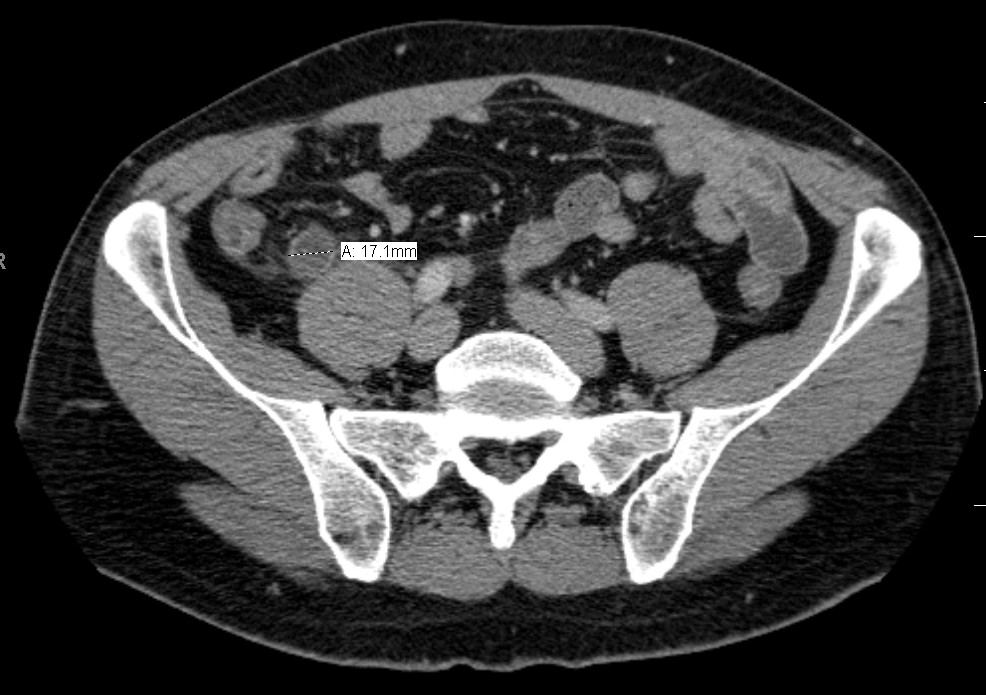
- Image the patients in the middle. CT is 95% sensitive and 94% specific in adults.4 Use IV contrast; oral contrast adds nothing.3 A clearly positive ultrasound rules appendicitis in, but an appendix that is not seen is an equivocal result, not a negative one.3
- Appendectomy within 24 hours is the standard, laparoscopic where possible, with a single dose of broad-spectrum antibiotic before surgery.2,1
- Antibiotics first is a real option for selected patients: uncomplicated appendicitis and no appendicolith.2 In CODA, 29% of the antibiotic group had an appendectomy by 90 days, and the excess complications were confined to patients with an appendicolith.5 In APPAC, 39.1% had a recurrence within 5 years.6
- Older adults and pregnant patients need a different path. Mortality reaches 8% in patients older than 65, and they should have CT if the Alvarado score is 5 or more.7 In pregnancy, use ultrasound first, then MRI, and treat with surgery rather than antibiotics alone.2
First steps
- Treat pain now. Opioid analgesia does not increase diagnostic or treatment errors in acute abdominal pain.8
- Ask about pregnancy. It changes both the imaging pathway and the treatment.2
- Send a white count with differential and a CRP, and calculate a risk score. WSES recommends the AIR score or the Adult Appendicitis Score.2,9
- Low risk: appendicitis is unlikely, but don't let the score alone decide that an adult needs no imaging.3 Arrange a recheck, and image if the pain persists.9,2
- Intermediate risk: image without delay.2
- High risk: call the surgeon.9 In patients younger than 40 with a high score, WSES suggests CT may be skipped before laparoscopy (weak recommendation).2
- Older than 65: get a CT if the Alvarado score is 5 or more.7
- No
- No
- No
- No: intermediate risk
- Perforation, abscess or diffuse peritonitis?YesIV antibiotics and the surgeon now. Piperacillin-tazobactam 3.375 g IV every 6 hours is one labeled option; adjust for kidney function.12
- No: uncomplicatedUncomplicated appendicitis: decide with the patientAppendectomy
- Follow-up: after nonoperative care of complicated appendicitis at age 40 or older, arrange colonoscopy and an interval CT; neoplasm is found in 3–17%.2
Clinical diagnosis and scores
- Common and serious. The lifetime risk is about 9% in the US. Perforation occurs in 16–40% overall, in 40–57% of younger patients and in 55–70% of those older than 50.2
- Perforation is what kills. Mortality is under 0.1% for nongangrenous appendicitis, 0.6% when gangrenous, and around 5% after perforation.2
- No single sign is reliable. Individual findings discriminate poorly, so WSES recommends an individualized, stepwise approach based on age, sex and the clinical picture (strong recommendation).2
- Negative appendectomy occurred in 5.2% of 45,218 patients in a 2025 global cohort. It was less common after a preoperative CT (adjusted risk ratio 0.69).11
| Score | What it uses | How it performs |
|---|---|---|
| AIR (Appendicitis Inflammatory Response), 0–12 | Vomiting; right lower quadrant pain; rebound or guarding (light, medium or strong); temperature ≥ 38.5 °C; white count; neutrophil proportion; CRP.9 | Groups: low 0–4, intermediate 5–8, high 9–12. A score of 9 or more was 98% specific. A score under 4 was 99% sensitive for complicated appendicitis, and the authors propose 0–3 as the new low-risk band.9 |
| Adult Appendicitis Score | Items not listed in the guideline text read for this page. | Low risk below 11, high risk 16 or more. Only 4% of patients with appendicitis scored below 11, none of them complicated. A score of 16 or more was 93% specific.2 |
| Alvarado (MANTRELS), 0–10 | Migration of pain to the right iliac fossa, anorexia, nausea or vomiting, right iliac fossa tenderness, rebound, fever, leukocytosis, left shift.13 | Below 5: 99% sensitive, a good rule-out. At 7 or more: only 81% specific. It overestimates the risk in women.13 WSES suggests against using it to confirm appendicitis in adults (weak).2 |
- Scores change care. In a Swedish trial, an AIR-based pathway cut imaging in low-risk patients (19.2% vs 34.5%), admissions (29.5% vs 42.8%) and negative explorations (1.6% vs 3.2%).14
- Intermediate risk: routine imaging and observation with selective imaging gave the same negative appendectomy rate (6.4% vs 6.7%) in the same trial.14
- Sex matters. In a UK study of 5,345 patients, the Adult Appendicitis Score performed best in women (8 or less: failure rate 3.7%) and the AIR score in men (2 or less: failure rate 2.4%).2
- Pregnancy: the Alvarado score runs higher because of a raised white count and nausea; at a cutoff of 7 it was 78.9% sensitive and 80.0% specific.2
- HIV: the Alvarado score is less sensitive.2
Can a score alone spare an adult from imaging? WSES says clinical scores are sensitive enough to exclude appendicitis and recommends using them that way (strong recommendation, high-quality evidence).2 ACEP found no adult study that met its criteria and advises against using a prediction rule to decide that an adult needs no advanced imaging (Level C).3 The guideline for older adults suggests scores to exclude, but not to diagnose, appendicitis (conditional).7
Imaging
| Test | Accuracy in adults | Role |
|---|---|---|
| Point-of-care ultrasound | Pooled sensitivity 91%, specificity 97%; 80% and 92% when done by emergency physicians.15 Emergency physician scans: 84% and 91% in 17 studies.16 | WSES first-line test if an experienced operator is available (strong).2 Not yet a stand-alone test or a rule-out.15 |
| Ultrasound (IDSA pooled data) | Definitive results only: sensitivity 0.99, specificity 0.95. Counting equivocal results: 0.68 and 0.96.10 | A clearly positive scan rules appendicitis in as well as CT or MRI (Level C).3 |
| CT | Sensitivity 0.95, specificity 0.94. After a negative CT, about 4% still had appendicitis at a 43% prevalence.4 | IDSA suggests CT as the first test in adults (conditional, very low certainty).10 WSES recommends low-dose contrast CT after a negative ultrasound in adolescents and young adults (strong).2 |
| MRI | Median sensitivity 0.96, specificity 0.97.10 | After an inconclusive ultrasound in pregnancy (weak).2 |
Getting the most from CT
- Use IV contrast when feasible. Oral or rectal contrast does not improve accuracy (Level B).3
- Noncontrast CT is acceptable in adults, with a small loss of sensitivity (Level C).3 In the Cochrane review, sensitivity was 0.96 with IV contrast and 0.91 without.4
- Low-dose CT works as well: sensitivity 0.94 against 0.95 for standard dose, with no difference in specificity.4
Reading an ultrasound report
- Positive means the whole dilated appendix was seen. That result is as good as a positive CT or MRI.3
- Not seen, or only partly seen, is equivocal. Nondiagnostic scans ranged from 10% to 81% across studies.3
- Adults are harder to scan. False negatives are a concern in women, older patients and those with a higher BMI.3
- Nonresolving pain with normal tests: get cross-sectional imaging before any operation. If the pain persists or progresses after negative imaging, WSES recommends diagnostic laparoscopy (strong).2
Which test first in adults? WSES recommends point-of-care ultrasound as the first-line test when imaging is needed (strong recommendation, moderate-quality evidence).2 IDSA suggests CT first, while noting that a definitive ultrasound or an MRI may come before it (conditional recommendation, very low certainty).10 ACEP limits its adult ultrasound advice to ruling in (Level C).3 An emergency physician meta-analysis judged ultrasound not yet good enough to rule out appendicitis on its own.15
Appendectomy and antibiotics
- Laparoscopic appendectomy is preferred over open surgery for both uncomplicated and complicated appendicitis (strong recommendation, high-quality evidence).2
- Timing: for uncomplicated appendicitis, plan surgery on the next available list within 24 hours, and don't delay it beyond 24 hours from admission (both strong).2 The 2025 edition keeps the 24-hour window.1
- Time before reaching a surgeon matters. In 42,317 patients, perforation rose from 22.9% when the surgeon first saw the patient within 12 hours of onset to 48.0% after 72 hours or more. Longer time in hospital was not linked to more perforation.11
- Preoperative antibiotic: one dose of a broad-spectrum agent 0 to 60 minutes before incision. No postoperative antibiotics for uncomplicated appendicitis (strong recommendation, high-quality evidence).2
- Complicated appendicitis: postoperative antibiotics, for no more than 3–5 days once the source is controlled (strong).2 The 2025 edition limits them to 2–3 days.1
- Abscess or phlegmon: laparoscopic surgery where advanced expertise is available; otherwise antibiotics with percutaneous drainage if accessible (both weak).2
- After nonoperative care of complicated appendicitis at 40 or older, arrange colonoscopy and an interval contrast CT (weak). Appendiceal neoplasm is found in 3–17% of these patients.2 The 2025 edition keeps follow-up to detect neoplasms.1
| Agent | Adult dose (label) | Label indication | Notes |
|---|---|---|---|
| Piperacillin-tazobactam | 3.375 g IV every 6 hours, infused over 30 minutes | Appendicitis complicated by rupture or abscess, and peritonitis | Reduce the dose if creatinine clearance is 40 mL/min or less.12 |
| Ertapenem | 1 g IV once daily | Complicated intra-abdominal infection | 500 mg daily if creatinine clearance is 30 mL/min/1.73 m² or less.17 |
| Single preoperative dose (uncomplicated) | Agent and dose per institutional protocol and label | — | WSES does not name an adult agent.2 |
Unreviewed doses. Verify against the current label and your institution's protocol before giving anything.
Choose the agent by local susceptibility patterns and protocol.12 The guidelines read for this page give no adult doses.
Antibiotics instead of surgery
- WSES recommends discussing it as a safe alternative in selected patients with uncomplicated appendicitis and no appendicolith. Warn them that treatment can fail and that complicated appendicitis can be missed (strong recommendation, high-quality evidence).2 The 2025 edition still calls it safe and effective in selected patients.1
- How to give it: IV antibiotics first, then oral, guided by the patient's condition (strong).2
- CODA (US, 1,552 adults): a 10-day course was noninferior to appendectomy for 30-day health status. 47% of the antibiotic group were not admitted. By 90 days, 29% had an appendectomy: 41% with an appendicolith and 25% without.5
- The appendicolith is the warning sign. In CODA, complications were 8.1 vs 3.5 per 100 overall, 20.2 vs 3.6 with an appendicolith, and 3.7 vs 3.5 without one.5
- Who CODA left out: septic shock, diffuse peritonitis, a walled-off abscess, free air or more than minimal free fluid, suspected cancer, pregnancy and immunodeficiency. Only about 30% of eligible patients agreed to be randomized. Antibiotic patients missed fewer workdays (5.26 vs 8.73).18
- APPAC (Finland, 530 adults aged 18–60 with CT-confirmed uncomplicated appendicitis): 27.3% had an appendectomy within a year, and recurrence reached 39.1% by 5 years. Only 2 of the 85 later appendectomies found complicated disease. At 5 years, complications were 24.4% after surgery vs 6.5% with antibiotics.6
- Oral-only treatment is unproven. In APPAC II, oral moxifloxacin alone succeeded in 70.2% at 1 year against 73.8% with IV ertapenem then oral antibiotics, and missed the noninferiority margin.19
- Pooled trials (13 RCTs): 30.7% of antibiotic patients needed appendectomy within a year. Wound infections were fewer (RR 0.25), and negative appendectomies at later surgery were more common (RR 3.16).20
Should antibiotics be offered routinely? WSES makes a strong recommendation to discuss them with selected patients.2 SAGES made conditional recommendations in favor of operating on both uncomplicated and complicated appendicitis.21 The Cochrane review rated most outcomes as low or very low certainty.20 The trials agree on the trade-off: about 3 in 10 have an appendectomy within the first year, and more do later.5,6,20
Special groups
Older adults (over 65)
- Higher stakes: mortality reaches 8% in patients older than 65, against 0–1% in younger patients.7
- Don't diagnose on the exam, the white count or the CRP alone (strong recommendations, low-quality evidence).7
- CT for everyone with an Alvarado score of 5 or more, to confirm or exclude appendicitis and look for perforation (strong). Below 5, observe; scan with IV contrast if not improving (conditional).7
- Can't have IV contrast? Ultrasound can confirm, but not exclude, appendicitis. MRI is next if available, or a noncontrast CT (conditional).7
- Treatment: antibiotics alone only in selected patients with CT-confirmed uncomplicated disease who accept the risk of recurrence (conditional), and not with diffuse peritonitis or free perforation (strong). Arrange colonic screening for all.7
Pregnancy
- Don't diagnose on symptoms and signs alone; always send labs (weak).2
- Graded compression ultrasound first, then MRI after an inconclusive scan (both weak). A negative or inconclusive MRI does not exclude appendicitis.2
- Treat with surgery. WSES suggests against antibiotics alone in pregnancy (weak), and prefers laparoscopic appendectomy (weak).2 See the page on abdominal pain in pregnancy for the obstetric side.
Disposition
- Confirmed appendicitis: involve the surgeon, and plan surgery within 24 hours or a shared decision on antibiotics first.2
- Low risk and going home: the AIR pathway uses outpatient care with a planned recheck within 24 hours.9 Image anyone whose pain does not settle.2
- Equivocal ultrasound: CT, MRI, observation or a surgical consult are all reasonable, depending on local resources and the patient's preference (ACEP, in children).3
- Antibiotics first can be outpatient: almost half the CODA antibiotic group were never admitted.5
Pitfalls
- Withholding analgesia until the surgeon has examined the patient.8
- Reading an ultrasound that did not see the appendix as negative.3
- Discharging a low-score adult with no recheck and no plan for persistent pain.3,9
- Trusting the exam and labs in an older adult.7
- Ordering oral contrast, which adds nothing and delays the scan.3
- Offering antibiotics first to a patient with an appendicolith without explaining the higher risk of surgery and complications.5
- Forgetting cancer follow-up after nonoperative care of complicated appendicitis at 40 or older, or in any older adult.2,7
How strong is the evidence?
The 2025 WSES Jerusalem guideline used GRADE, searched the literature to May 2025 and made 35 recommendations.1 Only its abstract was available for this page, so the detailed recommendations and their grades come from the 2020 edition.2
ACEP made no Level A recommendations, and its adult recommendations are Level C.3 IDSA rated all its imaging evidence very low certainty.10 The CT accuracy data come from studies the Cochrane authors judged low quality.4
Antibiotics versus surgery is the best-tested question, with several large trials.5,6,20 CODA still left out pregnancy, abscess and diffuse peritonitis,18 and the Cochrane review rated most outcomes low or very low certainty.20
On-shift teaching
Questions to ask a learner at the bedside. Tap a question to see the answer. Every answer uses facts cited above.
Q1Which scores does WSES recommend for adults, and what is wrong with the Alvarado score?
Q2The ultrasound report says the appendix was not seen. Is that negative?
Q3Does the CT need oral contrast?
Q4Who is a poor candidate for antibiotics first?
Q5How often does appendicitis come back after antibiotics alone?
Q6An 80-year-old has right lower quadrant pain and an Alvarado score of 5. What next?
References
What this page is built on
21 sources, cited 156 times. Dots are sources, filled by how far each was read; stronger color means a larger share of the citations. Tap a tier to see its sources.
Checked by the writer, not a physician. The dots show how each source was read, not that anyone has confirmed the claims.
- 1Podda M, Ceresoli M, De Simone B, et al. Diagnosis and treatment of acute appendicitis: 2025 edition of the World Society of Emergency Surgery Jerusalem guidelines. JAMA Surg. 2026;161(3):283–295.
- 2Di Saverio S, Podda M, De Simone B, et al. Diagnosis and treatment of acute appendicitis: 2020 update of the WSES Jerusalem guidelines. World J Emerg Surg. 2020;15(1):27.
- 3American College of Emergency Physicians Clinical Policies Subcommittee on Appendicitis; Diercks DB, Adkins EJ, Harrison N, et al. Clinical policy: critical issues in the evaluation and management of emergency department patients with suspected appendicitis. Ann Emerg Med. 2023;81(6):e115–e152.
- 4Rud B, Vejborg TS, Rappeport ED, et al. Computed tomography for diagnosis of acute appendicitis in adults. Cochrane Database Syst Rev. 2019;(11):CD009977.
- 5CODA Collaborative; Flum DR, Davidson GH, Monsell SE, et al. A randomized trial comparing antibiotics with appendectomy for appendicitis. N Engl J Med. 2020;383(20):1907–1919.
- 6Salminen P, Tuominen R, Paajanen H, et al. Five-year follow-up of antibiotic therapy for uncomplicated acute appendicitis in the APPAC randomized clinical trial. JAMA. 2018;320(12):1259–1265.
- 7Fugazzola P, Ceresoli M, Agnoletti V, et al. The SIFIPAC/WSES/SICG/SIMEU guidelines for diagnosis and treatment of acute appendicitis in the elderly (2019 edition). World J Emerg Surg. 2020;15(1):19.
- 8Manterola C, Vial M, Moraga J, Astudillo P. Analgesia in patients with acute abdominal pain. Cochrane Database Syst Rev. 2011;(1):CD005660.
- 9Andersson M, Kolodziej B, Andersson RE. Validation of the Appendicitis Inflammatory Response (AIR) score. World J Surg. 2021;45(7):2081–2091.
- 10Bonomo RA, Tamma PD, Abrahamian FM, et al. 2024 clinical practice guideline update by the Infectious Diseases Society of America on complicated intra-abdominal infections: diagnostic imaging of suspected acute appendicitis in adults, children, and pregnant people. Clin Infect Dis. 2024;79(suppl 3):S94–S103.
- 11Anyomih TTK, Aregawi AB, Calvache JA, et al.; AlliGatOr Collaborative. Pre-hospital time and risk of perforation in patients with acute appendicitis in 112 countries (AlliGatOr): an international, prospective, observational cohort study. Lancet Glob Health. 2026;14(11):104015.
- 12Zosyn (piperacillin and tazobactam) injection prescribing information. Baxter Healthcare. DailyMed.
- 13Ohle R, O'Reilly F, O'Brien KK, Fahey T, Dimitrov BD. The Alvarado score for predicting acute appendicitis: a systematic review. BMC Med. 2011;9:139.
- 14Andersson M, Kolodziej B, Andersson RE; STRAPPSCORE Study Group. Randomized clinical trial of Appendicitis Inflammatory Response score-based management of patients with suspected appendicitis. Br J Surg. 2017;104(11):1451–1461.
- 15Matthew Fields J, Davis J, Alsup C, et al. Accuracy of point-of-care ultrasonography for diagnosing acute appendicitis: a systematic review and meta-analysis. Acad Emerg Med. 2017;24(9):1124–1136.
- 16Lee SH, Yun SJ. Diagnostic performance of emergency physician-performed point-of-care ultrasonography for acute appendicitis: a meta-analysis. Am J Emerg Med. 2019;37(4):696–705.
- 17Ertapenem for injection prescribing information. DailyMed.
- 18Rezaie S. REBEL Cast Ep 89: the CODA trial – antibiotics vs appendectomy for appendicitis. REBEL EM, 2020.
- 19Sippola S, Haijanen J, Grönroos J, et al. Effect of oral moxifloxacin vs intravenous ertapenem plus oral levofloxacin for treatment of uncomplicated acute appendicitis: the APPAC II randomized clinical trial. JAMA. 2021;325(4):353–362.
- 20Doleman B, Fonnes S, Lund JN, et al. Appendectomy versus antibiotic treatment for acute appendicitis. Cochrane Database Syst Rev. 2024;4(4):CD015038.
- 21Kumar SS, Collings AT, Lamm R, et al. SAGES guideline for the diagnosis and treatment of appendicitis. Surg Endosc. 2024;38(6):2974–2994.
AI-generated draft. Not reviewed by a physician. This page is for education only and may contain errors, including in doses. Do not use it to diagnose, treat or make decisions about any patient. Rely on your own clinical judgment, your institution's protocols and current drug labeling. Reading this page does not create a physician-patient relationship. Full terms